

28643 views
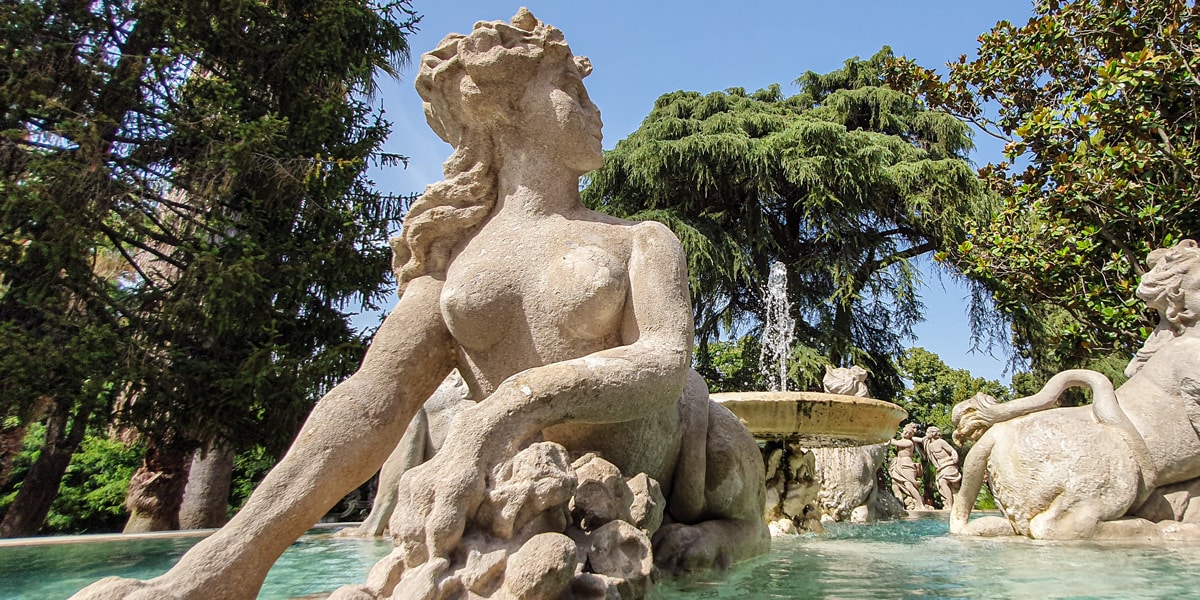
Villa Sciarra is the Rome park where a sphinx rests one paw on a skull, satyrs carry giant shells, and a child rides a stone turtle. None of these figures is ancient Roman, and most were not made for this garden.
The surprise is that an American couple assembled much of this strange mythological landscape in the early twentieth century using eighteenth-century sculptures brought from a ruined Lombard estate. Earlier owners, a battle for Rome, financial collapse, and a politically complicated donation all left additional layers.
The result is neither an archaeological site nor a formal sculpture museum. It is a free neighborhood park where the collection appears gradually among palms, laurels, fountains, and quiet paths. Despite the quality of the setting, Villa Sciarra seldom appears on standard sightseeing itineraries.
Yes. Villa Sciarra occupies about seven hectares on the lower slopes of Janiculum Hill, within the historic Trastevere district and directly against the seventeenth-century Janiculum Walls. Monteverde Vecchio begins nearby, which is why Romans often describe the park as being between Trastevere and Monteverde.
It does not feel like the better-known Janiculum promenade. There is no grand panorama over central Rome and no continuous line of monuments. The ground rises through a compact garden of curving paths, tall palms, evergreen trees, benches, and small clearings. The park is used as much for walking a dog, reading, and bringing children outside as for looking at art.
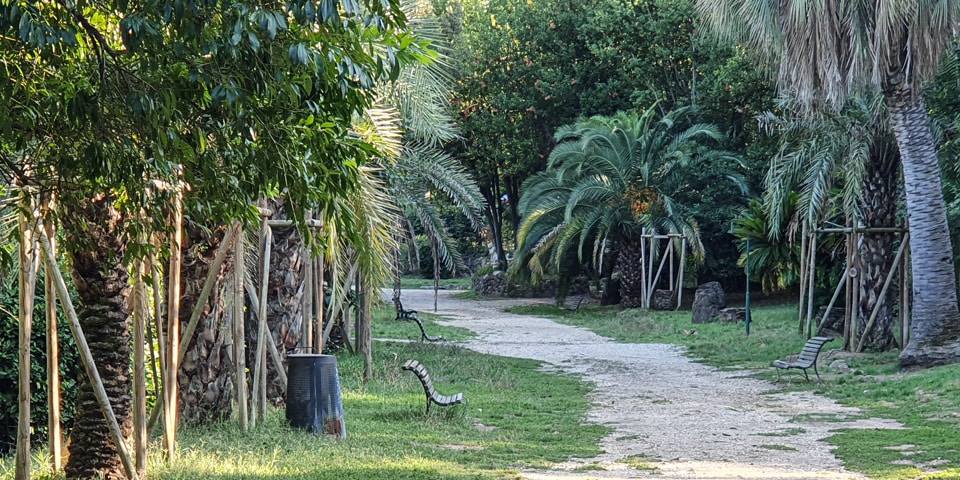
That everyday atmosphere is part of its appeal. Sculptures that would stand behind barriers in a museum are instead encountered beside a path or half concealed by foliage. Some visitors pass them without realizing that the figures form a connected program of seasons, rural work, mythology, and the woodland world of Pan.
The securely documented history of the estate begins in 1575, when Monsignor Innocenzo Malvasia acquired land here and built the Casino Malvasia. Rome changed the surrounding landscape under Pope Urban VIII, whose new Janiculum Walls of 1642–1644 brought the property inside the city’s enlarged defenses and increased its value as an urban villa.
The estate passed through the Barberini and Ottoboni families before reaching the Sciarra branch of the Barberini, from whom it takes its present name. Cardinal Pietro Ottoboni developed gardens, cultivated fruit trees and exotic plants, and sponsored excavations in the area during the early eighteenth century. The Sciarra later enlarged the property.
Its position beside the walls became dangerous in 1849. Republican troops led by Giuseppe Garibaldi defended the Janiculum against the French army sent to restore papal rule. Fighting badly damaged the Casino Barberini and the adjacent Casino Malvasia. The same battle is reconstructed nearby inside the Museum of the Roman Republic at Porta San Pancrazio.
The restored estate did not remain intact. Prince Maffeo II Sciarra lost the property after unsuccessful financial speculation, and much of the surrounding land was divided into building lots. What survives as Villa Sciarra is therefore the core of a once larger property rather than an unchanged aristocratic garden.
On May 15, 1902, the remaining villa was purchased by George Washington Wurts, a retired American diplomat and passionate gardener, and his wife, the wealthy Philadelphia heiress Henrietta Tower. They renovated the Casino Barberini, reshaped the grounds in the fashionable neo-Baroque taste, built a neo-Gothic castelletto, and kept white peacocks in a large iron aviary. The birds gave the estate its old nickname, the “Villa of the White Peacocks.”
Their decisive contribution came from northern Italy. The Wurts acquired eighteenth-century sandstone sculptures from the former Visconti property at Brignano Gera d’Adda, near Bergamo, and rearranged them throughout their Roman garden.
This explains the park’s unusual character. The figures look old because they are old, but most are not remains of ancient Rome or sculptures made for the Sciarra family. They are Lombard Baroque garden ornaments given a new setting and a new narrative by American collectors in Rome.
George Wurts died in 1928. In 1930, Henrietta transferred the villa to Benito Mussolini on the condition that its garden become a public park. Casino Barberini later became the home of the Italian Institute of Germanic Studies, founded in 1932 and still based in the building.
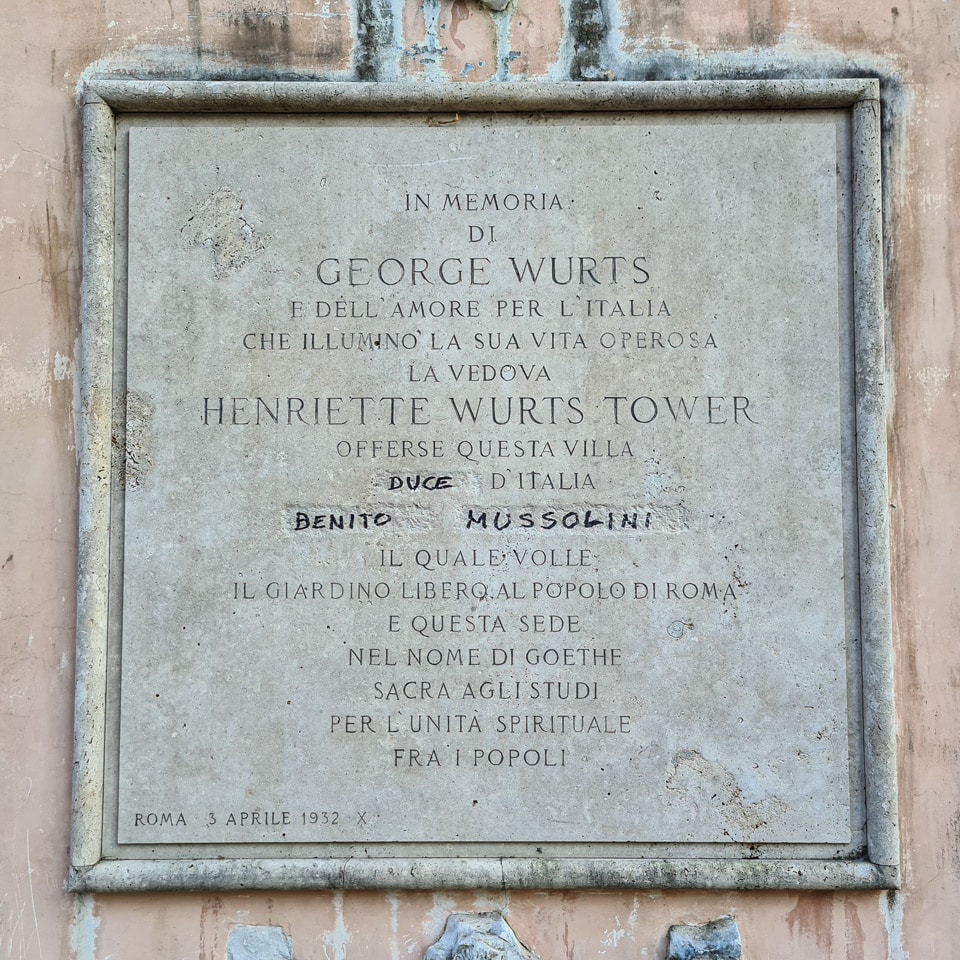
The plaque on the Casino preserves that transition—and the argument over how to remember it. Its original text said that Henrietta Wurts Tower “offered this villa to the Duce of Italy, Benito Mussolini,” who opened the garden to the people of Rome and dedicated the building to scholarship in the name of Goethe. The date, April 3, 1932, was the centenary of Goethe’s death; the Roman numeral X marks the tenth year of the Fascist era.
The words al Duce and Benito Mussolini were later chiseled out. The dark lettering visible in the photograph is not an official restoration: the erased words have periodically been rewritten by vandals. The damaged sentence now records both the Fascist dedication and its postwar rejection.
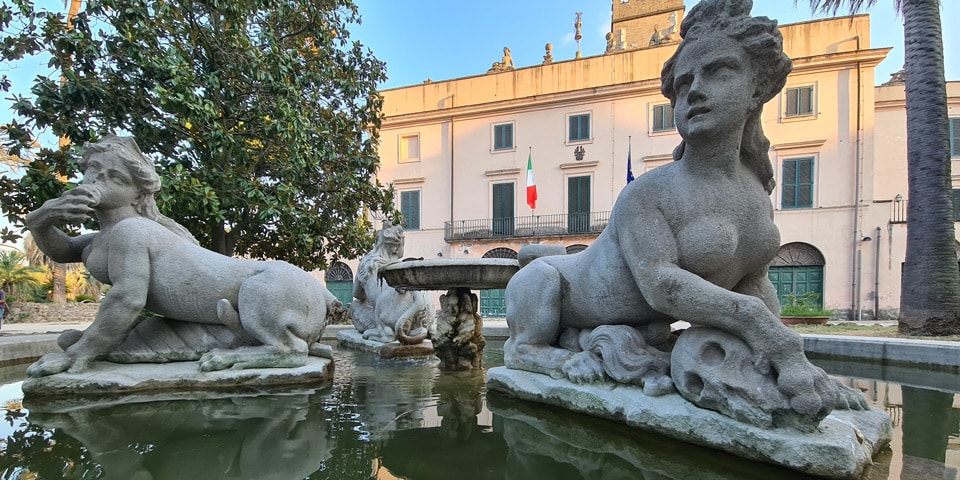
The fountain in front of Casino Barberini is known as the Fontana delle Sfingi, the Fountain of the Vices, or the Fountain of Human Passions. Its four female-headed sphinxes embody Anger, Lust, Greed, and Gluttony—only four of the traditional seven deadly sins.
The attributes make them readable. Anger places a paw on a skull; Lust rests on flowers; Greed guards a cornucopia spilling coins; and Gluttony has fruit, raising a piece toward her mouth. Their bodies face outward while their heads turn toward one another in pairs, converting the fountain into a circular moral puzzle.
The severe symbolism contrasts with the casual life around it. Children play near the basin and residents sit beneath the trees while four monsters display destructive appetite in front of an institute devoted to scholarship.
One of the park’s most curious groups is usually called the Fontana della Tartaruga, the Turtle Fountain. A putto sits astride an enormous turtle while a young faun reaches up beside him.
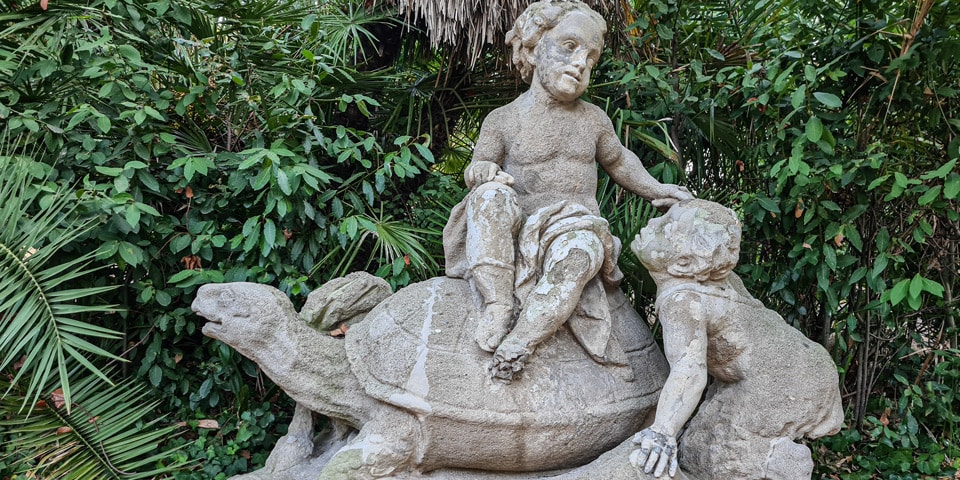
The rider is not a named mythological child. A putto is the familiar chubby infant figure of Renaissance and Baroque art; the small companion belongs to the unruly woodland family of fauns and satyrs. The official catalog identifies the sculpture as an eighteenth-century sandstone group, but no reliable surviving explanation assigns it a specific story. It is better read as playful garden fantasy than as an illustration of a lost classical myth.
The creature at the center of the Fountain of the Putti is often mistaken for a dragon. It is the biscione, the crowned serpent associated with the Visconti family of Milan. Its open jaws contain a small human figure, a heraldic image that is still visible in Milanese symbols today.
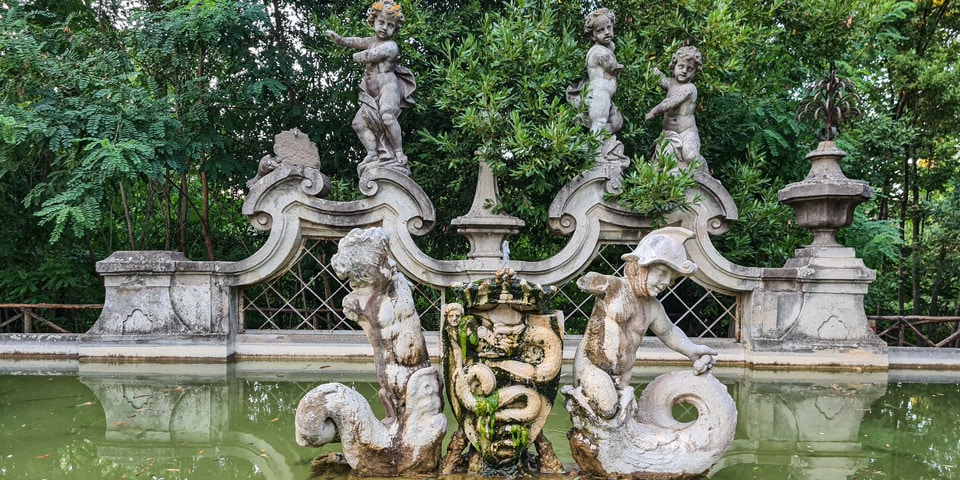
Two putti emerging from dolphins support the shield, while other children dance along the curved stonework behind them. The emblem is the clearest clue that the sculpture did not originate in Rome. It belonged to the decorative identity of the Visconti estate in Lombardy and traveled south with the Wurts collection.
The same serpent reappears at the Fountain of the Satyrs. Here a complex group of satyrs and young satyrs supports an immense shell, while a putto emerges from the biscione above.
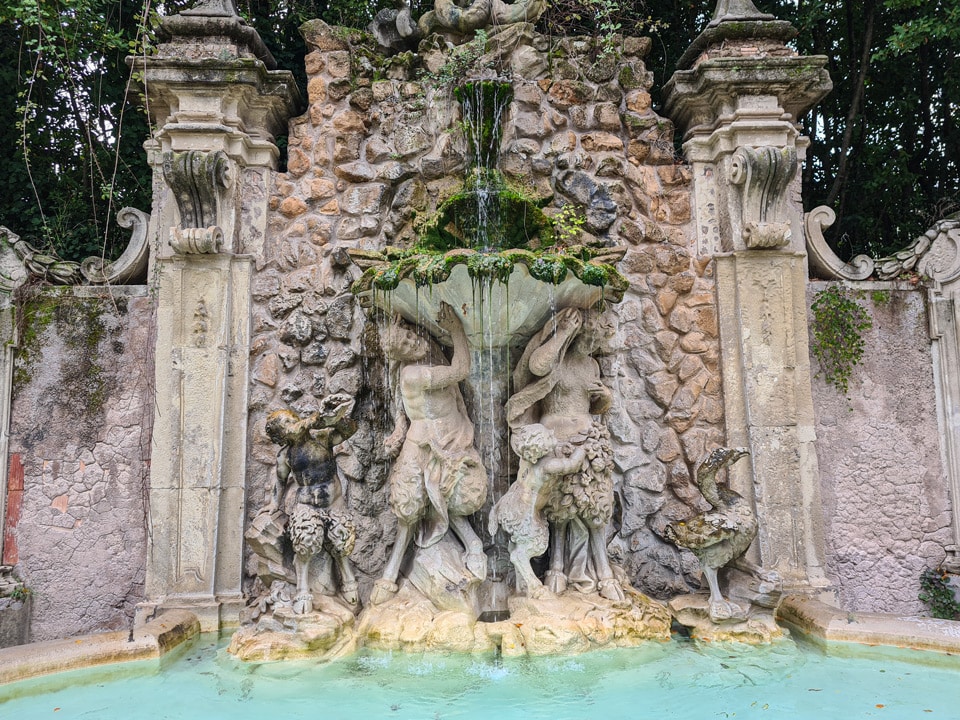
This fountain is particularly important because it is the only element from the Visconti villa reconstructed at Villa Sciarra in its entirety. The Wurts placed the other imported figures in new positions and architectural settings. In effect, one fountain is a transplanted Lombard ensemble; the rest of the park is an imaginative Roman remix.
The repeated goat legs, pointed ears, pipes, children, and animals are not random decoration. Much of the collection belongs to the world of Pan, the god of shepherds, wild places, music, fertility, and uncontrolled outdoor pleasure.
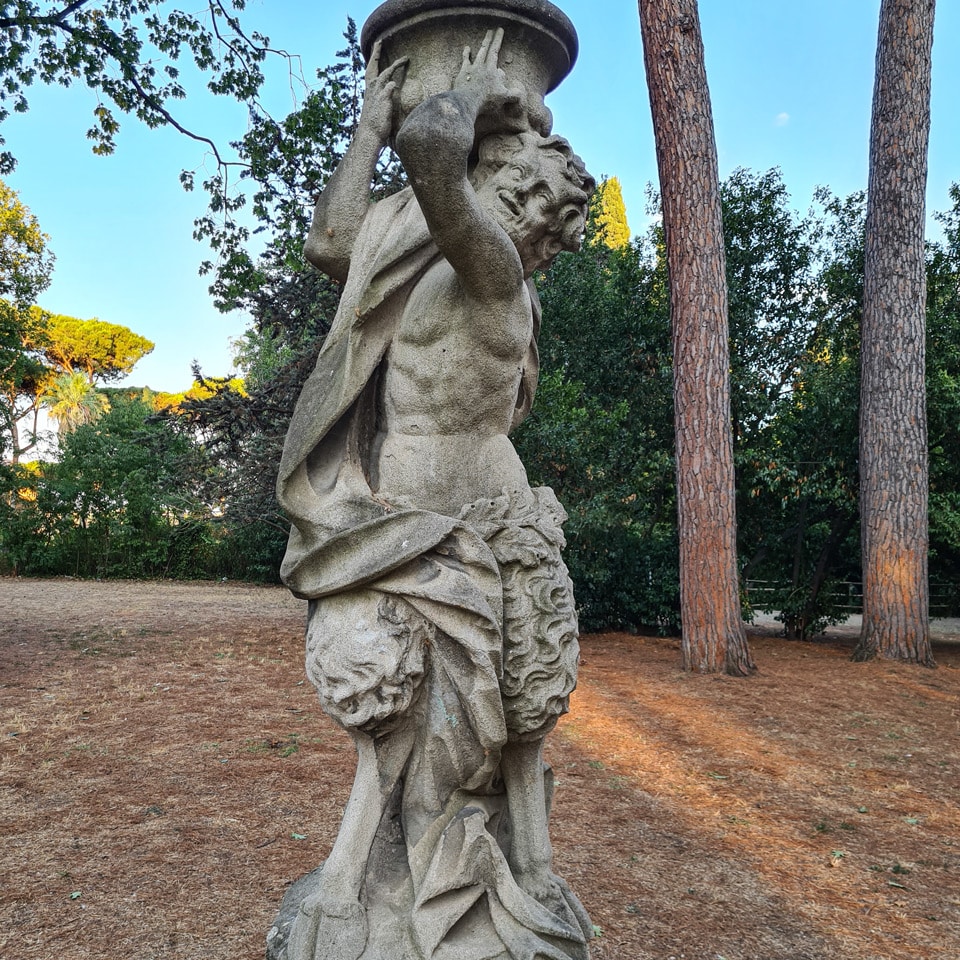
A standing satyr with goat legs raises a large vessel above his head. It is not a portrait or a scene with a secure literary narrative, but a garden figure built around the satyr’s double nature: muscular and almost human above, animal below.
Near an entrance, two young satyrs wrestle and play with a goat across a rockwork fountain. Rome’s official description connects the scene directly with the seasonal, mythological, and especially Pan-inspired program of the garden—woodland life presented as noisy, physical fun rather than polite classical dignity.
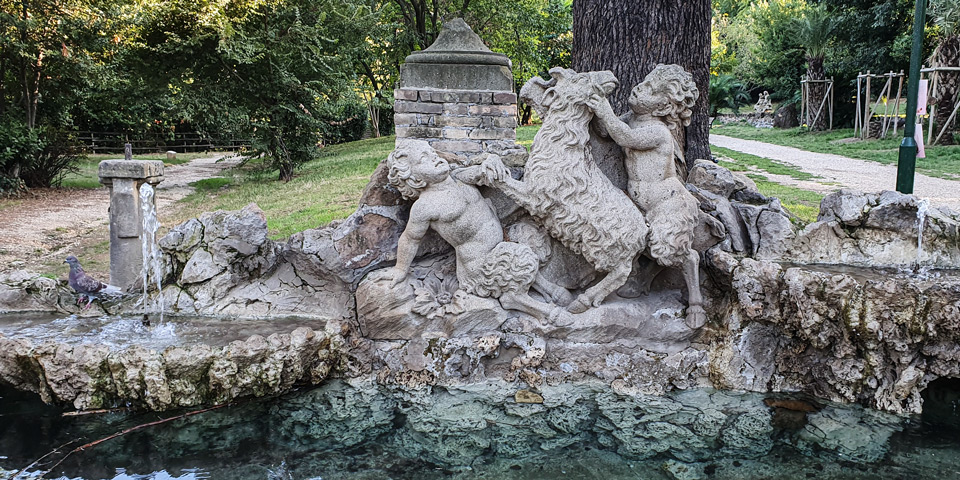
These figures are weathered, and that is part of how they work. Moss, stains, missing details, and the surrounding vegetation make the sandstone bodies look as though they are returning to the wild world they represent. A major restoration program reached its first completed phase in July 2025. The work cleaned and stabilized the Fontana dei Satiri, the Fontana dei Putti, and numerous other groups, while also treating damaged stone, metal fittings, and fountain basins.
The larger groups turn episodes from classical mythology into garden theater. Their stories are not always apparent from a single viewing angle, but the figures’ gestures and companions provide clues.
Apollo pursues the nymph Daphne, who raises her arms as she begins the transformation that will save her from him. The damaged stone version in Villa Sciarra is not a copy of Bernini’s marble. It is a separate eighteenth-century treatment of the same episode.
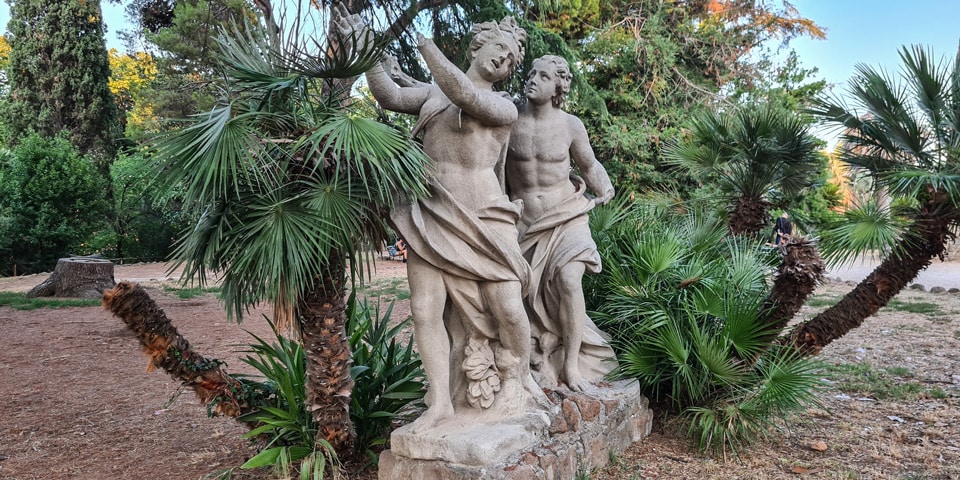
The comparison is instructive. In the celebrated Apollo and Daphne at the Borghese Gallery, Bernini captures the exact instant when skin becomes bark and fingers become leaves. Villa Sciarra’s group is rougher and more theatrical, designed to be read outdoors among real foliage rather than examined closely in a gallery.
The pursuit of Syrinx belongs to the same family of stories. To escape Pan, the nymph is transformed into marsh reeds; Pan cuts the reeds and makes the pipes that bear his name. The sculptural group places the goat-legged god beside the woman and the tall reeds that contain the ending of the myth.
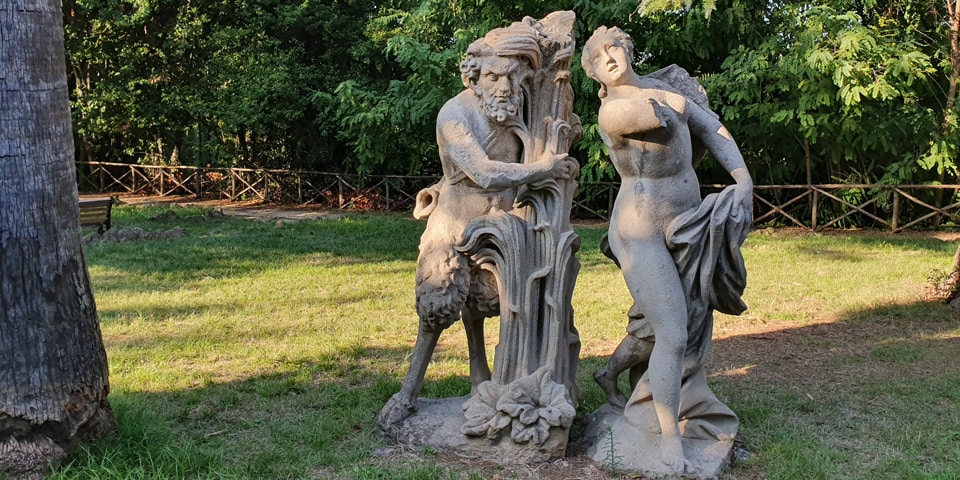
Seen beside the playful young satyrs and goat, this scene reveals the darker side of the garden’s Pan imagery. Music and woodland pleasure are inseparable from pursuit and loss.
The group with a seated man, a standing woman, and a dog is officially identified as Endymion and Diana. Endymion was the beautiful shepherd-hunter condemned or granted, depending on the version, an eternal sleep. In Greek myth his divine visitor is usually Selene, the Moon; later art frequently merges her lunar identity with Diana.
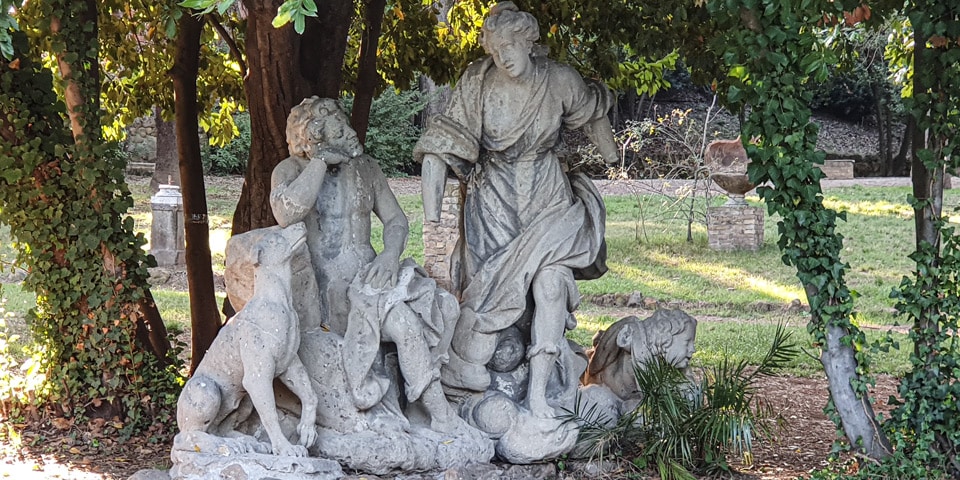
The dog helps identify Diana’s hunting world and turns what might otherwise look like an ordinary couple into a mythological scene. Like the other major sandstone groups, the figures came from the Visconti property at Brignano Gera d’Adda.
I lived for years in Monteverde Vecchio and have walked through Villa Sciarra dozens of times in different seasons. The two photographs below were taken in summer and in late November. The garden changes dramatically—from dry grass and hard Mediterranean light to wet stone, darker foliage, and cold air—but it never loses the combination of beauty and strangeness that makes it memorable.
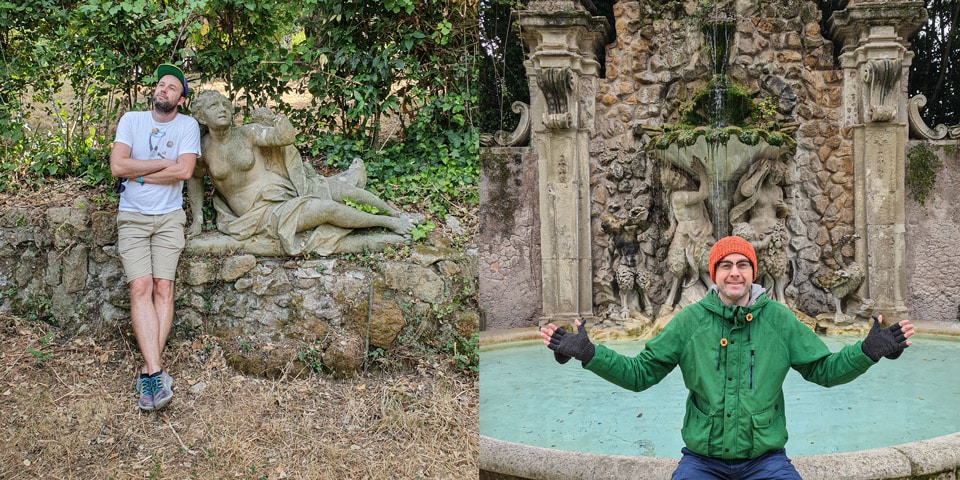
My honest advice is not to cross Rome on a first visit solely to check Villa Sciarra off a list. It does not have the scale of Villa Borghese, the views of Piazzale Garibaldi, or one universally recognized masterpiece.
It is an excellent choice if you are staying in Trastevere or Monteverde Vecchio, want a quiet hour away from traffic, enjoy unusual sculpture, or are already walking up the Janiculum. From the park, a longer route can continue toward Porta San Pancrazio, the monumental Fontana dell’Acqua Paola, and the Janiculum viewpoints.
Villa Sciarra rewards attention rather than ambition. Look at what the sphinxes are holding, find the child inside the serpent’s jaws, and notice how the same story of pursuit returns in different corners. Once those connections become visible, the park stops looking like a random collection of damaged statues and becomes one of Rome’s most peculiar open-air narratives.
Rome.us © 2026. Created with love by Roman experts and guides.