
Rome.us
  • TAXI FARES CALCULATOR
  • ABOUT US
  • HOW TO GET
    • Fiumicino Airport
    • Ciampino Airport
    • Termini Railway Station
    • Public Transport
    • To Venice
    • To Florence
    • To Ostia Antica
    • To Naples
    • To Milan
    • To Pisa
    • To Siena
  • TIPS
    • TOP Attractions
    • Tickets to Vatican museums
    • Rome Three Day Itinerary
    • Rainy Days in Rome
    • Buying a Sim Card in Italy
    • Renting a Car in Rome
    • Apps for Tourists
    • Free Things to Do
    • Unusual Things to do
    • ASK US
    • Instagram
    • Pinterest
  • ANCIENT SITES
    • Arch of Constantine
    • Castel Sant’Angelo
    • Catacombs
    • Colosseum
    • Mamertine Prison
    • Mouth of Truth
    • Pantheon
    • Roman Forum
    • Theater of Marcellus
  • WHERE TO STAY
    • How to Choose a Hotel in Rome
    • Hotels with Best Views
    • Hotels near Termini
    • Hotels near the Colloseum
    • Best Hostels
    • Hotels near Navona Square
    • 3 Star Hotels
    • 4 Star Hotels
    • 5 Star Hotels
    • Apartments For Rent
  • VATICAN CITY
    • St Peter’s Basilica
    • Sistine Chapel
    • Vatican Museums
    • Raphael’s Rooms
    • Michelangelo’s Pieta
    • St Peters Dome
    • St Peter’s Square
    • Vatican Military
    • Swiss Guard
    • Pilgrims of Hope Jubilee
  • MUSEUMS
    • Ara Pacis Augustae
    • Borghese Gallery
    • Capitoline Museums
    • Caravaggio’s Paintings
    • Great Synagogue
    • Palazzo Farnese
    • Spada Gallery
  • PARKS
    • Appian Way
    • Orange Garden
    • Park of the Aqueducts
    • Pincio Terrace
    • Villa Ada
    • Vatican Gardens
    • Villa Borghese
    • Villa Celimontana
    • Villa Torlonia
    • Zoo
  • CHURCHES
    • Capuchin Crypt
    • Holy Stairs
    • Sant’Agnese in Agone
    • San Giovanni in Laterano
    • Santa Maria Maggiore
    • Saint Paul Outside the Walls
    • St Peter in Chains
    • St. Ignatius of Loyola
  • FOUNTAINS & SQUARES
    • Navona Square
    • Spanish Steps
    • Trevi Fountain
    • Altar of The Fatherland
    • Fontana della Barcaccia
    • Fountain of the 4 Rivers
    • Fountain of the Pantheon
    • Piazza del Popolo
    • Piazza Venezia
    • Turtle Fountain
    • Triton Fountain
  • HILLS
    • Aventine
    • Capitoline
    • Janiculum
    • Palatine
    • Pincian
  • DAY TRIPS
    • To Tivoli
    • To Ostia Antica
    • Beaches near Rome
    • To Alberobello
  • WEATHER
    • January
    • February
    • March
    • April
    • May
    • June
    • July
    • August
    • September
    • October
    • November
    • December
  • WHERE TO EAT
    • Famous Roman Dishes
    • Best Pizza Places
    • Best Pasta Places
    • Local Italian Food
    • Best Gelato Places
    • Best Rooftop Bars
  • NEIGHBORHOODS
    • Campo Marzio
    • Jewish Ghetto Quarters
    • Quartiere Coppedè
    • Monti
    • Sant’Eustachio
    • Trastevere
    • Trevi
  • Shopping
    • Castel Romano Outlet
    • Farmers Markets
    • Souvenirs from Rome
  • EMPERORS
    • Good Emperors
    • Marcus Aurelius
    • Gaius Julius Caesar
    • Nero
    • Octavian Augustus
    • Caligula
    • Hadrian
    • Vespasian
    • Commodus
    • Trajan
Home / Parks and Gardens /

The Janiculum Busts: Who Are These Marble Patriots?

Written by: Artur Jakucewicz

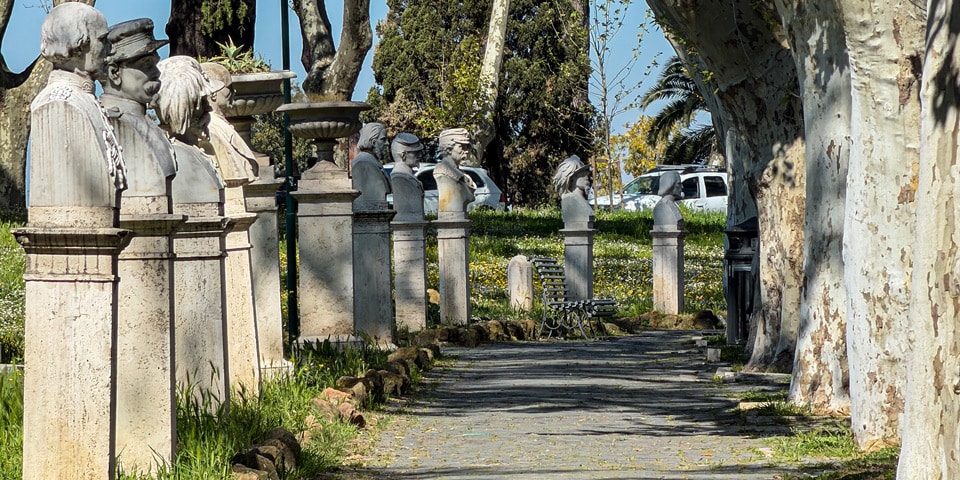
Marble busts of Italian patriots lining the tree-shaded Janiculum promenade in Rome

The marble faces along the promenade on Janiculum Hill are not Roman emperors, and they are not simply Garibaldi’s generals. They belong to the men and one woman whom post-unification Rome chose to remember as builders, defenders, and voices of the Italian nation.

Some fought on this hill during the siege of 1849. Others joined later campaigns, organized revolutions from exile, wrote patriotic verse, or carried the cause onto a theater stage. Foreign volunteers stand among the Italians. The collection is therefore less a military roll call than a long, unfinished group portrait of the Risorgimento.

Contents

Toggle
  • A Battlefield Turned into a Hall of Faces
  • They Were Not All Generals
  • The Collection Is Still Changing
  • Best Value Hotels Near Marble Patriots
  • Nearby Attractions

A Battlefield Turned into a Hall of Faces

The busts make sense only when the ground beneath them is understood. In 1849, the Janiculum was the principal battlefield in the defense of the short-lived Roman Republic. Republican volunteers held the ridge against a French army sent to restore Pope Pius IX. Fighting around Porta San Pancrazio, Villa Corsini, and the Vascello left the area devastated and many of its defenders dead.

The Republic fell, but its defense became one of the defining episodes of the movement for Italian unification. After Rome became the capital of the Kingdom of Italy, the city transformed the former battlefield into a public memorial landscape. The history of the siege is reconstructed nearby inside the Museum of the Roman Republic at Porta San Pancrazio.

On July 26, 1884, Rome’s municipal government formally accepted a proposal to reserve the Janiculum promenade for busts of patriots who had distinguished themselves in the defense and liberation of Rome. Most of the first portraits on tall rectangular pedestals were installed between 1885 and 1888. Additions continued through the twentieth century, so the avenue never represented a single battle, generation, or political faction.

At the summit, Emilio Gallori’s enormous monument to Giuseppe Garibaldi supplies the visual center. The smaller portraits bring the story down to human scale. Garibaldi appears above the skyline as the national hero; his contemporaries meet the walker almost face to face.

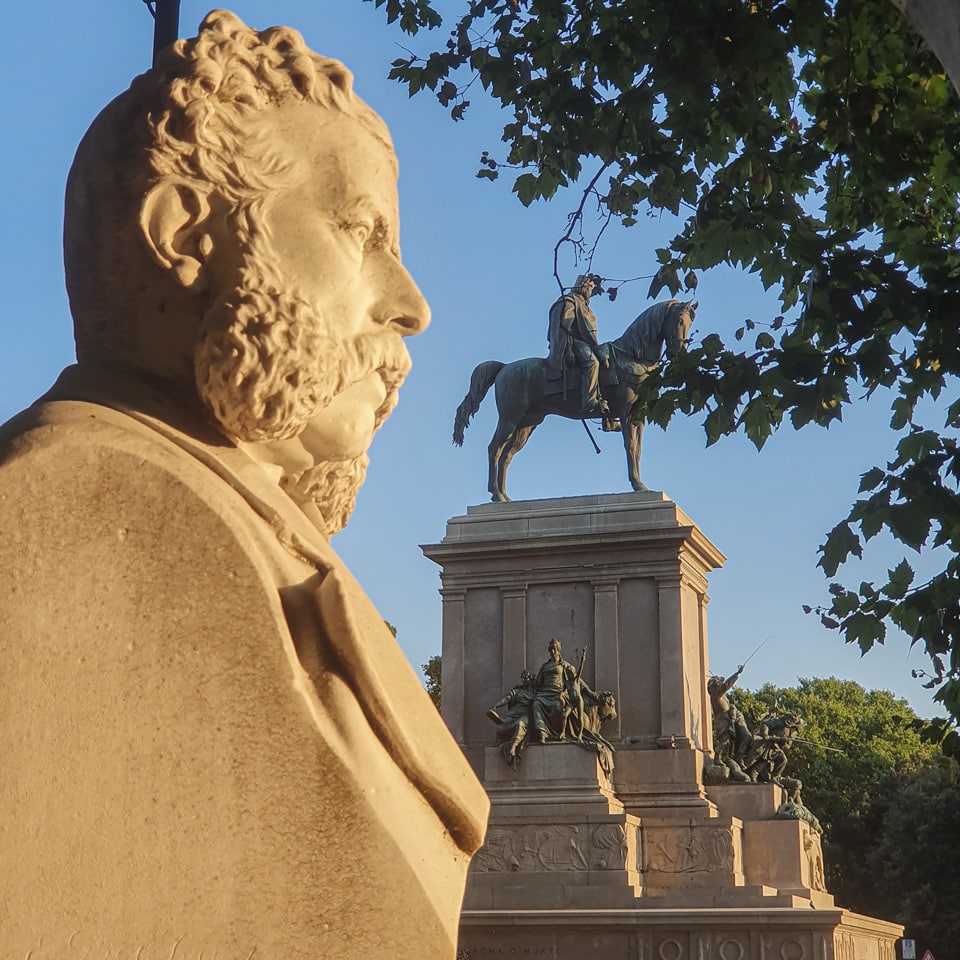
Bust of Nicola Fabrizi with the Giuseppe Garibaldi Monument in the background on Janiculum Hill in Rome

The relationship is especially clear in the view above. Nicola Fabrizi stands in the foreground while Garibaldi rises behind him. Fabrizi was a patriot, organizer, and politician who worked with Giuseppe Mazzini, built revolutionary networks from exile, and pursued his own vision of action in southern Italy. He was not merely a subordinate in someone else’s army. The composition of the hill turns men with separate careers into participants in the same national narrative.

They Were Not All Generals

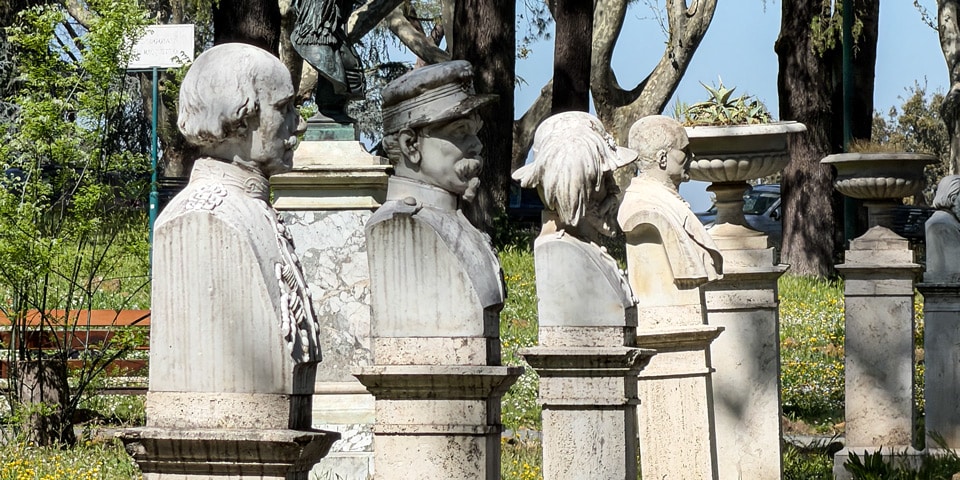
Uniforms, medals, caps, cloaks, civilian coats, and bare shoulders make the avenue look inconsistent because its subjects were inconsistent. The collection’s guiding idea was broad: its subjects could have fought for Rome and Italy “with weapons or with words.” Soldiers dominate the collection, but the marble ranks also contain politicians, writers, priests, doctors, and artists.

Different military uniforms and headwear represented among the marble patriot busts on Janiculum Hill

Tommaso Salvini is the best example of why it is worth reading the names. He became one of the most celebrated Shakespearean actors of the nineteenth century, famous internationally for playing Othello. In 1849, however, the twenty-year-old actor was in Rome and volunteered in the National Guard to defend the Republic. His broad civilian lapels and theatrical mustache make his bust look out of place among the officers until that missing part of his biography is known.

Goffredo Mameli fought with Garibaldi and died at only twenty-one after being wounded during the defense of Rome. Yet his most enduring weapon was a poem: he wrote the words of Il Canto degli Italiani, which became Italy’s national anthem. Quirico Filopanti was a mathematician, writer, and secretary of the Roman Republic’s Constituent Assembly. Alessandro Gavazzi had been a Barnabite priest and served as a fiery military chaplain before becoming a radical preacher.

The sole woman represented among the historic busts is Colomba Antonietti. She cut her hair, wore military clothing, and fought beside her husband, Luigi Porzi, during the defense of Rome. French fire killed her in June 1849. Her presence is small compared with the long male procession, but it prevents the monument to Anita Garibaldi from standing as the hill’s only memory of a woman who fought.

The collection also makes the Risorgimento look less exclusively Italian than schoolbook summaries often suggest. Official accounts traditionally singled out John Peard from England, Herman Lijkanen from Finland, István Türr from Hungary, and the Bulgarian revolutionary Petko Voivoda. Their busts acknowledge that Garibaldi’s campaigns and the Roman Republic attracted volunteers whose idea of national liberty crossed national borders.

The Collection Is Still Changing

Rome’s official descriptions long counted 84 busts along the promenade, and that remains the number repeated on signs and guide pages. It describes the restored historic collection, not a monument frozen forever.

On May 21, 2024, a new marble face joined the Janiculum memorial: Andrés Aguiar, whose surname also appears as Aguyar in Italian sources. The Afro-Uruguayan was born into slavery around 1811. He gained his freedom, fought with Garibaldi in South America, followed him to Italy, and became one of his trusted lieutenants. A French shell killed him in Trastevere on June 30, 1849, during the final defense of the Republic.

For generations, Roman memory reduced him to nicknames such as Andrea il Moro—“Andrea the Moor”—while the white officers and volunteers around him received individual marble portraits. His belated bust, created by sculptor Işık Özçelik and installed 175 years after his death, does more than increase the total by one. It makes the omissions in the earlier collection visible.

That is the best way to look at the entire avenue. It is not an objective list of everyone who made Italy, but a record of whom successive generations decided deserved a face in public space. The nineteenth-century city emphasized military sacrifice and national unity. Later additions widened the geography of the story, and Aguiar’s arrival forced Rome to confront the role race played in deciding who was remembered by name.

There is no need to study every pedestal during one walk. Start with the names, then look at the clothes and attributes: a medal-covered uniform, a clerical garment, or a civilian coat often reveals why one face differs from the next. From Piazzale Garibaldi, follow the rows for a few minutes in either direction and choose three unfamiliar people to investigate later.

The panorama may be what brings most visitors to the Janiculum, but these faces explain what the hill became after the battle. Garibaldi is the headline in bronze. The busts are the footnotes in marble—and some of those footnotes change the story.

Best Value Hotels Near Marble Patriots

Lorenz Suites
12 min
2034 ft
620 m
Intra Residenza
16 min
2690 ft
820 m
Suitedream Vatican
18 min
2887 ft
880 m
Boutique Atelier 800
22 min
3576 ft
1.1 km
Trilussa Palace
24 min
3970 ft
1.2 km

Nearby Attractions

Daily Noon Cannon Firing
3 min 430 ft 130 m
Janiculum Hill
3 min 430 ft 130 m
Monument to Giuseppe Garibaldi
3 min 490 ft 150 m
Piazzale Garibaldi - Panoramic Terrace
3 min 520 ft 160 m
Father-Son Monument
3 min 520 ft 160 m
Museum of the Roman Republic
4 min 720 ft 220 m
Fountain of Acqua Paola
5 min 820 ft 250 m
Anita Garibaldi Monument
7 min 1180 ft 360 m
Garibaldi Ossuary Mausoleum
8 min 1310 ft 400 m
Rome’s Lighthouse
10 min 1670 ft 510 m

Author: Artur Jakucewicz

Artur Jakucewicz

I have lived in Rome for over 10 years and am glad to share my experience and knowledge. I love ancient history and architecture — author of travel guides in Italy for independent travelers.

Dive Deeper into Rome's Stories

Fiumicino Airport Terminal 3

28655 views

How to Get from Fiumicino Airport to Rome City Center

Visiting Sistine Chapel

937486 views

Sistine Chapel

The Borghese Gallery and Museum The Ultimate Guide for Visitors

17275 views

The Borghese Gallery and Museum

Vatican Museums Guide

993172 views

The Vatican Museums

The Colosseum

145371 views

Colosseum

Visiting Pantheon in Rome

35972 views

Pantheon

Roman Forum in Rome Italy

49372 views

Roman Forum

What to See in Rome

38174 views

What to See in Rome: A Walking Route Through 30 Top Attractions

Hotels with best views in Rome

18810 views

Hotels with Best Views in Rome

Show more

About us

About us ROME.US Authors Kate Zusmann and Artur Jakucewicz
We're Kate and Artur, a duo bound by our shared fascination with the Eternal City – Rome. Our paths, driven by a mutual passion for its timeless stories and architectural marvels, converged in a way we had never imagined.

Explore Rome

  • Statue of Emperor Titus

    Emperor Titus

  • The Oppian Hill

    Oppian Hill

  • Inside the Palazzo Farnese in Rome

    Palazzo Farnese

  • Jewish Ghetto in Rome

    Jewish Ghetto Quarters

  • How to Get from Paris to Rome

    How to Get from Paris to Rome

Rome.us
  • social logo
  • social logo
  • social logo
  • social logo

This website uses cookies. For more info read the cookies policy

Rome.us © 2026. Created with love by Roman experts and guides.