2461 views
Rome has roughly 2,000 fountains, more than any other city on earth. That number spans medieval wall spouts, Renaissance basins, and full Baroque spectacles, but also the 2,500 cast-iron drinking fountains called nasoni — “big noses” in Roman dialect, named for the curved iron spout — that stand on street corners across the city, running continuously and free to drink from. This guide covers the main squares and their fountains in the order a visitor is likely to encounter them moving through the historic center.
Ten things about Rome’s fountains that go beyond the obvious.
Here’s a guide to Rome’s main squares and their fountains.
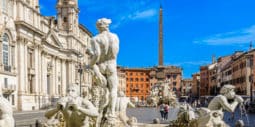
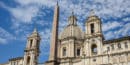
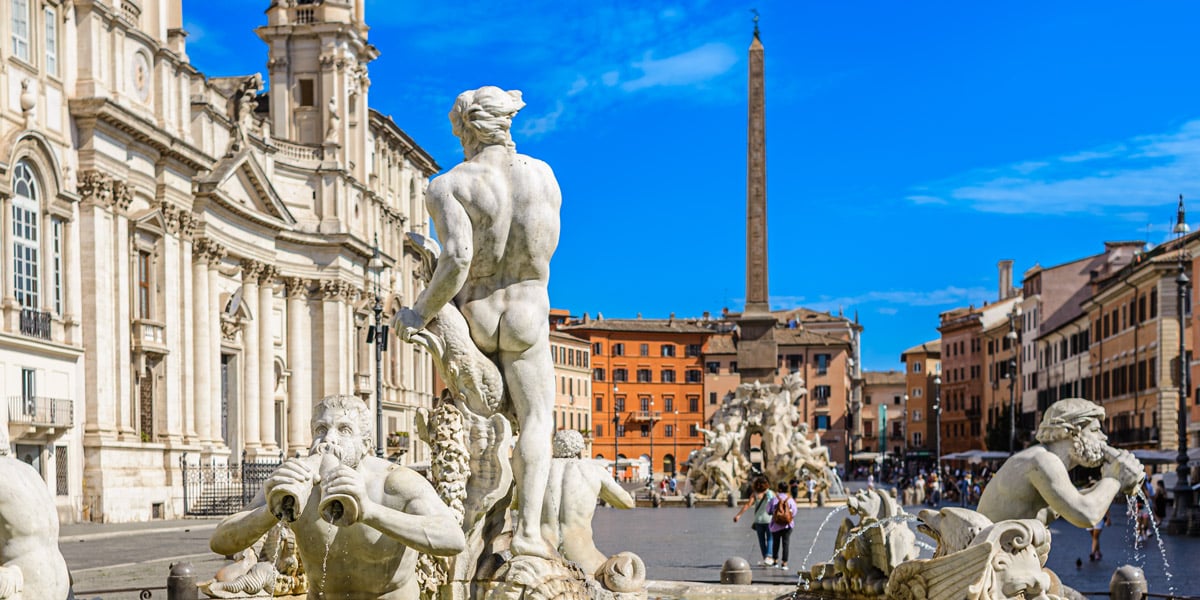
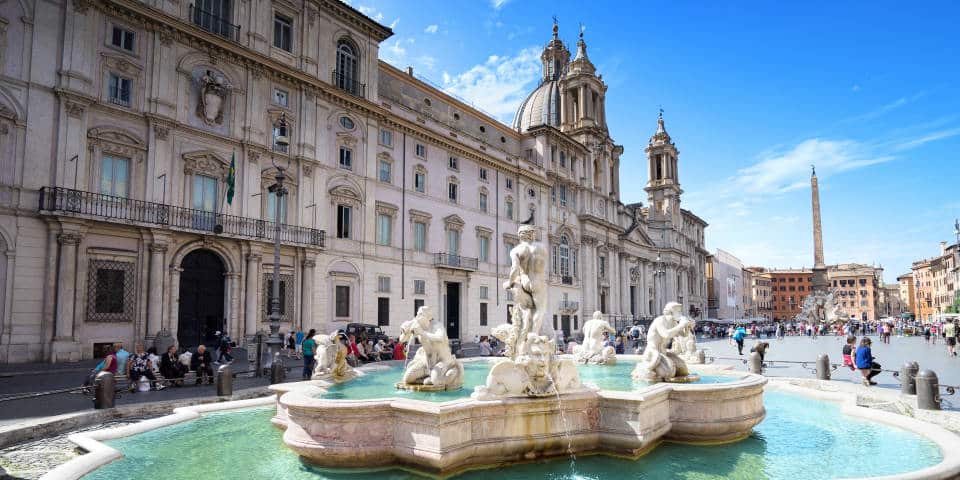
Piazza Navona is the most theatrical of Rome’s Baroque squares, and its elongated oval shape is not an architect’s invention — it traces the exact footprint of the Stadium of Domitian, the 1st-century athletics arena that stood here. The seating banks became the foundations of the surrounding buildings over the centuries, and the piazza inherited the shape of the track. Three Baroque fountains line its long axis, commissioned by different popes across nearly 80 years. The square is lined with restaurants, cafés, and souvenir shops. If you want to stay nearby, see the best hotels near Piazza Navona.
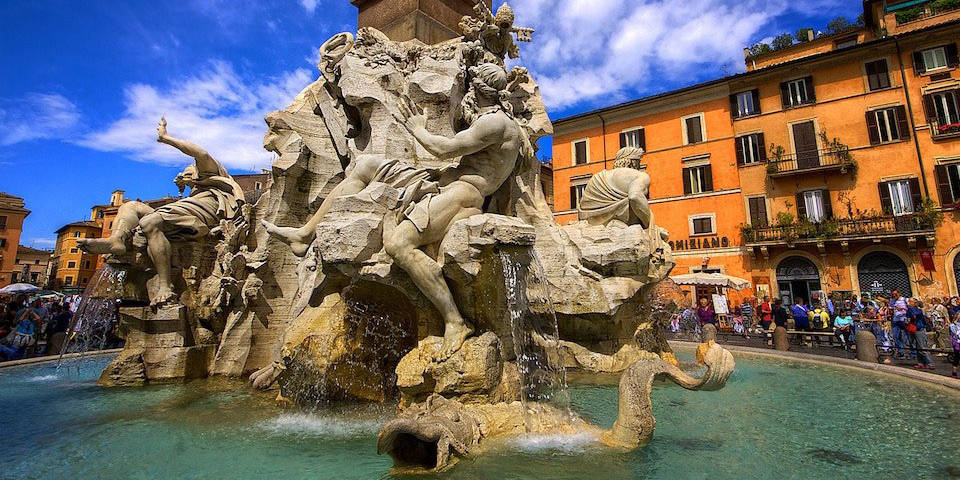
The Fountain of the Four Rivers (Fontana dei Quattro Fiumi) was commissioned by Pope Innocent X and inaugurated in 1651. Bernini designed four colossal river gods — the Nile, Ganges, Danube, and Río de la Plata — representing the four continents then known to Europeans. The Nile figure covers its head with a cloth, not from disdain toward Borromini’s church opposite (a popular legend that doesn’t hold up historically), but because the Nile’s source was unknown in 1651, and Bernini couldn’t sculpt what no one had seen.
See also a Guide to Borromini’s Masterpieces in Rome.
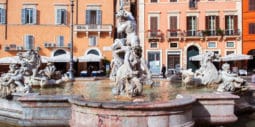
The Fountain of Neptune stands at the north end of Piazza Navona, but the Neptune figure wasn’t always there. Giacomo della Porta designed the basin in the 1570s; it stood empty of any central sculpture for nearly 300 years. The dramatic statue of Neptune battling an octopus was added only in 1878, when sculptor Antonio Della Bitta won a competition to finally give the long-empty basin its centerpiece. The basin and the figure are separated by three centuries.
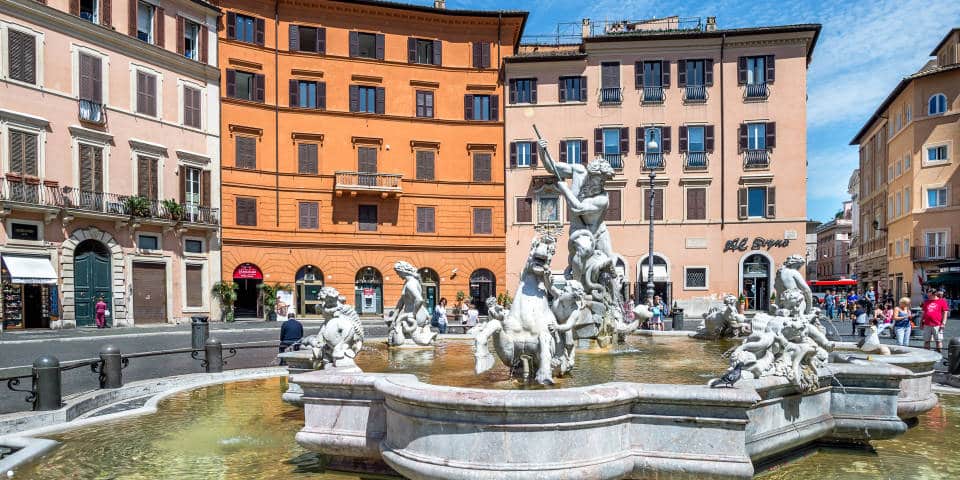
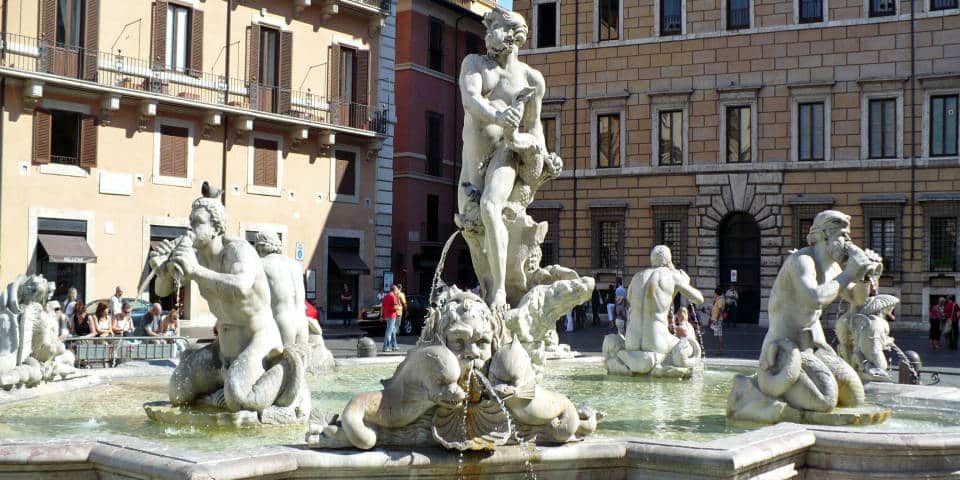
Fontana del Moro closes the southern end of Piazza Navona with a powerful triton figure wrestling a dolphin inside a conch shell, encircled by four smaller Tritons. The name is less settled than it sounds: no contemporary documents record Bernini referring to the central figure as a Moor, and historians note the “Moorish” reading seems to have developed through popular use rather than artistic intent. The current figures are 19th-century copies by sculptor Luigi Amici; the 1653 originals are reportedly in Roman municipal storage, their exact location unconfirmed. In September 2011, a man climbed into the fountain and used a stone to damage one of the figures. Police identified him from security footage within hours.
The Campo de’ Fiori is the only major square in Rome’s historical center without a church.
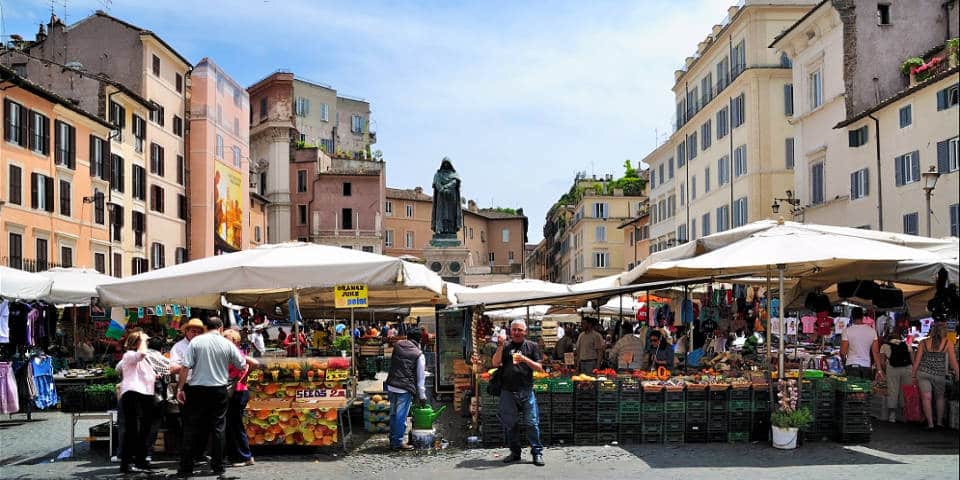
Instead of a patron saint, its center is occupied by a hooded bronze statue of Giordano Bruno, a philosopher burned at the stake on this spot in 1600 for heresy. The square served as an execution site for centuries before becoming a market. By day it hosts a popular flower, fruit, and vegetable market; by evening the surrounding restaurants and bars fill the streets. Many hotels, apartments, and gelaterias are nearby.
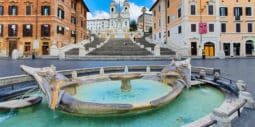
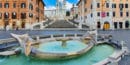
The Spanish Steps climb from this square, and almost nothing about them is actually Spanish. The square owes its name to the Spanish Embassy to the Holy See, but the 135-step staircase was designed by Italian architect Francesco de Sanctis, built between 1723 and 1725, and paid for with money left by a French diplomat. The square attracts thousands of visitors, and famous luxury brands including Prada, Bulgari, and Dior are clustered in the surrounding streets. The poet John Keats died in the building on the right side of the steps in 1821 — now the Keats-Shelley House museum.
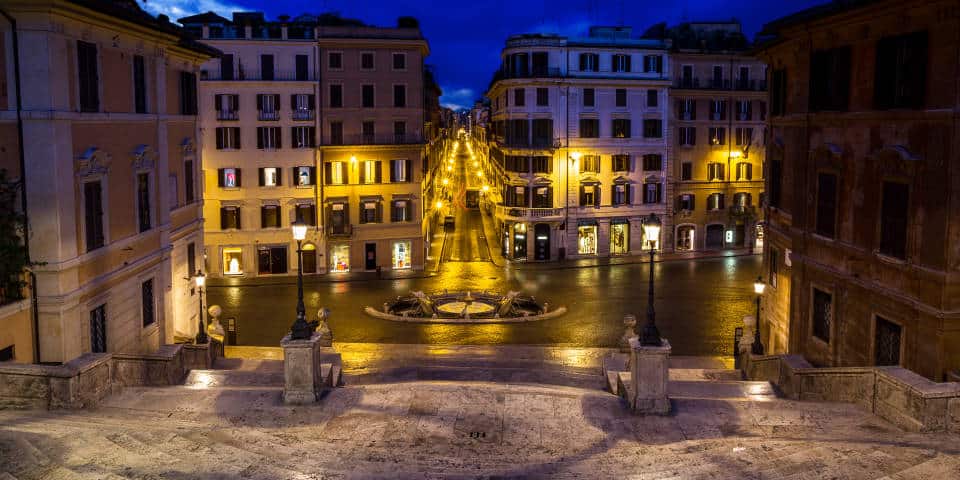
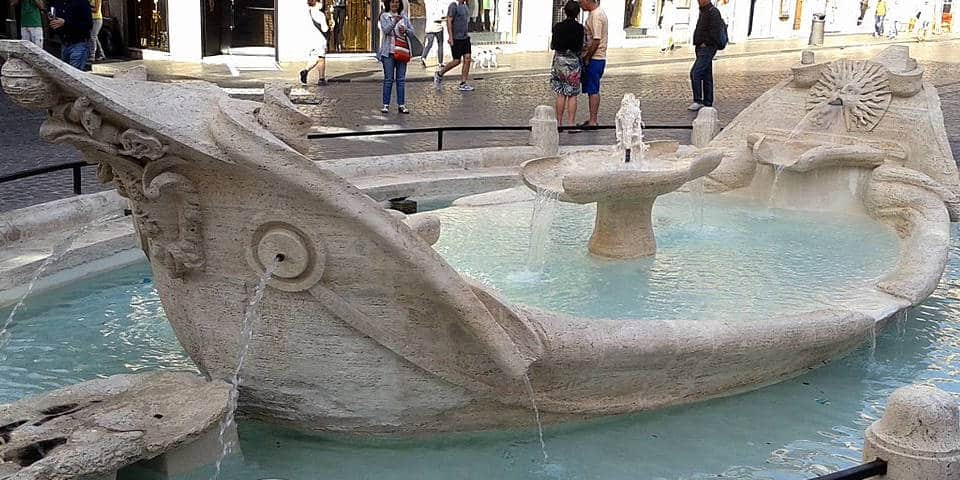
The Fountain of the Boat (Fontana della Barcaccia) at the foot of the Spanish Steps was designed by Pietro Bernini, father of the more famous Gian Lorenzo, and completed around 1629. The half-sunken boat design is as much a practical solution as an aesthetic one: the water pressure in Piazza di Spagna was too weak to drive a tall fountain jet, so Pietro Bernini made low pressure part of the concept — a boat appearing to founder under the weight of its own water. A flood in 1598 reportedly left an actual boat stranded in the square, and that image became the starting point for the design.
Piazza di Santa Maria in Trastevere is one of the most reliably atmospheric squares in Rome, particularly after dark, when the 12th-century gold mosaic facade of the Basilica of Santa Maria in Trastevere glitters above the square and the surrounding streets fill with locals and visitors. Every evening people come to eat Italian gelato or visit one of the restaurants on the piazza, and street performers draw crowds throughout the evening.
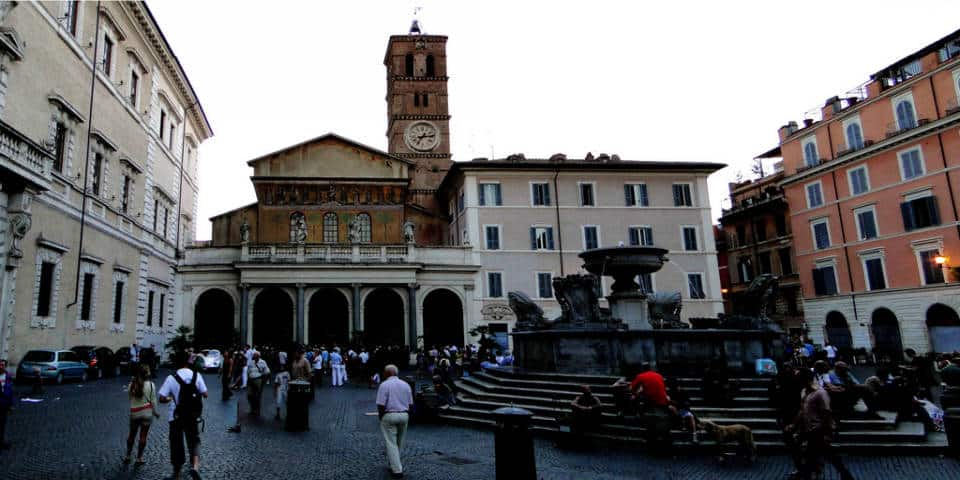
The fountain at the center of the square is believed to be the oldest in Rome, documented at this site since the 8th century. It is thought to be the oldest fountain in Rome, dating back to the 8th century, though the exact date of the original structure is unknown. The fountain you see today reflects centuries of rebuilding: Donato Bramante redesigned it around 1499, Bernini moved it to the center of the square and enlarged it in 1659, and Carlo Fontana gave it the current octagonal basin at the end of the 17th century. Three of the most important architects in Roman history left their mark on one relatively modest fountain that most visitors encounter mainly as a place to sit before dinner.
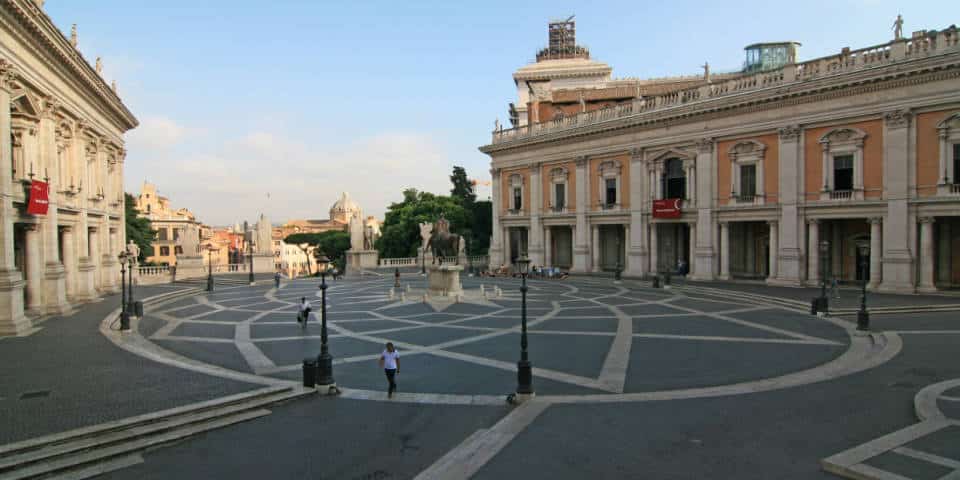
Piazza del Campidoglio was designed by Michelangelo in 1538, but he died in 1564 before it was finished, and construction continued for more than a century after his death. What you walk into today is largely his vision: the trapezoidal plan, the twelve-pointed star paving, and the three palaces that now form the Capitoline Museums. The equestrian statue at the center is a copy of the bronze Marcus Aurelius; the original survived the Middle Ages only because generations of Romans mistakenly believed it depicted Constantine, the first Christian emperor. Roman Divinities were once honored on this hill; today it is the seat of Rome’s city government.
The fountain set into the facade of Palazzo Senatorio was incorporated into Michelangelo’s redesign of the square around 1536 and is known as the Fontana della Dea Roma.
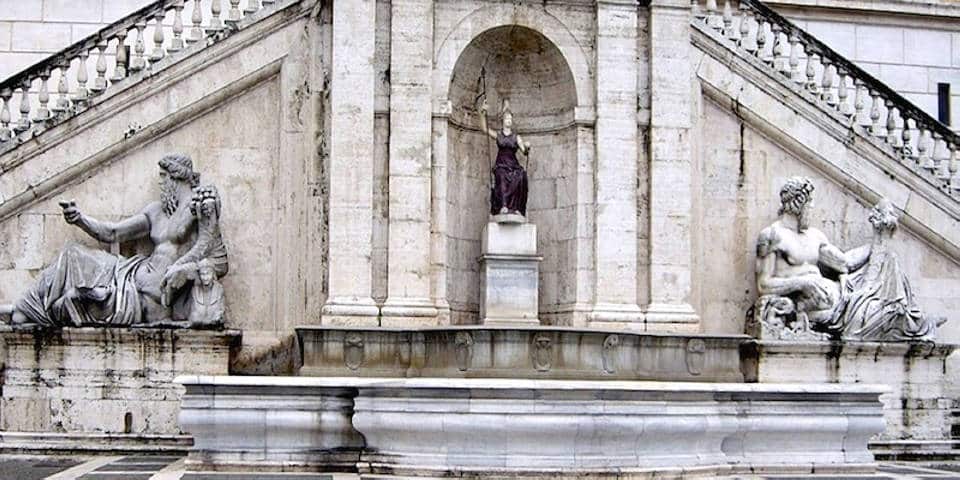
The reclining goddess figure at its center is an ancient Roman sculpture repurposed into Michelangelo’s architectural frame. Water didn’t reach the Capitoline Hill until decades after the design was set, so the fountain functioned as a purely decorative niche for years before the aqueduct infrastructure finally caught up.
Piazza della Rotonda takes its name from the Pantheon, which has been known informally as the Rotonda since it became the church of Santa Maria Rotonda in 609 AD — the moment that saved it from being quarried for stone like every other major public building of ancient Rome. The square is compact and usually crowded, but the fountain at its center provides a focal point that keeps eyes moving between the ancient portico and the modern city. Beautiful restaurants and gelaterias surround the piazza.
The Fountain of the Pantheon has two distinct histories stacked on top of each other. The original basin was designed by Giacomo della Porta in 1575 and carved by Leonardo Sormani.
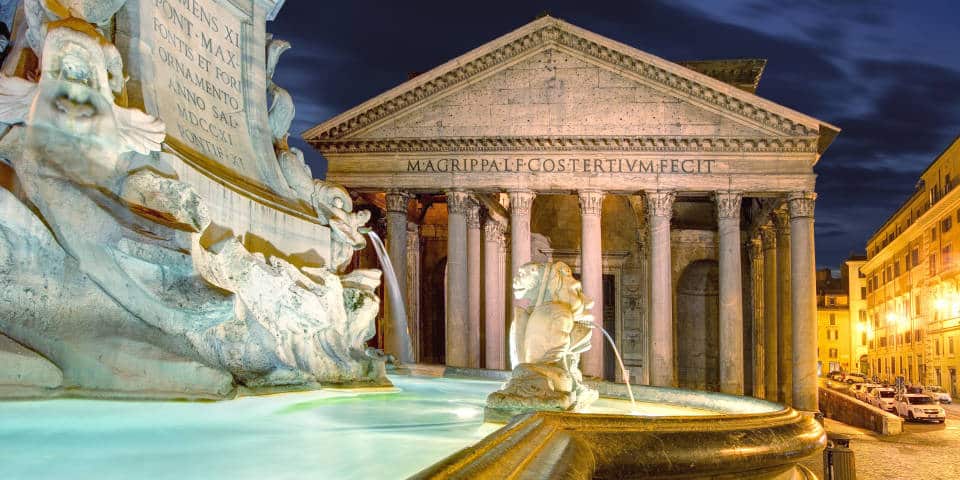
Then in 1711, Pope Clement XI had architect Filippo Barigioni add the Macuteo Obelisk at the center — a red granite monument carved for Pharaoh Apries around 580 BC, predating the fountain beneath it by over 2,100 years. Its twin stands two minutes away in Piazza della Minerva, balanced on the back of Bernini’s marble elephant.
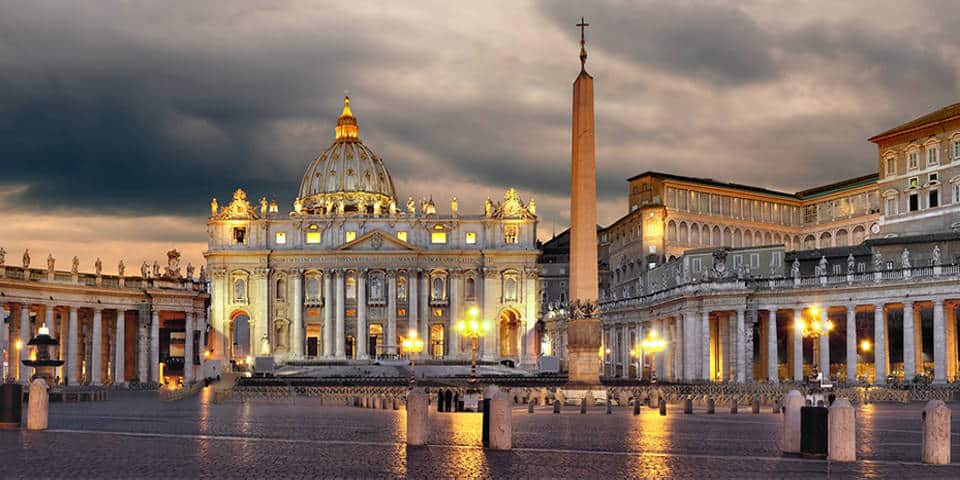
Saint Peter’s Square is world-famous for the Basilica di San Pietro, the largest church in the world — but most visitors photograph the central obelisk without registering that the square has two matching fountains, one on either side of it. The first was designed by Carlo Maderno in 1613; Bernini added the second in 1675 to provide symmetry when he completed his great colonnade. The Egyptian obelisk at the center predates both fountains: it was moved here from the Circus of Nero in 1586, a feat that required 900 workers, 140 horses, and 47 cranes. The square is crowded throughout the day; early morning gives the most space to appreciate the fountains and Bernini’s colonnade without crowds blocking the sight lines.
Piazza del Popolo is organized around an Egyptian obelisk that has changed addresses twice. Pharaoh Ramesses II had it carved at Heliopolis; Augustus brought it to Rome in 10 BC and installed it at the Circus Maximus on the central barrier of the great chariot track. When Pope Sixtus V reorganized this square in 1589, he moved the obelisk here. The architect Giuseppe Valadier gave the square its current neoclassical form between 1816 and 1824, with two symmetrical ramps flanking the obelisk and matched Baroque churches closing the southern end.
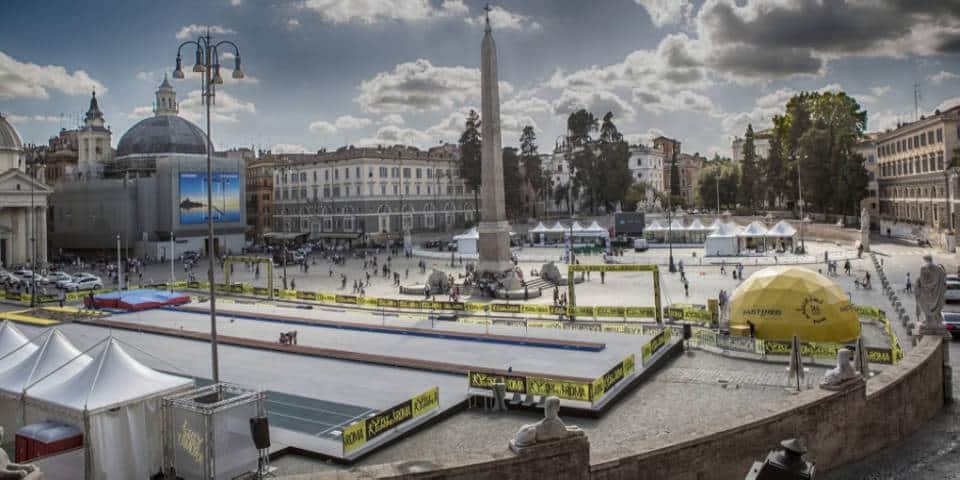
The square contains churches, a fountain, monuments, and two matched Baroque churches that appear identical from the front but have different interior plans — one circular, one oval — because the plots of land were different shapes. Villa Borghese lies directly above and behind the square.
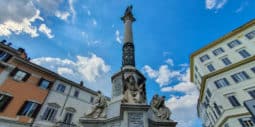
Piazza della Madonna dei Monti is a small square popular among locals and visitors on warm summer evenings. It functions as a living room for the Monti neighborhood: people gather on the steps around the central fountain with wine and conversation from early evening onward. The surrounding streets offer some of the city’s best independent restaurants, wine bars, and vintage shops. It makes a natural ending point for a Monti evening.
The Fontana dei Catecumeni was designed by Giacomo della Porta and executed by Battista Rusconi for Pope Sixtus V in 1588–89.
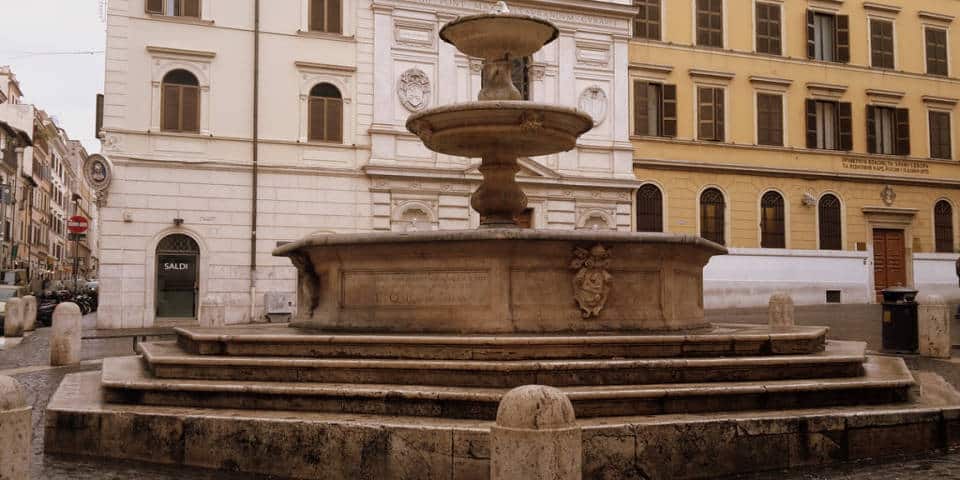
Steps were added by Girolamo De Rossi in 1595. The fountain was restored under Pope Innocent XI in 1680 and again in 1880 and 1997, when the square became pedestrian-only. Its low, intimate scale suits the piazza perfectly.
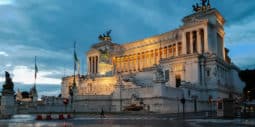
Piazza Venezia is the intersection of Rome’s main arteries — Via del Corso, Via del Plebiscito, Via del Teatro di Marcello, and Via dei Fori Imperiali all converge here, making it both the city’s central orientation point and one of its most chaotic traffic situations. The square takes its name from Palazzo Venezia, built in 1455 by Cardinal Pietro Barbo — later Pope Paul II — which served as the Venetian embassy and later as Mussolini’s workplace; the balcony from which he addressed wartime crowds still faces the square.
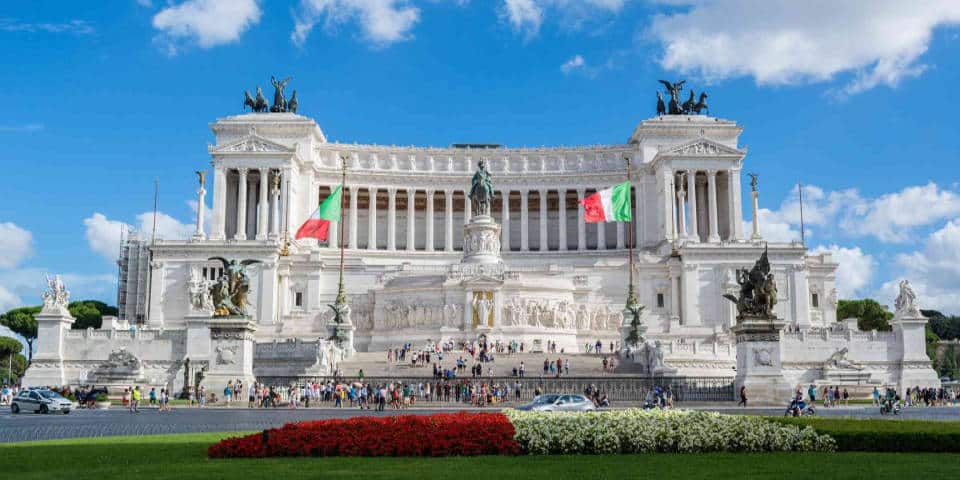
The Vittoriano monument closing the square’s southern end was inaugurated in 1911 to honor Victor Emmanuel II. Romans have been divided about its gleaming white marble ever since — its nicknames include “the Wedding Cake” and “the Typewriter.” The panoramic terrace at the top, reached by a free glass elevator at the back, gives one of the best views in the city.
Located in the Jewish Ghetto, Piazza Mattei is one of the smallest and quietest squares in the historic center, framed by Renaissance palaces and anchored by the Turtle Fountain. It receives a fraction of the foot traffic of its neighbors and rewards the short detour required to find it.
The Turtle Fountain (Fontana della Tartarughe) is a fountain of the late Italian Renaissance.
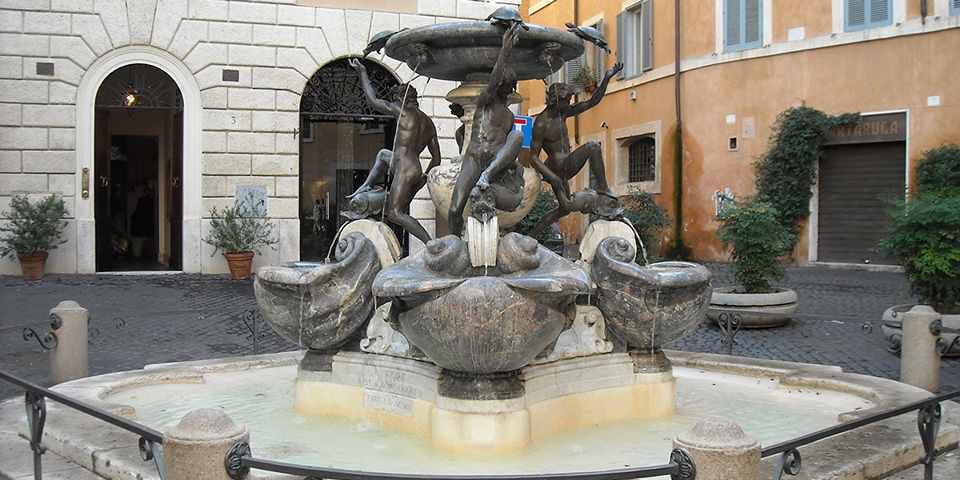
It was built between 1581 and 1588 by Giacomo della Porta and Taddeo Landini: four bronze youths balance on dolphins and stretch upward toward the upper basin. The turtles scrambling into that basin came later — added during a restoration in 1658–59 and attributed to Bernini, though some scholars credit Andrea Sacchi. Whatever the authorship, the turtles transformed a graceful fountain into an unforgettable one.
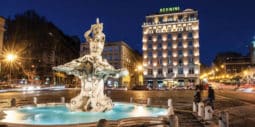
Piazza Barberini is a large square at the foot of the Quirinal Hill, surrounded by hotels, bars, restaurants, and a cinema — a working urban square rather than a sightseeing destination in itself, but worth pausing at for the Baroque masterpiece in its center.
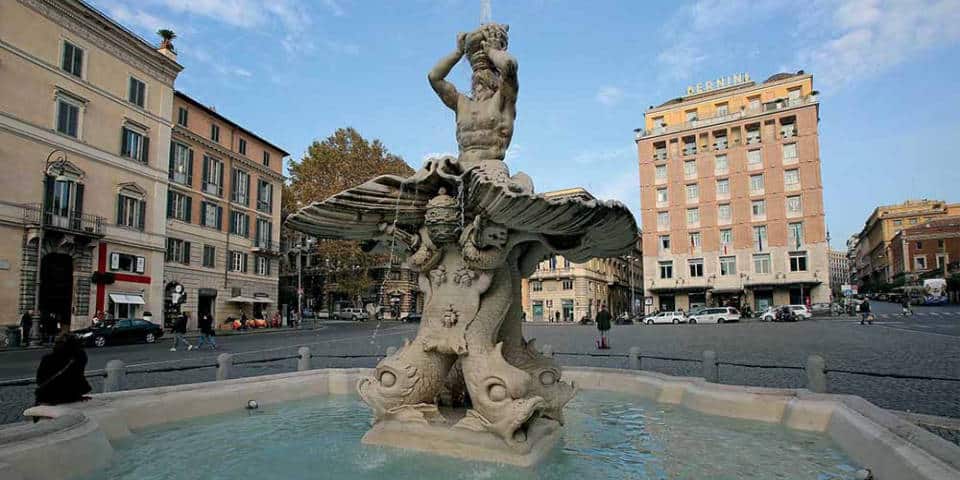
The Triton Fountain (Fontana del Tritone) was sculpted by Bernini and completed in 1643 — the first large free-standing Baroque fountain in Rome not attached to a wall or a palace facade. Four dolphin tails form the base; a muscular Triton kneels on the shell they support and blows water through a conch shell raised above his head. Pope Urban VIII commissioned it, and the Barberini family’s bees appear in the decorative details at the base, near the Palazzo Barberini entrance which houses the Galleria Nazionale d’Arte Antica.
Piazza della Repubblica is located next to Termini Railway station, and its curved colonnades follow the exact outline of the semicircular exedra of the ancient Baths of Diocletian. Michelangelo converted the main hall of the baths into the Basilica of Santa Maria degli Angeli e dei Martiri, still in regular use today. The square’s former name, Piazza dell’Esedra, still appears in older guidebooks.
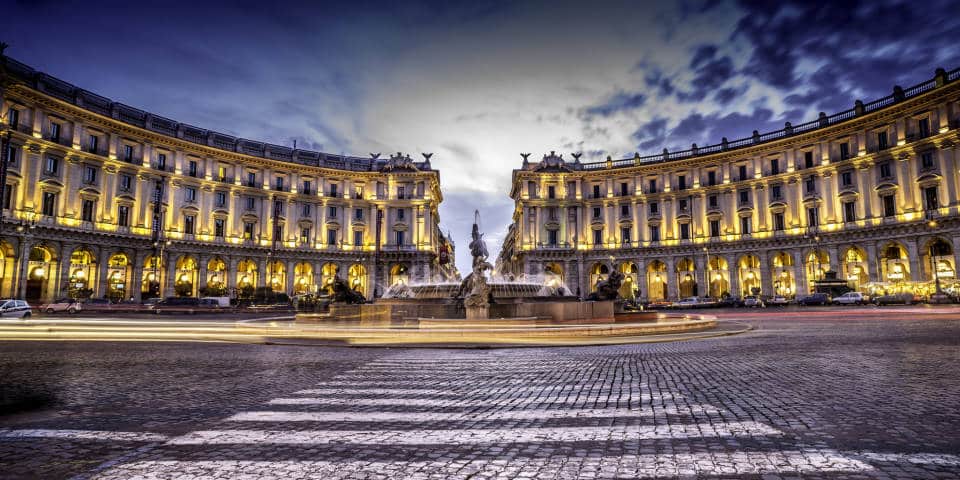
The Fountain of the Naiads (Fontana delle Naiadi) was unveiled in 1901 with four sensuous bronze nymphs representing rivers, lakes, the ocean, and underground waters. Their nakedness provoked an immediate public controversy: the Vatican protested formally, and police were stationed around the fountain for days to manage the crowds. Within a generation, the Naiads had become one of Rome’s most celebrated sculptures. The four nymphs recline at the basin’s edge with animals representing their respective domains — a swan, a water snake, a lizard, and a horse.
Piazza del Quirinale occupies the summit of the tallest of Rome’s seven hills and offers impressive views across the rooftops toward St. Peter’s.
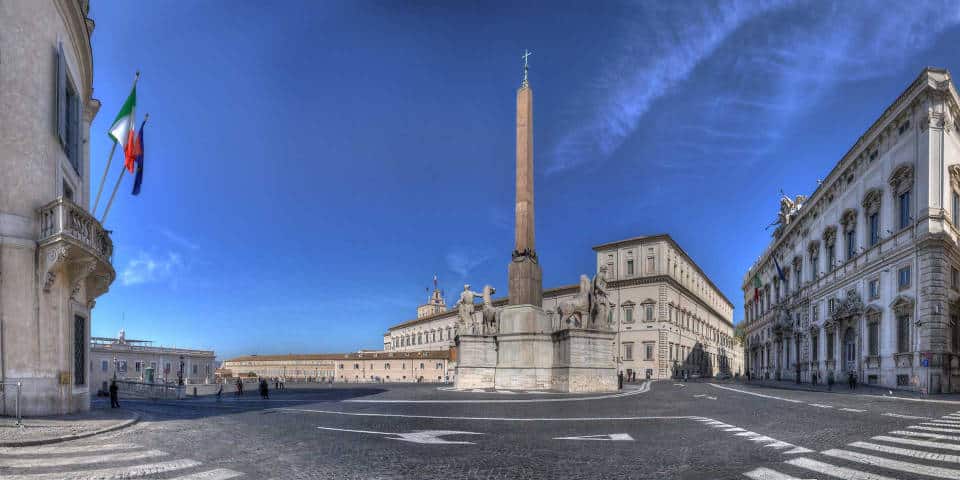
Its centerpiece is a monumental composition assembled from ancient objects that once stood in completely different parts of the city: two colossal statues of horse tamers — Castor and Pollux, the Dioscuri, brought here from the ancient Baths of Constantine — flanking an obelisk that originally stood at the Mausoleum of Augustus, with a large ancient granite basin serving as the fountain trough. The Palazzo del Quirinale, dominating the square, was designed as a summer residence for popes beginning under Gregory XIII in 1573 and became the seat of the Italian royal family after unification. It is now the official residence of the President of Italy.
The fountain element — the basin and trough — was commissioned by Pope Pius VII and designed by architect Raffaele Stern in 1818, unifying the ancient statues and obelisk into a single composition. The granite basin itself is an ancient Roman trough, brought here from the Roman Forum. The assembled monument combines objects spanning more than a thousand years of Roman history.
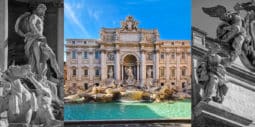
The most famous fountain in Rome is the Trevi Fountain (Fontana di Trevi) — the terminal point of the Aqua Virgo, an aqueduct built by Agrippa in 19 BC whose underground route has delivered water to this spot for over 2,000 years. The Baroque composition was designed by Nicola Salvi and completed in 1762 after 30 years of construction. Oceanus stands at the center in a shell chariot pulled by seahorses; two figures beside him represent the calm sea and the stormy sea.
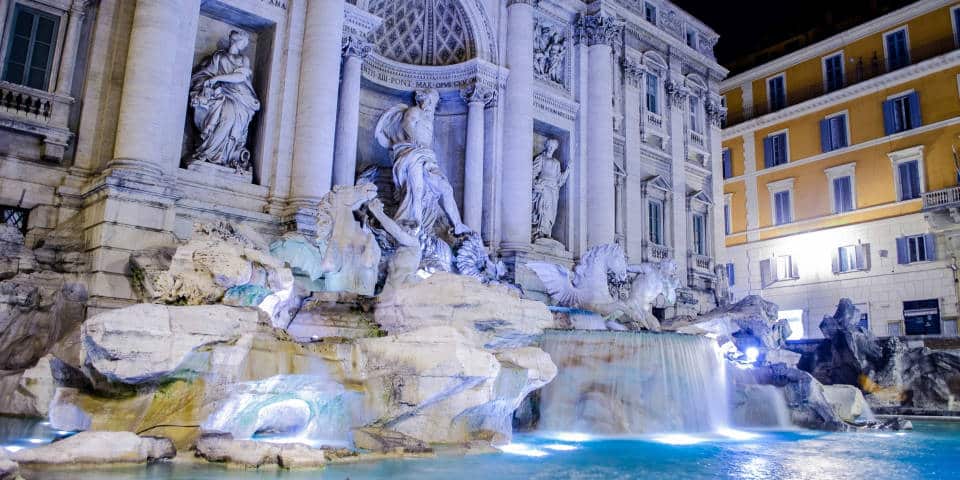
Throwing a coin with your right hand over your left shoulder is said to guarantee your return to Rome — a ritual that now generates around €1.4 million a year for Roman charity. Arrive before 9 AM or after midnight if you want to see the fountain without a wall of tourists between you and the marble.
The Fontana dell’Acqua Paola, known as Il Fontanone (“the big fountain”), stands on the Janiculum (Gianicolo) Hill above Trastevere and was built in 1612 to mark the endpoint of the renovated Acqua Paola aqueduct. It was the first major fountain on the right bank of the Tiber River.
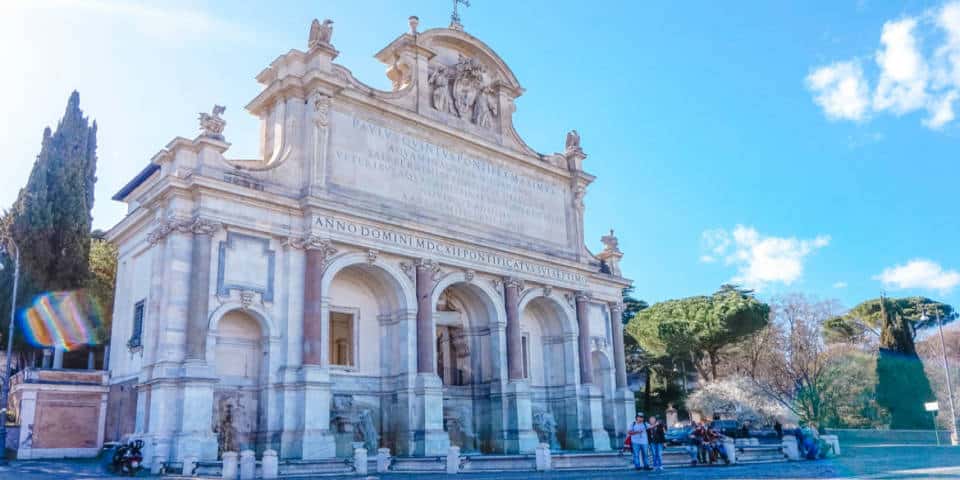
Pope Paul V had his name embedded in the Latin inscription across the facade — the fountain’s name comes directly from him — and the five arches incorporate granite columns taken from Old St. Peter’s Basilica. Its immense white facade is visible from much of the city. The film “La Grande Bellezza” (The Great Beauty, 2013) opens here at dawn.
The Fountain of the Eagle (Fontana dell’Aquilone) is located in the Vatican Gardens and seen only by those with garden access — one of Rome’s more remarkable fountains precisely because so few people have stood in front of it.
Commissioned by Pope Paul V and designed by Jan van Santen (known in Italy as Vasanzio), it was built near the Casino di Pio IV — a small garden residence designed by Pirro Ligorio in 1561 for Pope Pius IV. The eagle is the heraldic symbol of the Borghese family, Paul V’s family, and dominates the fountain’s decorative program.
The Fountain of the Frogs (Fontana delle Rane) was built in 1924, but it belongs entirely to the spirit of Baroque Rome. It serves as the centerpiece of the Coppedè quarter, a fantastical residential district designed by architect Gino Coppedè between 1913 and 1927 in a style that mixes Art Nouveau, medieval, and classical references into something entirely its own.
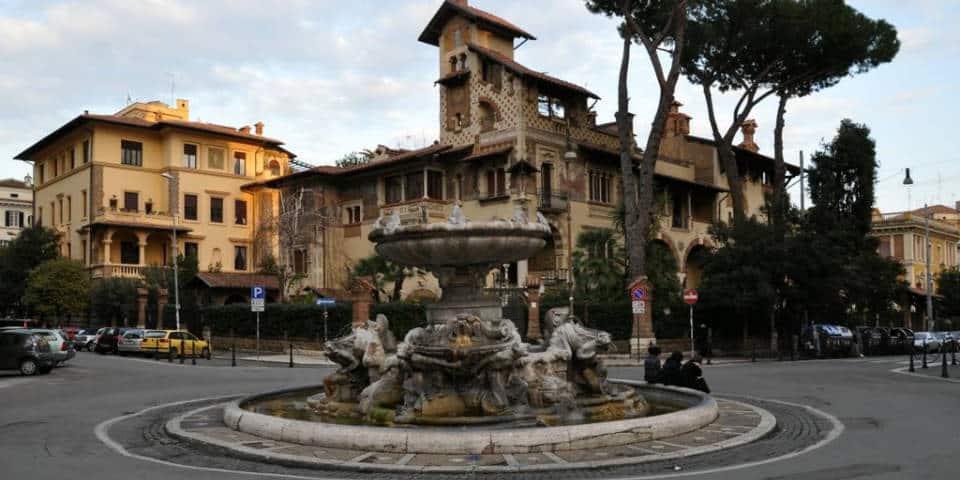
Eight frogs ring the upper bowl, water entering the basin from their mouths and from a central spray. The Coppedè quarter is one of Rome’s most rewarding detours for anyone who has finished the standard sights and wants to see something genuinely unexpected.
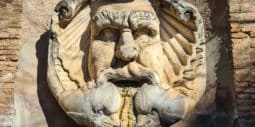
The Porter (Il Facchino) is one of the six talking statues of the Eternal City.
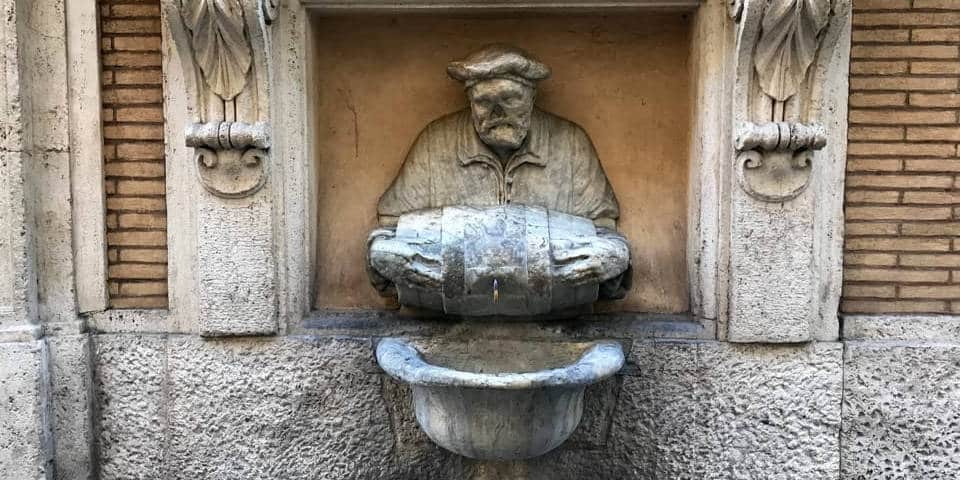
Set into the wall of a building on Via Lata near Piazza Venezia, the small stone figure of a water carrier holding a barrel is easy to walk past without noticing. Created around 1580 and attributed to Jacopino del Conte, it was originally located on Via del Corso before being moved to Via Lata in 1874. For centuries it served as one of Rome’s anonymous message boards: citizens attached satirical pamphlets targeting popes, cardinals, and powerful families, knowing the stone figure would take the blame rather than the author. The man’s face has been worn smooth by weather and by the paving stones thrown at it over the years by those who objected to the messages.
Every fountain and square in Rome has a story longer than a single visit allows. The city rewards the curious over the efficient — slow down, read the inscriptions, and look for the details the brochures leave out.
Rome.us © 2026. Created with love by Roman experts and guides.