
Rome.us
  • TAXI FARES CALCULATOR
  • ABOUT US
  • HOW TO GET
    • Fiumicino Airport
    • Ciampino Airport
    • Termini Railway Station
    • Public Transport
    • To Venice
    • To Florence
    • To Ostia Antica
    • To Naples
    • To Milan
    • To Pisa
    • To Siena
  • TIPS
    • TOP Attractions
    • Tickets to Vatican museums
    • Rome Three Day Itinerary
    • Rainy Days in Rome
    • Buying a Sim Card in Italy
    • Renting a Car in Rome
    • Apps for Tourists
    • Free Things to Do
    • Unusual Things to do
    • ASK US
    • Instagram
    • Pinterest
  • ANCIENT SITES
    • Arch of Constantine
    • Castel Sant’Angelo
    • Catacombs
    • Colosseum
    • Mamertine Prison
    • Mouth of Truth
    • Pantheon
    • Roman Forum
    • Theater of Marcellus
  • WHERE TO STAY
    • How to Choose a Hotel in Rome
    • Hotels with Best Views
    • Hotels near Termini
    • Hotels near the Colloseum
    • Best Hostels
    • Hotels near Navona Square
    • 3 Star Hotels
    • 4 Star Hotels
    • 5 Star Hotels
    • Apartments For Rent
  • VATICAN CITY
    • St Peter’s Basilica
    • Sistine Chapel
    • Vatican Museums
    • Raphael’s Rooms
    • Michelangelo’s Pieta
    • St Peters Dome
    • St Peter’s Square
    • Vatican Military
    • Swiss Guard
    • Pilgrims of Hope Jubilee
  • MUSEUMS
    • Ara Pacis Augustae
    • Borghese Gallery
    • Capitoline Museums
    • Caravaggio’s Paintings
    • Great Synagogue
    • Palazzo Farnese
    • Spada Gallery
  • PARKS
    • Appian Way
    • Orange Garden
    • Park of the Aqueducts
    • Pincio Terrace
    • Villa Ada
    • Vatican Gardens
    • Villa Borghese
    • Villa Celimontana
    • Villa Torlonia
    • Zoo
  • CHURCHES
    • Capuchin Crypt
    • Holy Stairs
    • Sant’Agnese in Agone
    • San Giovanni in Laterano
    • Santa Maria Maggiore
    • Saint Paul Outside the Walls
    • St Peter in Chains
    • St. Ignatius of Loyola
  • FOUNTAINS & SQUARES
    • Navona Square
    • Spanish Steps
    • Trevi Fountain
    • Altar of The Fatherland
    • Fontana della Barcaccia
    • Fountain of the 4 Rivers
    • Fountain of the Pantheon
    • Piazza del Popolo
    • Piazza Venezia
    • Turtle Fountain
    • Triton Fountain
  • HILLS
    • Aventine
    • Capitoline
    • Janiculum
    • Palatine
    • Pincian
  • DAY TRIPS
    • To Tivoli
    • To Ostia Antica
    • Beaches near Rome
    • To Alberobello
  • WEATHER
    • January
    • February
    • March
    • April
    • May
    • June
    • July
    • August
    • September
    • October
    • November
    • December
  • WHERE TO EAT
    • Famous Roman Dishes
    • Best Pizza Places
    • Best Pasta Places
    • Local Italian Food
    • Best Gelato Places
    • Best Rooftop Bars
  • NEIGHBORHOODS
    • Campo Marzio
    • Jewish Ghetto Quarters
    • Quartiere Coppedè
    • Monti
    • Sant’Eustachio
    • Trastevere
    • Trevi
  • Shopping
    • Castel Romano Outlet
    • Farmers Markets
    • Souvenirs from Rome
  • EMPERORS
    • Good Emperors
    • Marcus Aurelius
    • Gaius Julius Caesar
    • Nero
    • Octavian Augustus
    • Caligula
    • Hadrian
    • Vespasian
    • Commodus
    • Trajan
Home / Fountains and Squares /

Fontana dell’Acqua Paola — Rome’s Baroque Giant on the Janiculum

Written by: Artur Jakucewicz

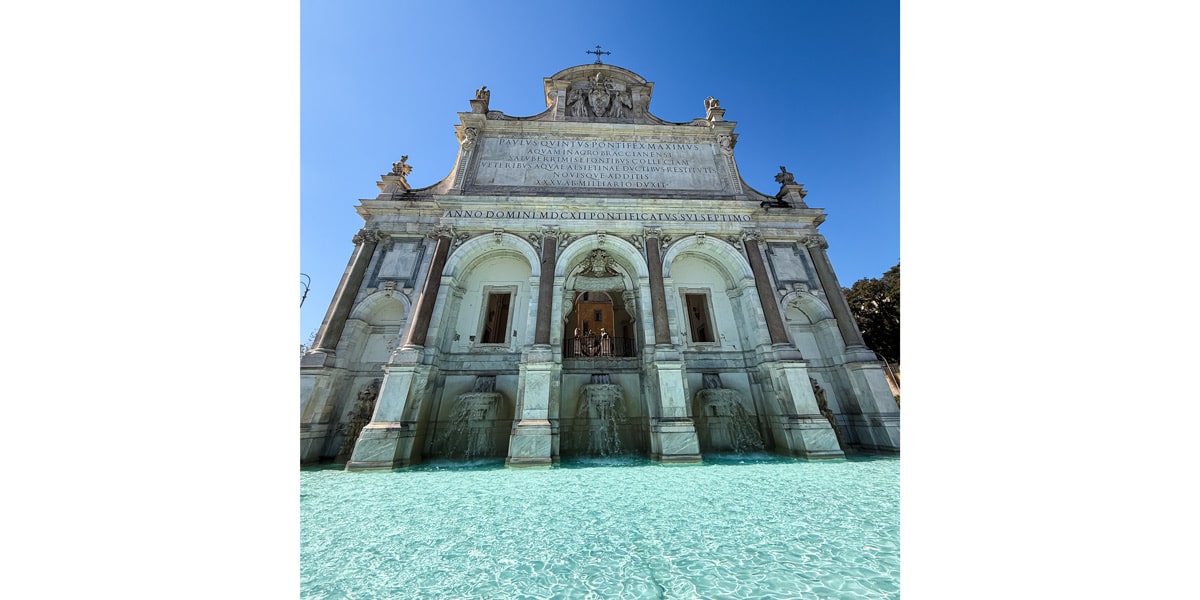
Full facade of the Fontana dell'Acqua Paola with its three cascades on the Janiculum hill, Rome
Closest bus stops
Garibaldi/Iacobucci1 min 65 m: 115
Psg Gianicolo/Villa Corsini2 min 113 m: 115 870
Closest subway stations
Circo Massimo40 min 2 km: B
Baldo Degli Ubaldi 56 min 2.8 km: A
Address Via Garibaldi, Roma
Website www.sovraintendenzaroma.it

On the crown of the Janiculum hill, above Trastevere, stands a fountain the size of a small palace.

Romans do not usually call it by its official name, Fontana dell’Acqua Paola. They call it Il Fontanone — the Big Fountain — and until the Trevi Fountain was finished a hundred and fifty years later, it was exactly that: the largest and grandest fountain in Rome. Almost nobody walks up to see it. The tourists queuing three deep at the Trevi have no idea that the fountain their own Trevi was modeled on is sitting empty a bus ride away, free to visit, with the whole city laid out beside it.

This guide is what to look at when you go, why it is there at all, and why it is one of the best cheap detours in Rome.


Contents

Toggle
  • A Triumphal Arch for Water
  • The Pope Who Built It — And the Wine Tax That Paid for It
  • The Inscription That Got the Aqueduct Wrong
  • The Marble Came from the Forum — and from Old St. Peter’s
  • The Borghese Eagle Everywhere You Look
  • A Fountain That’s Also an Archive
  • The Fountain That Inspired the Trevi
  • The View from the Terrace
  • How to Get to the Fountain of Acqua Paola
  • Is the Fountain of Acqua Paola Worth Visiting?
  • Things to Know before Visit
    • Is the Fountain of Acqua Paola free to visit?
    • Was the Fountain of Acqua Paola in “The Great Beauty”?
    • Why is the Fountain of Acqua Paola called Il Fontanone?
    • How do I get to the Fountain of Acqua Paola from the Trevi Fountain?
  • Best Value Hotels Near Fountain of Acqua Paola
  • Nearby Attractions

A Triumphal Arch for Water

Il Fontanone is shaped like a Roman triumphal arch, and that was the point. When Pope Paul V unveiled it in 1612 he wanted anyone climbing the Janiculum to read it as a monument — not a well, not a bath, but a civic victory. Five arches spread across the fasade, three tall central ones with water pouring from their niches, two lower on the flanks, all cut from travertine and dressed in colored marble. High above sits a broken pediment carrying the papal crest, an inscription board, and the cross of Christ. Below, a wide semicircular basin holds the water that spills from every side at once.

Stand back from the piazza and the whole thing lines up: cascade, basin, colonnaded terrace behind you, and the skyline of Rome directly ahead. That composition is the reason directors keep filming here — the opening sequence of Paolo Sorrentino’s Oscar-winning The Great Beauty is shot at this fountain, and the terrace behind it has appeared in the Bond film Spectre.

The Pope Who Built It — And the Wine Tax That Paid for It

The fountain is named after Pope Paul V — Acqua Paola, the water of Paul — and it stands at the end of an aqueduct he restored to bring water thirty-five miles across country from Lake Bracciano. Trastevere and the Janiculum, cut off from Rome’s main aqueducts by the Tiber, had been drinking brackish spring water and river water for centuries. Paul V decided to fix that, and to be remembered for fixing it.

The project was not popular. To pay for the aqueduct and the fountain, the pope levied a special tax on wine, and Romans, who took their wine seriously, minded. A phrase entered the Roman dialect: Vali come l’Acqua Paola — “you’re worth as much as Acqua Paola” — which became a way of calling someone worthless. The most beautiful fountain in the city was, for its first generation, also the most resented.

The design credit is often mangled in guidebooks, so it is worth setting straight. The original fountain of 1612 was drawn by Flaminio Ponzio, one of Paul V’s favorite architects; when Ponzio died mid-project, Giovanni Fontana finished it. Almost eighty years later, in 1690, a completely separate pope hired a completely separate architect — Carlo Fontana, Giovanni’s nephew — to make the big change you see today. Three architects, three different jobs, spread across the seventeenth century.

The Inscription That Got the Aqueduct Wrong

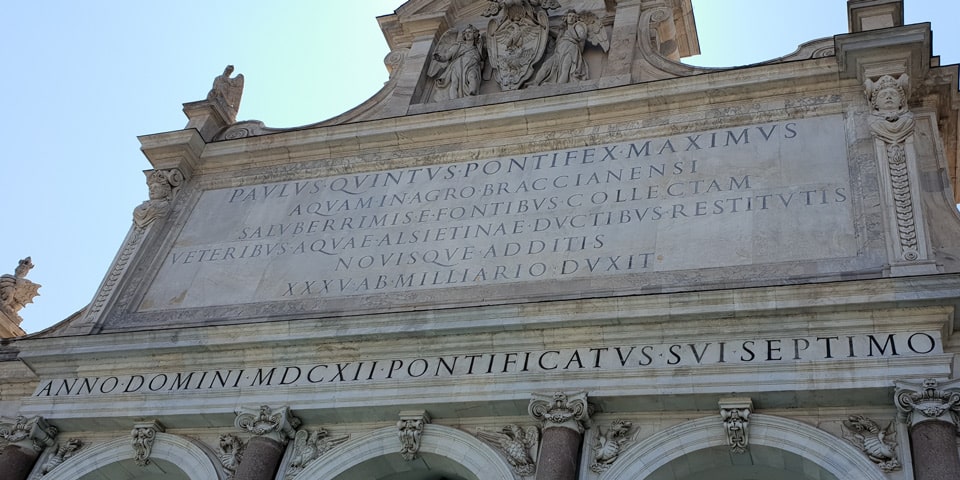
Look up at the marble panel over the arches and you will see the biggest, boldest words on the building. This is the fountain’s dedication, and it contains a famous mistake.

Latin dedication inscription on the Fontana dell'Acqua Paola crediting the Aqua Alsietina, with the date 1612, Rome


The text reads in Latin: PAVLVS QVINTVS PONTIFEX MAXIMVS · AQVAM IN AGRO BRACCIANENSI · SALVBERRIMIS E FONTIBVS COLLECTAM · VETERIBVS AQVAE ALSIETINAE DVCTIBVS RESTITVTIS · NOVISQVE ADDITIS · XXXV AB MILLIARIO DVXIT · ANNO DOMINI MDCXII PONTIFICATVS SVI SEPTIMO.

In English: “Pope Paul V, Supreme Pontiff, having restored the old channels of the Aqua Alsietina and added new ones, brought to Rome from the thirty-fifth milestone the water gathered in the territory of Bracciano from the most wholesome springs. In the Year of Our Lord 1612, the seventh year of his pontificate.”

The problem is the phrase Veteribus Aquae Alsietinae Ductibus — “the old channels of the Aqua Alsietina.” Paul V’s engineers did not, in fact, restore the Aqua Alsietina. They restored the Aqua Traiana, the aqueduct built by the emperor Trajan in 109 AD. The two arrive from roughly the same direction, and the mistake was not caught for decades.

The reason is a good story in itself. The best surviving Roman handbook on the aqueducts, Frontinus’s De Aquaeductu, was written just before the Aqua Traiana was built — Frontinus died about nine years before Trajan finished it — so the definitive ancient source didn’t mention it. Paul V’s engineers, working from Frontinus, knew about the Alsietina and assumed that was what they were reviving. Only in 1680, seventy years later, did the antiquarian Raffaele Fabretti, digging through the papal archives, prove which aqueduct was really under the fountain. The stone got carved with the wrong name and has been advertising a scholarly error to the whole of Rome ever since.

The Marble Came from the Forum — and from Old St. Peter’s

This is the kind of fountain that grew out of other buildings. In seventeenth-century Rome you did not quarry new stone if you could rob old, and Paul V’s builders robbed generously. The white marble facing came in part from the Forum of Nerva, dismantled in 1606 for exactly this kind of construction project; the same stockpile was also used for the pope’s Borghese chapel in Santa Maria Maggiore.

The four great granite columns that flank the arches came from a still more famous source: Old St. Peter’s Basilica, the Constantinian church that once stood where the modern basilica now rises. When the old church was pulled down and replaced by Michelangelo’s dome, its columns were saved and redistributed across the city, and four of them ended up here. Standing in the piazza with your hand on one of these shafts, you are touching a piece of the church consecrated by Constantine’s builders around the year 330.

The Borghese Eagle Everywhere You Look

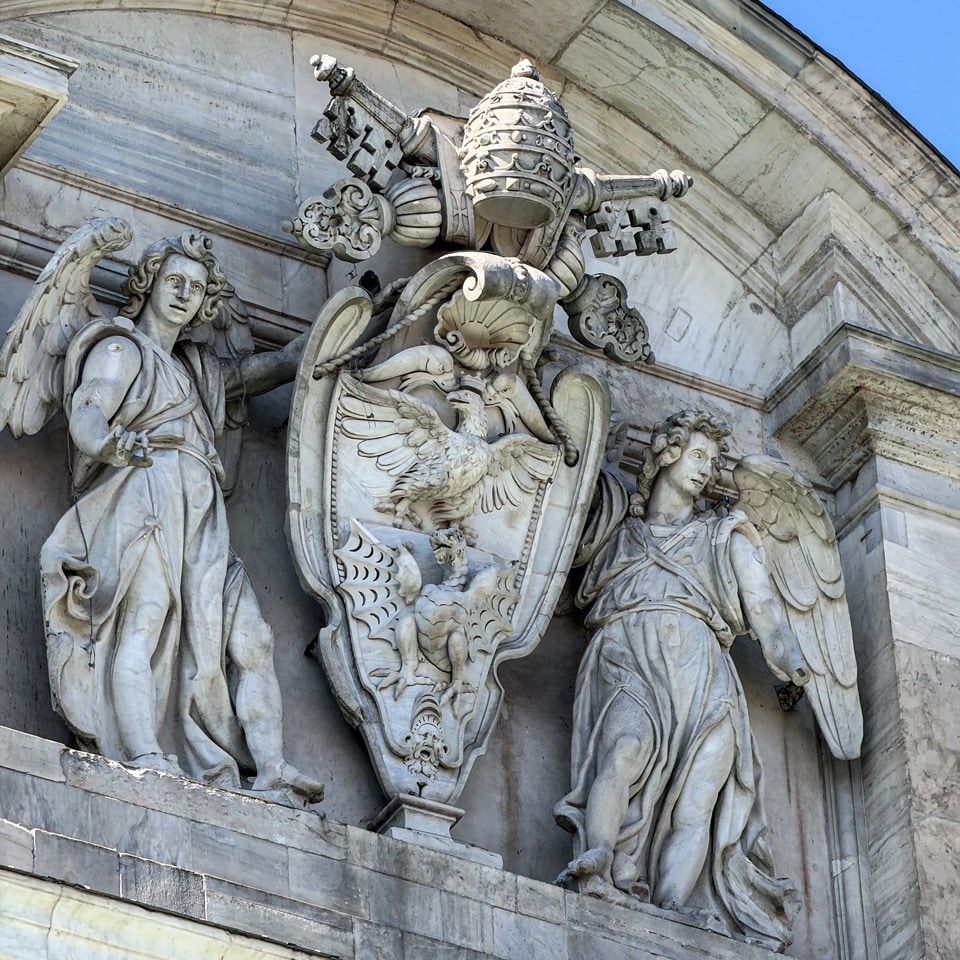
Paul V was born Camillo Borghese, and once you know what to look for you will find his family’s symbols worked into every high point of the fountain. Directly above the inscription sits the Borghese coat of arms — an eagle and a dragon on a shield — crowned by the papal tiara and the crossed keys of Saint Peter, flanked by two marble angels who together hold it aloft. The angels were carved in 1610 by the sculptor Ippolito Buzio.

Borghese family crest with papal tiara, crossed keys, eagle and dragon flanked by marble angels on the Acqua Paola fountain, Rome


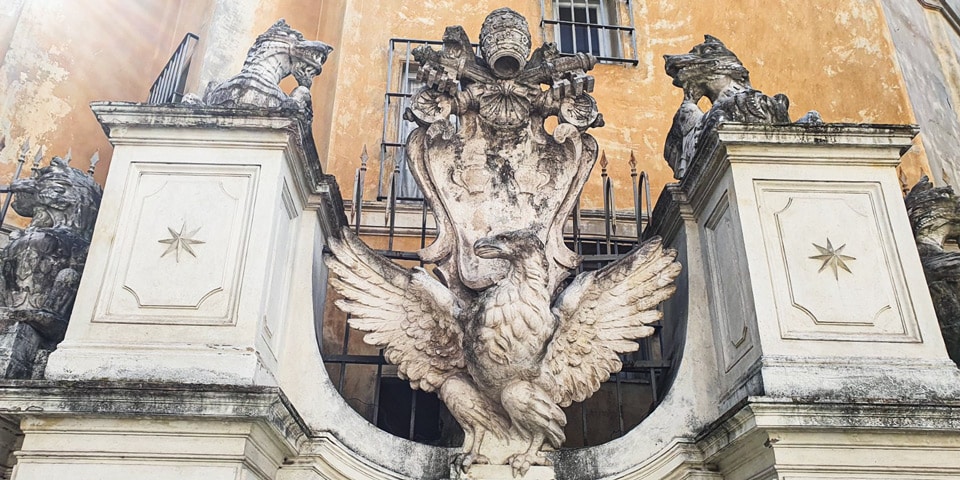
Walk to the side of the fountain, out of sight of the piazza, and the same eagle appears again on the gates that lead into the papal reservoir garden behind. This is the part of Il Fontanone almost nobody photographs. The fountain is not just a fasade — it is the front of a walled compound that once held the water tanks, service buildings and gardens of the whole Trajan-Paola aqueduct system. The Borghese eagle above the gate is the same one above the fasade: this whole hillside was, and looked like, papal property.

Borghese eagle with papal tiara and keys crowning the gate to the Acqua Paola fountain complex on the Janiculum, Rome


A Fountain That’s Also an Archive

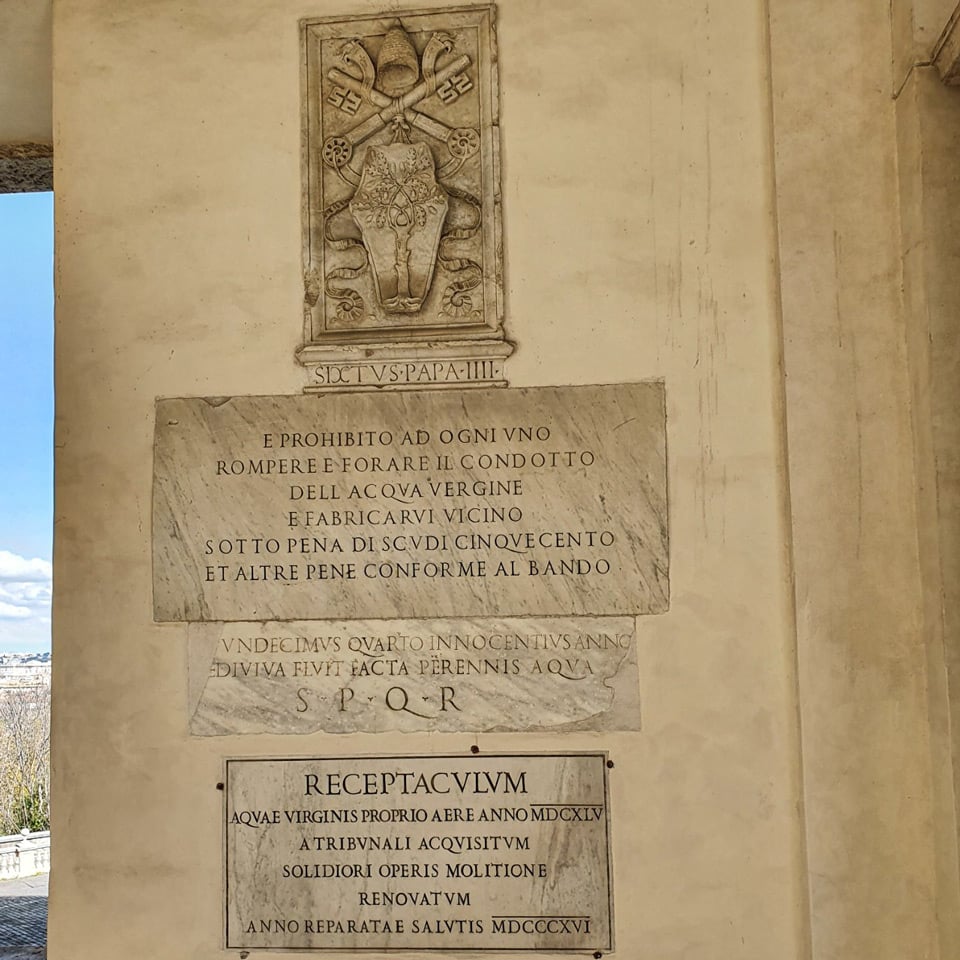
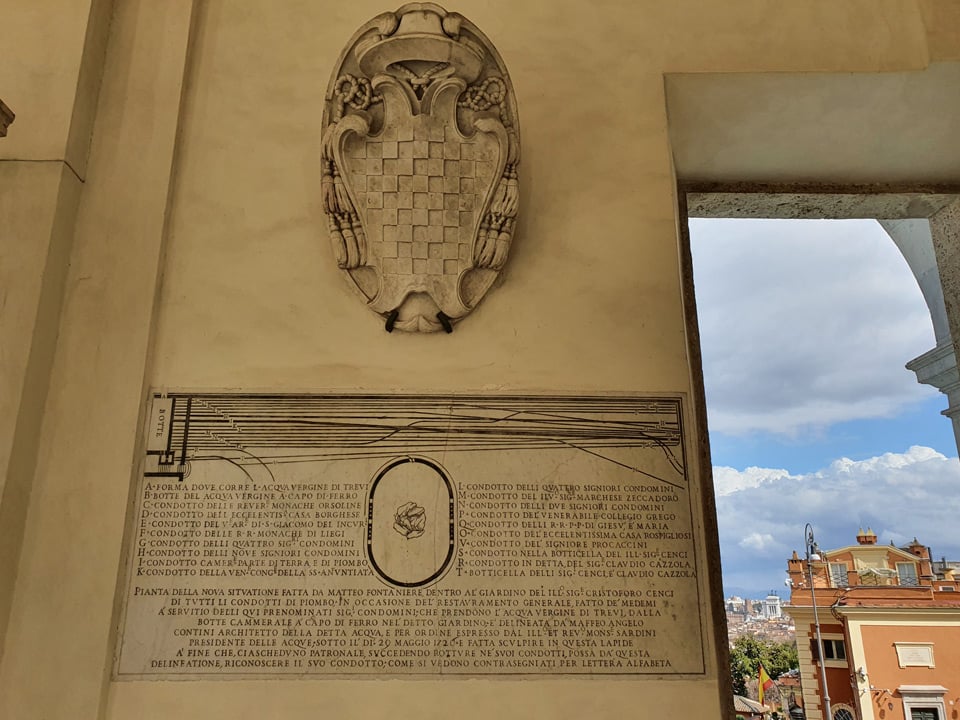
The most surprising thing at Il Fontanone is not on the fasade at all. Step under one of the side arches and look at the walls. They are covered in old marble plaques, from different centuries, carrying different popes’ coats of arms — and most of them are not about Acqua Paola.

Coat of arms of Pope Sixtus IV with a marble inscription forbidding damage to the Acqua Vergine channel under a fine of 500 scudi, on the wall of the Acqua Paola fountain, Rome


One plaque, under the arms of Pope Sixtus IV from the fifteenth century, is a public warning: “It is forbidden for anyone to break or pierce the channel of the Acqua Vergine, or to build near it, under penalty of five hundred scudi and other punishments as ordered by the edict.” Five hundred scudi was a serious sum — a small vineyard, or a comfortable year’s income. The threat is spelled out on marble and left in the open, because Rome’s water infrastructure was public property and violating it was a crime.

Another plaque, dated 29 May 1720, carries something even stranger: a full engineering map of lead water pipes, showing whose property each conduit fed — Palazzo Borghese, the Rospigliosi household, the four condomini, the Greek College, the confraternity of the Santissima Annunziata, and so on. This is a legal record of who had rights to the water of the Acqua Vergine in 1720, engraved so that any future rupture could be traced to its owner.

1720 marble map of Acqua Vergine water rights and lead pipe distribution mounted on the wall of the Acqua Paola fountain, Rome


These plaques are the reason Il Fontanone is more interesting than its guidebook description. For four centuries the terrace outside the fountain was the administrative front door of Rome’s water system, and popes used its walls the way modern governments use notice boards — for ownership records, edicts, and public warnings about several aqueducts, not just the one the fountain was built for. Nowhere else in the city can you read the water law of Renaissance and Baroque Rome directly off a wall.

The Fountain That Inspired the Trevi

The single most useful fact about Il Fontanone is one that no guidebook mentions: for a hundred and fifty years, this was the model for what a big Roman fountain looked like. From its opening in 1612 until the Trevi Fountain was finished in 1762, the Fontana dell’Acqua Paola was the largest and most theatrical fountain-mostra — the monumental display at an aqueduct’s end — in the entire city. The Trevi was a very old, very ordinary fountain during all that time. When Nicola Salvi finally designed the new Trevi, he copied Il Fontanone’s basic idea: a triumphal-arch fasade with a central niche pouring water, spread across the front of a palace-scale structure, ending in a wide basin at ground level.

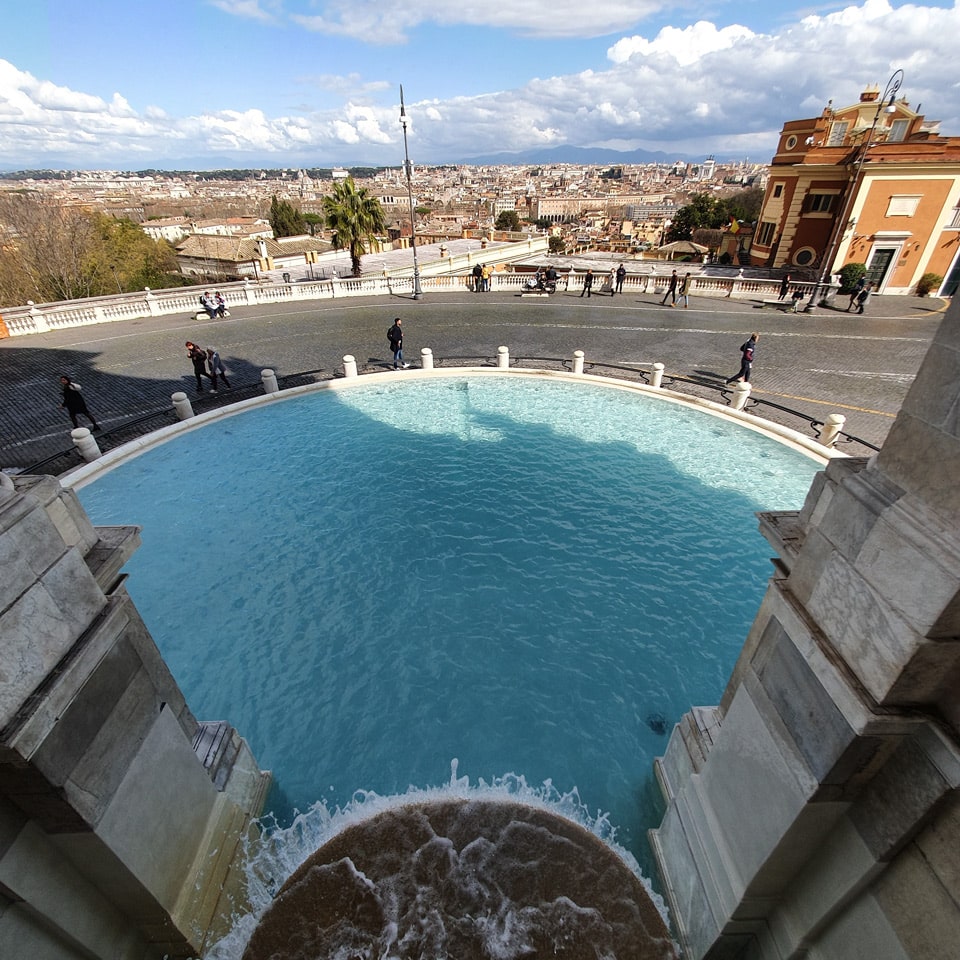
The wide basin part is the giveaway. Il Fontanone did not originally have a great semicircular pool — until 1690, water fell into five separate small basins under each arch. In that year the architect Carlo Fontana was hired by Pope Alexander VIII to replace the five basins with one huge semicircular one, mirroring the shape of the terrace outside. It transformed the fountain from a flat wall of water into a theatrical hemicycle.

View of the Acqua Paola fountain's semicircular 1690 basin from inside the fountain's niche, Rome

When Salvi designed the Trevi seventy years later, the semicircular basin cascading below a triumphal-arch fasade was already the accepted Roman formula for a great fountain — because Il Fontanone had made it so. Stand here and you are looking at the prototype of the fountain everyone crosses the city to see.

The View from the Terrace

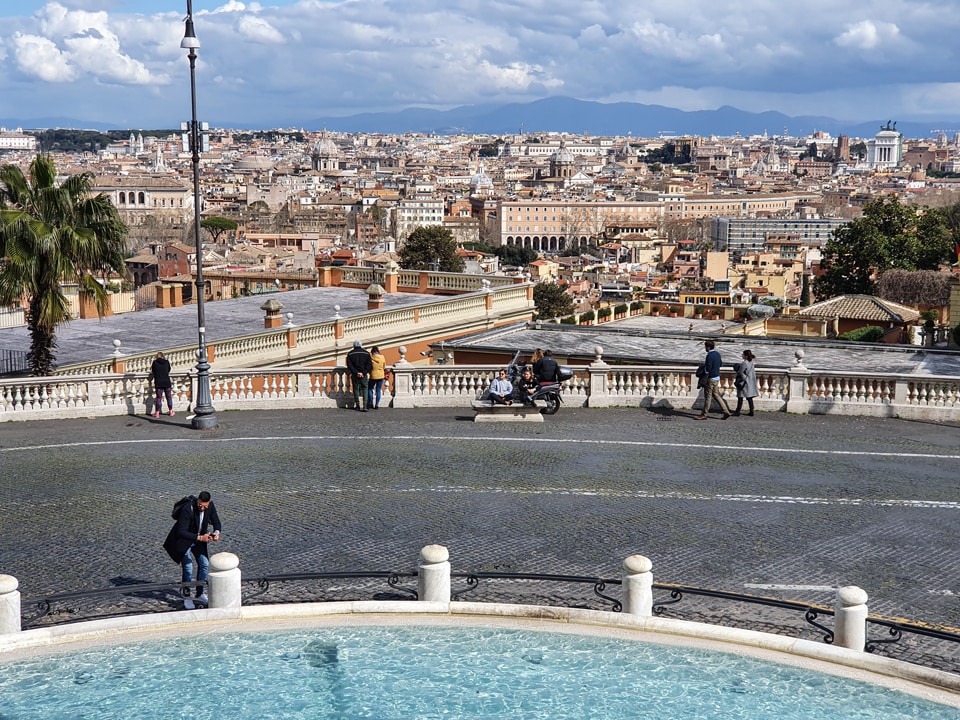
Turn your back on the fountain and Rome is spread out below you at exactly the angle a Renaissance painter would have chosen. The Janiculum is the second-highest hill in the modern city, and the terrace in front of Il Fontanone points due east across the entire historic center.

Panorama of Rome from the Acqua Paola fountain terrace on the Janiculum hill, with the dome of the Pantheon and the twin towers of Trinita dei Monti visible on the skyline

Some of what you can see is easy to name. The huge white marble bulk on the right of the skyline is the Vittoriano, the Altar of the Fatherland, the national monument to unified Italy. Look left and up and you can pick out the pale twin bell towers of Trinita dei Monti, the church at the top of the Spanish Steps. Between them, low and flat and easy to miss, is the dome of the Pantheon, half-hidden in the roofs. On a clear day the Sabine hills close the horizon.

This is not a small side benefit. Il Fontanone shares a piazza with the terrace called Piazzale Anicio Bonanni, and its bigger neighbor Piazzale Garibaldi is a five minute walk further up. Together they make up one of the two great free viewpoints of central Rome. Ninety percent of the visitors who make it up here come for the view; the fountain, honestly, is a bonus most of them do not really study.

How to Get to the Fountain of Acqua Paola

The Janiculum is not on any tourist’s default route, and that is exactly why it is quiet. Two easy public options: bus 115 from Piazza Trilussa in Trastevere runs directly up to the terrace, and bus 870 from Largo di Torre Argentina climbs the hill from the other side of the river. If you would rather walk, follow Via Garibaldi uphill from Trastevere; it takes about twenty minutes at a steady pace and hurts a little on hot days, but it is the walk Romans have made for four hundred years.

The fountain is a public open-air monument. There is no admission, no ticket, and no closing time — the piazza is open twenty-four hours, and the fountain is floodlit at night. Combining a visit here with the Villa Corsini or the Botanical Garden just downhill, or with dinner in Trastevere afterward, makes for one of the best cheap half-days in central Rome.

Is the Fountain of Acqua Paola Worth Visiting?

Yes — with one honest caveat.

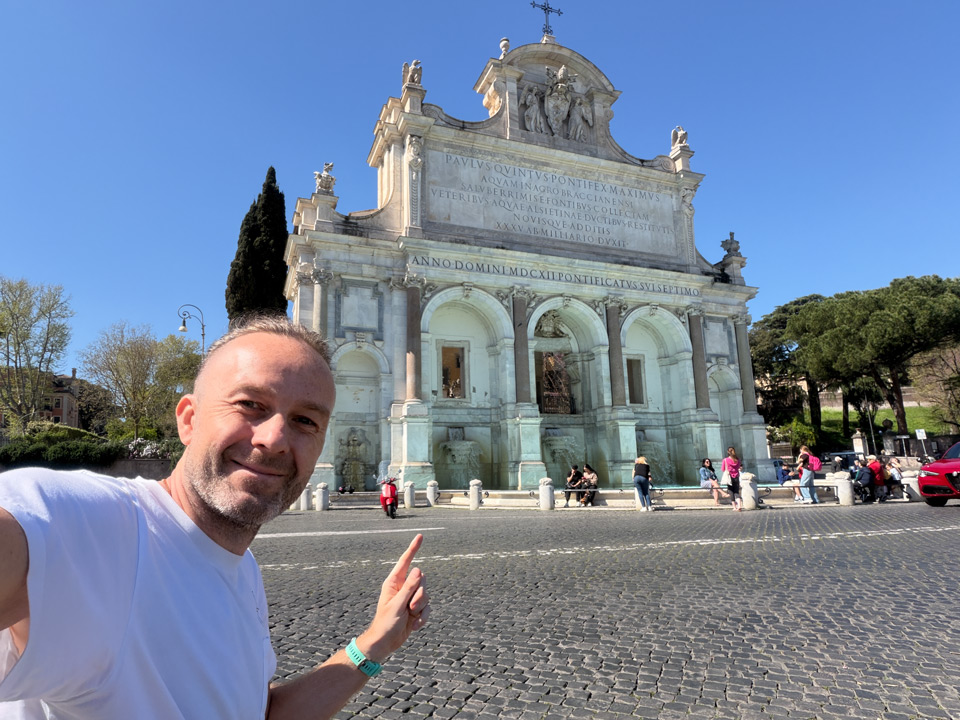
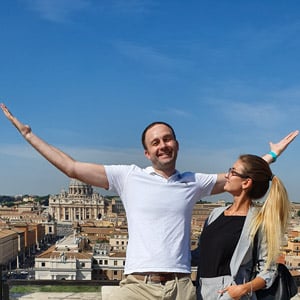
Artur Jakucewicz in front of the Fontana dell'Acqua Paola fountain on the Janiculum hill, Rome

You are not going to build a Rome trip around this fountain. It sits away from the main tourist circuit, and you will spend forty minutes climbing a hill for something you can look at, top to bottom, in another twenty. If your instinct is to say “one more fountain, no thanks” — that instinct is not crazy.

But almost every one of my guests who has actually gone up says the same thing coming down: it was the quietest great monument they saw in the whole city. No line. No hawkers. No selfie crush. Just an enormous, painted stone arch pouring water at the top of a hill, a terrace looking across the entire skyline, and — if you know where to look — Latin inscriptions, a papal fine of five hundred scudi, and the prototype the Trevi Fountain was copied from. It is free, it is fifteen minutes by bus, and it is the one great Baroque monument in central Rome that you can still stand in front of alone.

Go early or go at sunset. Both work. The fountain faces west and lights up gold in the late afternoon, and the panorama across Rome is at its best from about an hour before sundown. Bring water. Bring a jacket in winter; the hill catches the wind. And when you come back down into Trastevere for dinner, you will have seen the biggest fountain nobody warned you about.

Things to Know before Visit

Is the Fountain of Acqua Paola free to visit?

Yes. Il Fontanone is a public open-air monument, open twenty-four hours a day with no ticket, no admission fee, and no closing time. The fountain is floodlit at night.

Was the Fountain of Acqua Paola in “The Great Beauty”?

Yes. The opening sequence of Paolo Sorrentino's Oscar-winning 2013 film La Grande Bellezza was shot at the Fontana dell'Acqua Paola. The terrace behind the fountain has also appeared in the James Bond film Spectre.

Why is the Fountain of Acqua Paola called Il Fontanone?

"Il Fontanone" simply means "the Big Fountain" in Roman dialect. From its opening in 1612 until the Trevi Fountain was completed in 1762, this was the largest fountain-mostra in Rome, and Romans have called it Il Fontanone ever since — the name outlasted its record.

How do I get to the Fountain of Acqua Paola from the Trevi Fountain?

The easiest way is bus 115 from Piazza Trilussa in Trastevere, which climbs the Janiculum directly to the fountain terrace. From the Trevi, walk to Trastevere across Ponte Sisto (about fifteen minutes) and pick up the 115 there. Total travel time is roughly forty minutes.

Best Value Hotels Near Fountain of Acqua Paola

Lorenz Suites
11 min
1804 ft
550 m
Intra Residenza
12 min
2034 ft
620 m
Gianicolo Miracle Suite
18 min
2887 ft
880 m
V Collection Piazza Farnese
20 min
3281 ft
1 km

Nearby Attractions

Garibaldi Ossuary Mausoleum
3 min 490 ft 150 m
Father-Son Monument
5 min 750 ft 230 m
Museum of the Roman Republic
5 min 790 ft 240 m
Marble Patriots
5 min 820 ft 250 m
Daily Noon Cannon Firing
7 min 1150 ft 350 m
Janiculum Hill
7 min 1210 ft 370 m
Monument to Giuseppe Garibaldi
8 min 1310 ft 400 m
Piazzale Garibaldi - Panoramic Terrace
8 min 1350 ft 410 m
Basilica Santa Maria in Trastevere
10 min 1670 ft 510 m
Palazzo Corsini
11 min 1770 ft 540 m

Author: Artur Jakucewicz

Artur Jakucewicz

I have lived in Rome for over 10 years and am glad to share my experience and knowledge. I love ancient history and architecture — author of travel guides in Italy for independent travelers.

Dive Deeper into Rome's Stories

Fiumicino Airport Terminal 3

29049 views

How to Get from Fiumicino Airport to Rome City Center

Visiting Sistine Chapel

937646 views

Sistine Chapel

The Borghese Gallery and Museum The Ultimate Guide for Visitors

17405 views

The Borghese Gallery and Museum

Vatican Museums Guide

993368 views

The Vatican Museums

The Colosseum

145500 views

Colosseum

Roman Forum in Rome Italy

49682 views

Roman Forum

What to See in Rome

38474 views

What to See in Rome: A Walking Route Through 30 Top Attractions

Hotels with best views in Rome

19000 views

Hotels with Best Views in Rome

Hotel Near The Colosseum in Rome

20317 views

Hotels Close to the Colosseum in Rome

Show more

About us

About us ROME.US Authors Kate Zusmann and Artur Jakucewicz
We're Kate and Artur, a duo bound by our shared fascination with the Eternal City – Rome. Our paths, driven by a mutual passion for its timeless stories and architectural marvels, converged in a way we had never imagined.

Explore Rome

  • Villa Borghese

    Villa Borghese Gardens

  • Campo Marzio Neighborhood in Rome

    Campo Marzio District in Rome

  • Best Vegetarian and Vegan Restaurants in Rome

    Best Vegetarian and Vegan Restaurants in Rome

  • The Church of Saint Andrew on the Quirinal

    Sant’Andrea al Quirinale

  • Five Good Roman Emperors Nerva Trajan Hadrian Antoninus Pius Marcus Aurelius

    Five Good Emperors of Rome

Rome.us
  • social logo
  • social logo
  • social logo
  • social logo

This website uses cookies. For more info read the cookies policy

Rome.us © 2026. Created with love by Roman experts and guides.
  • Español