
28465 views
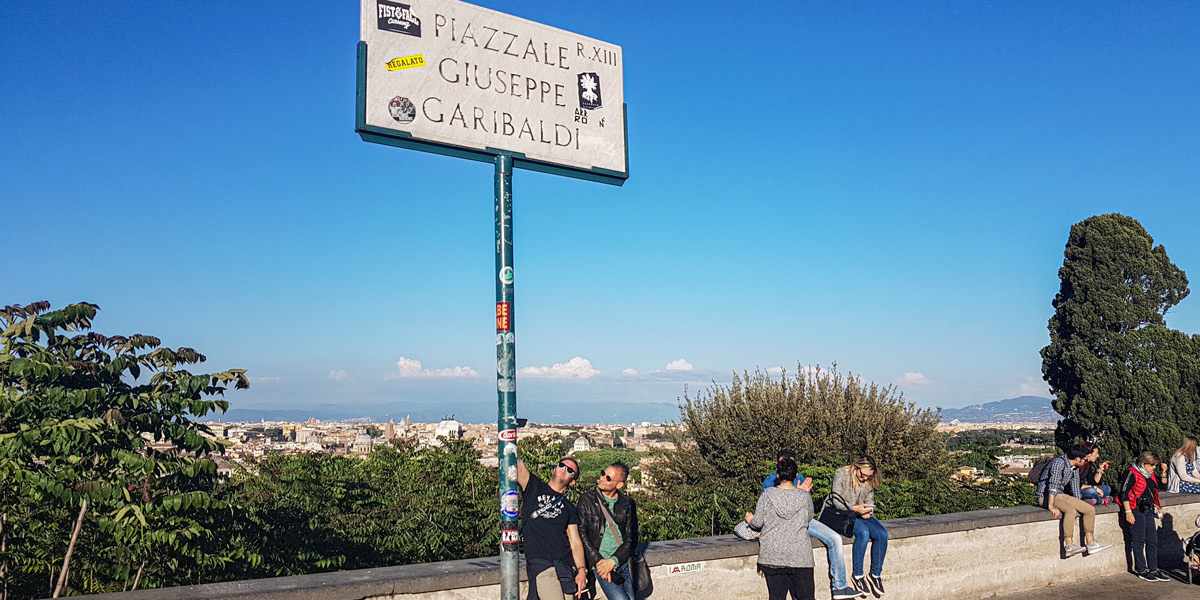
On the Janiculum Promenade, paths and people converge at Piazzale Garibaldi. Runners doing dawn sprints, a Roman family with a stroller and a thermos on a Sunday afternoon, a school group sitting on the steps, and a couple who came for sunset and stayed for the city lights all funnel onto this broad gravel terrace at the top of the ridge. It is less a single attraction than the stage where the hill’s daily life, political memory, and panorama come together.
The famous panorama is only half the story. A telephoto lens separates individual landmarks from the roofscape, while a thirty-second walk across the piazzale opens a second view of St. Peter’s dome.
The Italian name explains the layout. A piazzale is usually a broad open area, often panoramic and not necessarily enclosed by buildings like a traditional piazza. This one earns the name honestly. Two long avenues of the Passeggiata del Gianicolo, lined with marble busts of Risorgimento patriots, converge here from opposite directions and open onto the terrace. It is a meeting point by design, not an accident of geography.
The equestrian statue at the center made Garibaldi the piazzale’s defining figure. Emilio Gallori’s monument was unveiled in 1895, after the new Italian state had begun turning the Janiculum into a public promenade dedicated to the defense of Rome.
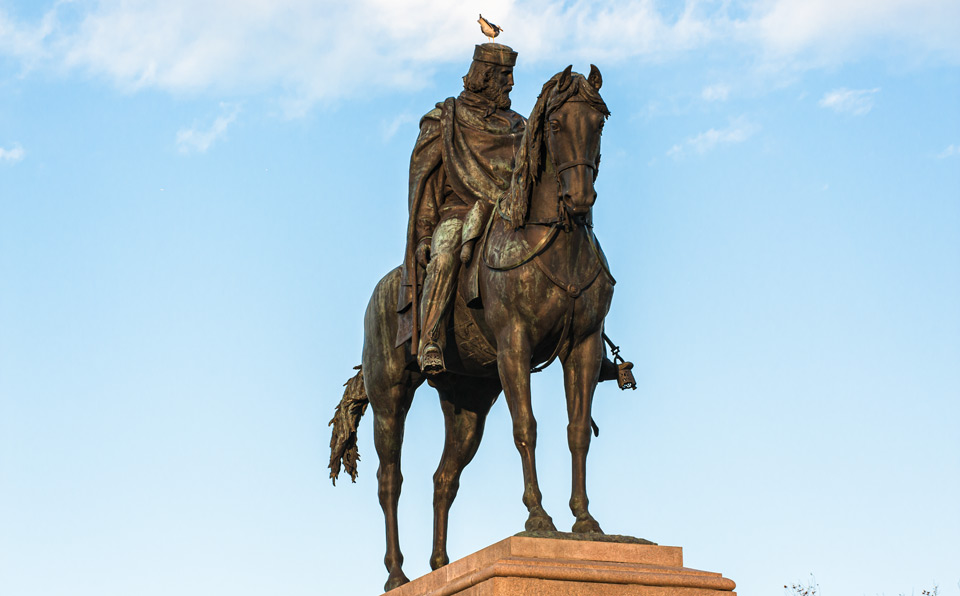
A bronze general on a bronze horse stands on the highest point of the hill, looking out over the city.
This is Giuseppe Garibaldi, sculpted by Emilio Gallori and unveiled on September 20, 1895, during the commemorations for the twenty-fifth anniversary of Rome’s capture by the Kingdom of Italy. The reliefs and allegorical groups around the pedestal connect the defense of the Roman Republic in 1849 with the campaigns that led to Italian unification. We unpack those scenes and inscriptions in a separate deep dive on the monument. Here, the statue matters mainly as the visual anchor that gives the piazzale its identity.
If you are on the piazzale anywhere near midday, you will hear it before you understand it: a single, flat, very loud bang from directly beneath the terrace. This is Il Cannone del Gianicolo, a blank round fired at exactly noon — a tradition introduced by Pope Pius IX on December 1, 1847, to give Rome’s church bells one official signal for the hour. The ceremony moved to the Janiculum in 1904 and now takes place in a small casemate built into the hillside just below the piazzale.
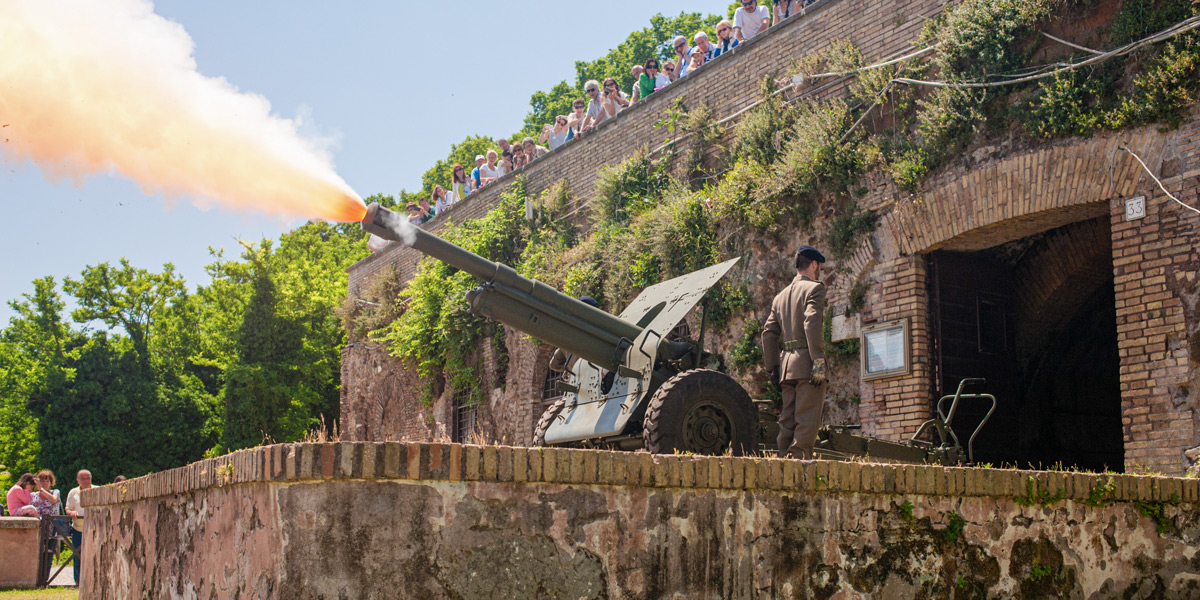
It is loud enough that first-time visitors sometimes think something has gone wrong. Nothing has. The soldiers roll the gun back into storage within minutes, and the piazzale returns to its ordinary business as if nothing happened. The full story of the tradition — and exactly where to stand so your ears don’t ring for the rest of the afternoon — is in our separate guide to the noon cannon.
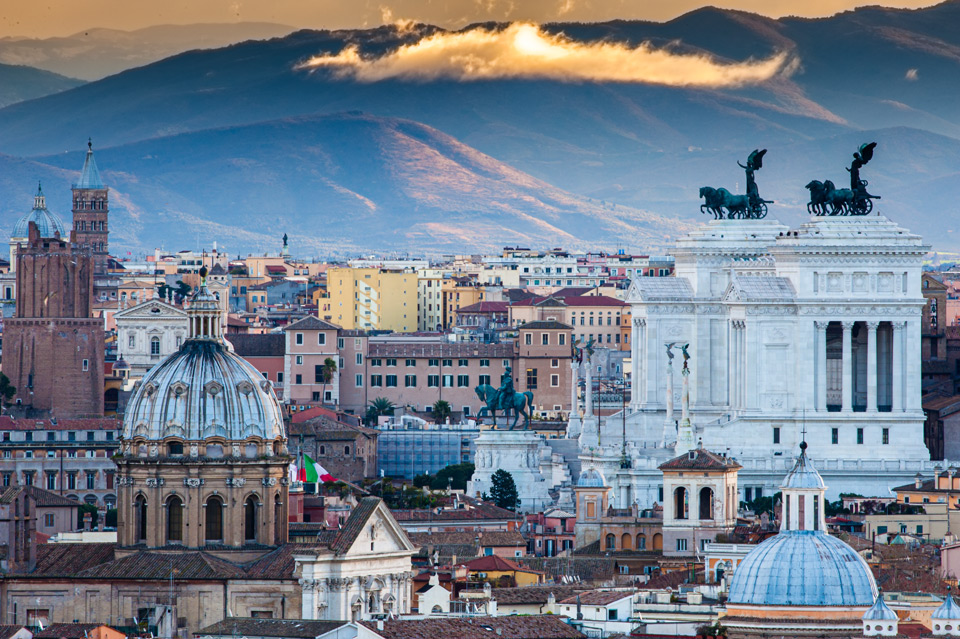
The panorama from the parapet is famous, but Piazzale Garibaldi becomes more legible through a long lens. A focal length of 200mm or more compresses the distance and pulls individual landmarks out of the haze of rooftops. Scan from left to right and here is what a telephoto picks out.
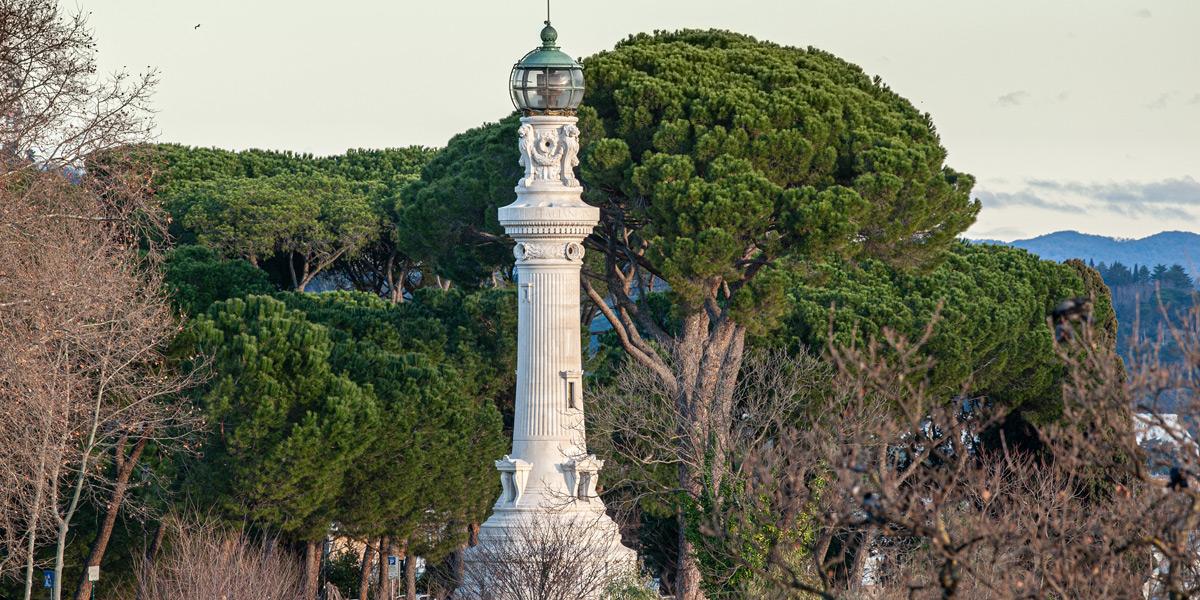
At the far left, rising alone above the pines of the Passeggiata, is the Faro del Gianicolo — the Janiculum Lighthouse, a twenty-meter column of white Botticino stone topped by a glass lantern. Designed by Manfredo Manfredi in 1911, it was donated to Rome by the Italian community in Argentina to mark fifty years of Italian unity. A long lens flattens the pines behind it into a solid wall of green and turns the lighthouse into a clean, isolated silhouette.
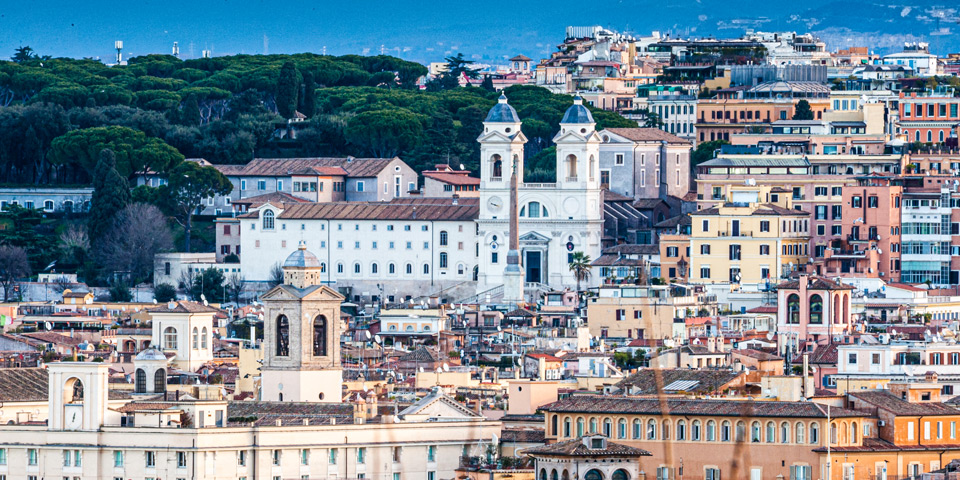
Look toward the Pincian Hill on the opposite side of the city and you can pick out the twin bell towers of Trinità dei Monti — the church directly above the Spanish Steps, with the obelisk in front of its facade visible even from this distance.
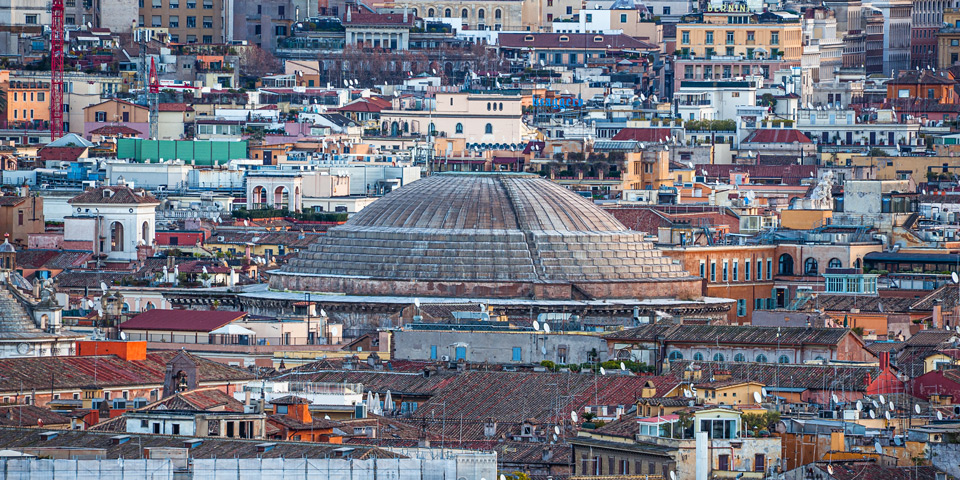
Closer to the center of the frame, low and gray among the terracotta roofs, is the dome of the Pantheon. Its portico and pediment disappear below the surrounding roofline, leaving only the upper stepped rings of the concrete dome in view. The present building dates to Hadrian’s reconstruction of AD 118–125, yet from here its most famous feature reads less like a monument than part of the roofscape.
Further right, bright in white marble, is the Vittoriano, with the Altare della Patria at its center and bronze quadrigae above. It is one of the clearest landmarks on the skyline even before you raise the camera; through a telephoto, the chariots and columns separate from the white silhouette.
Directly ahead is St. Peter’s dome, close enough that even a moderate zoom resolves its windows, ribs, and lantern. From the main terrace, a telephoto lets it fill the frame on its own; across the piazzale, the trees create a different composition.
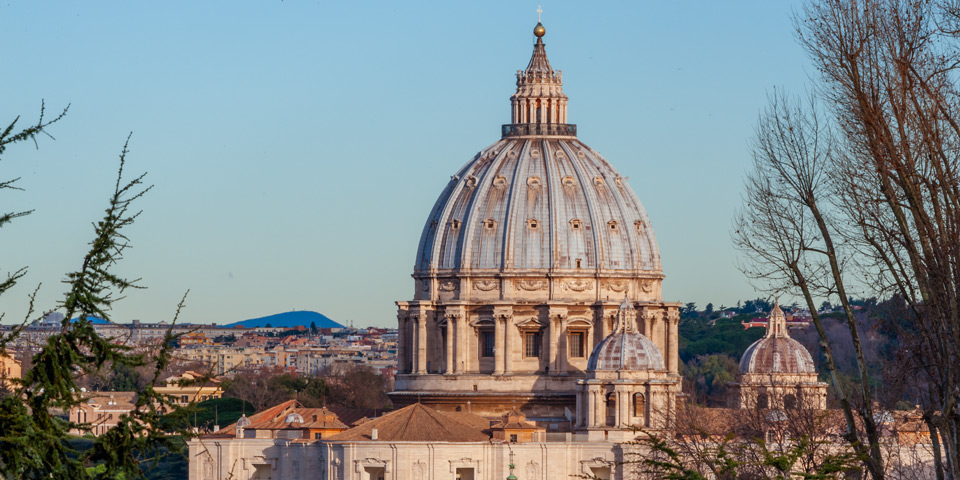
The close-up above comes from the main terrace. Before leaving, walk behind the statue to the opposite edge of the piazzale.
Between the umbrella pines, a second, much narrower view opens up — St. Peter’s again, but framed low and close through branches rather than against open sky. There is no sign or formal photo point, just a low wall in the shade where the trees happen to line up with the dome. Reaching it costs nothing and takes about thirty seconds of walking.
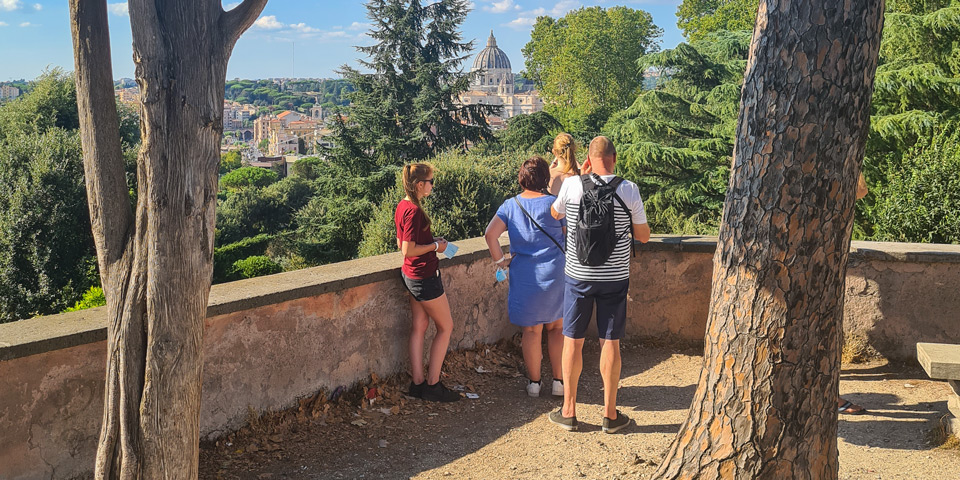
Come for the noon cannon, the statue, or the wide skyline from the main terrace. Before you leave, cross the square and let the pines turn St. Peter’s dome into the final frame.
Rome.us © 2026. Created with love by Roman experts and guides.