

28421 views
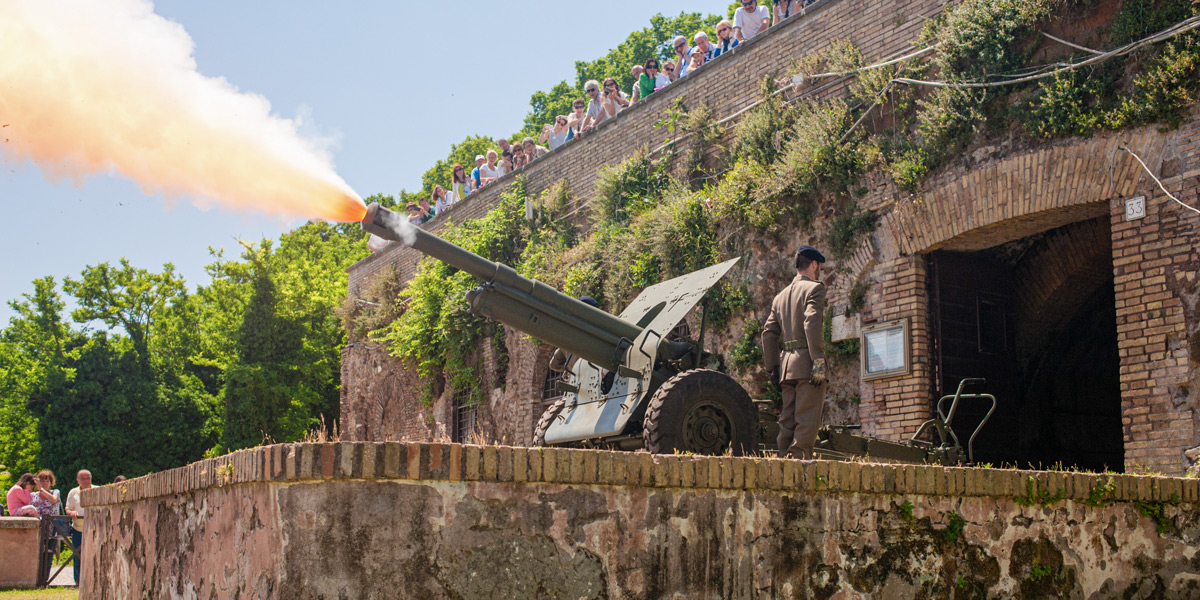
Every day in Rome, at exactly twelve o’clock noon, an army cannon fires a single blank round from the top of the Janiculum hill. The sound rolls across the whole historic center — you can hear it from the Vatican, from Trastevere, all the way to the Esquiline on a still day — and for a second the pigeons come off the roofs. Then the city keeps going. This has happened, with only one long interruption for the Second World War, since 1 December 1847. It is the oldest continuously performed public ritual in Rome, and the last living use of a real artillery piece in the city center.
This is a guide to what actually happens at Il Cannone del Gianicolo, why the tradition exists at all, and — from someone who once made the mistake of standing too close — where you should and should not stand when the gun goes off.
The tradition started as a fix for a very Roman problem. In the mid-nineteenth century, every parish in Rome rang its own bells for the Angelus at midday, and they never agreed. The city had hundreds of churches, hundreds of clocks, and — since each was slightly off from every other — no such thing as a single moment when it was noon. Priests were late for services. Ordinary business was harder to coordinate. In a papal capital where the Angelus mattered, this had become slightly embarrassing.
Pope Pius IX signed off on the solution on 1 December 1847: at the stroke of twelve, a cannon would fire from a fixed high point in the city, and every church in Rome would ring its bells the moment they heard it. That first cannon fired from Castel Sant’Angelo, on the right bank of the Tiber.
The signal that told the gunner exactly when to fire is a story on its own. The astronomers at the Roman College observatory measured true solar noon from their instruments, and to relay it across the city they mounted a six-meter pine pole on the roof of the church of Sant’Ignazio next door. A wicker basket holding a black ball was raised up the pole in the morning; at solar noon they let it drop. A soldier at Castel Sant’Angelo, watching through a spyglass across the rooftops, saw the basket fall and pulled the lanyard. Two clocks and a basket on a pole synchronized the whole city.
The cannon fired from Castel Sant’Angelo until August 1903. It was then moved briefly to Monte Mario, north of the Vatican, and finally — on 24 January 1904 — installed on the Janiculum, directly beneath the statue of Giuseppe Garibaldi, where you find it today. The choice was deliberate: the Janiculum is higher than any of the classic seven hills, and its terrace faces east across the Tiber toward the historic center, so the sound of the blast rolls out over Rome instead of being trapped behind buildings.
The gun has fallen silent only once in the century-plus since. During the Second World War it was replaced by an air raid siren for reasons of public order, and stayed silent afterward for fifteen years. On 21 April 1959 — the 2,712th anniversary of the founding of Rome — the cannon was fired again for the first time since the war, and has fired every noon since.
The cannon on the Janiculum is not a museum piece. It is a working Italian Army field howitzer — an OTO Melara Model 56, 105 mm caliber, the same pack howitzer issued to Italian mountain artillery regiments in the second half of the twentieth century — and it is operated by a formal five-man army crew in uniform, from the Reggimento Addestrativo del Comando Artiglieria.
The gun you see today is the fourth or fifth in the line. When the tradition moved to the Janiculum in 1904, the piece installed here was one of the actual 75 mm field guns that had fired on 20 September 1870 to open the Breccia di Porta Pia — the breach in the walls through which the Kingdom of Italy took Rome from the papacy and made it the national capital. That gun is now in the Artillery Museum in Turin. It was replaced in 1932 by a 149 mm howitzer captured from Austria-Hungary in the First World War, and finally by the current Model 56 on 2 February 1991. In other words, three of the four cannons that have fired the Roman noon have themselves been trophies or veterans of the wars that made modern Italy.
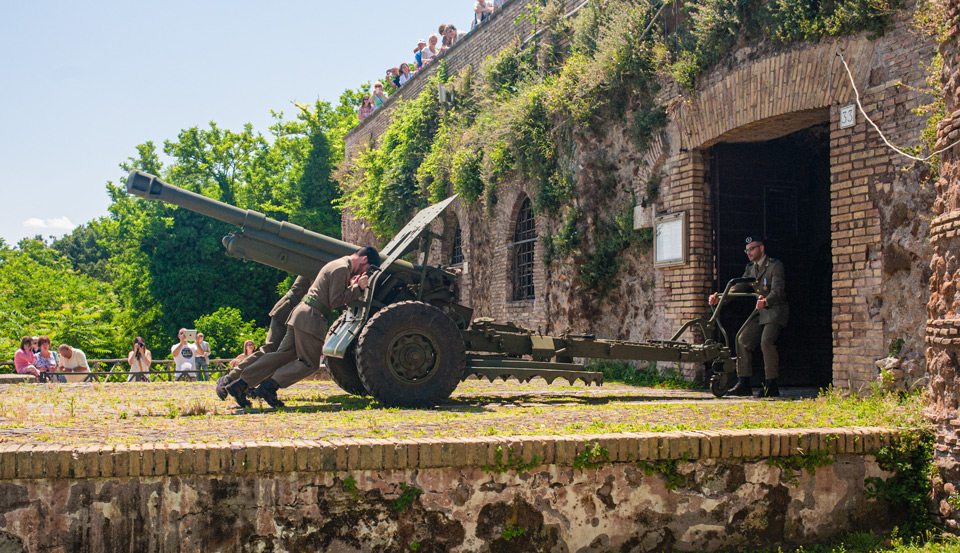
The crew rolls the gun out of the small brick casemate built into the hillside — you can see the arched doorway marked 33 behind it — sets it on its firing platform, loads a blank cartridge, and fires on the second. The barrel points east, out across the Tiber toward the historic center, so the muzzle blast rolls straight down into the city. That is why you hear it so clearly from three kilometers away.
The round itself is a blank: no shell, no projectile, only the propellant charge. The noise is real, though. It is loud enough to set off car alarms on the streets below.
This is the part of the visit that guidebooks skip and that I learned the hard way.
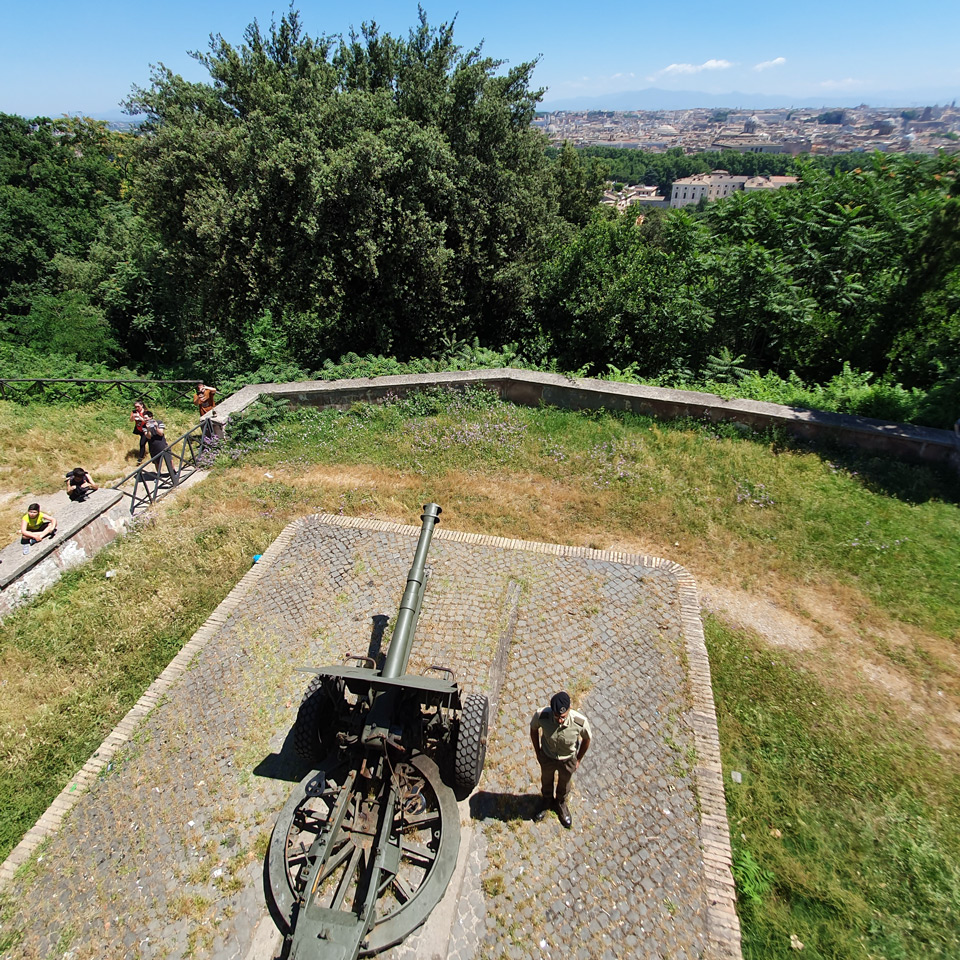
There are two levels. The upper terrace, along the parapet above the gun, is where almost everyone should watch from. You look down onto the cannon from above, you see the flash clearly, you get the whole view of Rome as a bonus, and you keep your hearing. The lower platform, next to the gun itself, is technically open to the public — no rope, no guard turning you back — but you should not stand there for the firing. The muzzle blast at that distance is a physical shove, and the pressure wave hits before you have time to react.
The first time I photographed the noon shot from below, I forgot to plug my ears. My ears rang for hours. Do not do this. Watch from the upper terrace.
The upper terrace fills up. Not tourist-crush levels, but enough that at ten minutes to noon the front row of the parapet is already taken. If you want a clean line of sight and a chance at a photograph of the flash, get there at least fifteen minutes early. Twenty is safer in high season. There is shade from the umbrella pines behind the parapet, so waiting is not unpleasant even in July.
After the shot, stay for another five minutes. The crew rolls the gun back into the casemate in a quiet, methodical routine — no music, no ceremony, just uniformed soldiers putting a piece of army equipment away — and it is honestly one of the more interesting parts of the visit. It reminds you that this is not a re-enactment. It is a real army detail, performed every day.
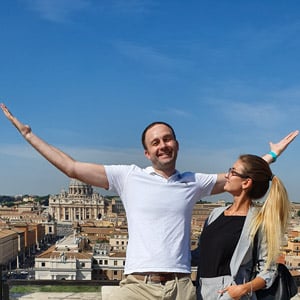
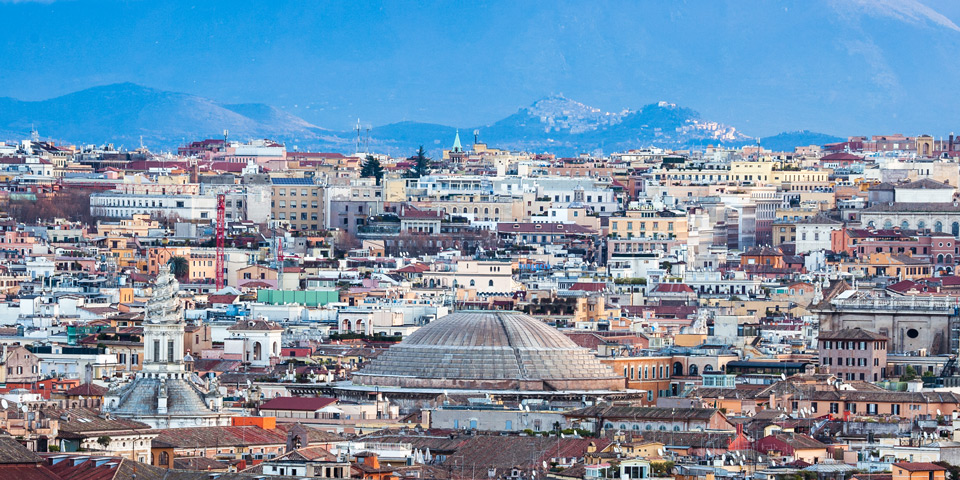
The noon cannon is the reason to come at noon, but it is not the reason to come to the Janiculum at all. The hill has one of the finest free panoramas in the city. From the parapet where you watch the cannon fire, the whole historic center opens out below you: the dome of the Pantheon just to your left, the Vittoriano’s white marble bulk in the middle distance, the Pantheon low and easy to miss between the roofs, the twin bell towers of Trinita dei Monti above the Spanish Steps further to the right, and — on a clear day — the Sabine hills closing the horizon.
The Fontana dell’Acqua Paola, the enormous Baroque fountain the Trevi was later modeled on, is a two minute walk south from the cannon terrace. Combined with the noon firing, the fountain, and the walk along the ridge to Piazzale Garibaldi with its equestrian monument, the whole Janiculum can be done in a slow ninety minutes and costs nothing at all.
The Janiculum is not on the metro. Two easy public options: bus 115 from Piazza Trilussa in Trastevere climbs directly to the cannon terrace, and bus 870 from Largo di Torre Argentina comes up the other side of the hill. If you would rather walk, follow Via Garibaldi uphill from Trastevere — about twenty minutes at a steady pace on a hot day. From central Rome, plan on around forty to fifty minutes of total travel time, including the walk from your bus stop to the parapet. That means leaving the Trevi Fountain by 11:00 at the latest if you want to be there in time for noon.
There is no ticket, no admission, no reservation. The cannon fires whether one person is watching or a hundred. On weekdays outside the summer season you may find yourself with fifteen or twenty other people at most; on a Saturday in June the terrace is comfortably full but not oppressive.
One warning about the time. The cannon fires at exactly 12:00, not “around noon” — the Italian Army times it to the second by satellite clock. If you arrive at 12:01, it is already over. Do not gamble on being close.
Yes — with the honest note that this is a five-second event you traveled forty-five minutes for. If the appeal of that trade doesn’t grab you, skip it and go to lunch.
But almost everyone I’ve sent up here comes back with the same reaction: they didn’t expect to like it as much as they did. It is not the flash itself, which is over before you can compose a photograph. It is the whole small ceremony — the crew in olive uniforms, the quiet minutes before the shot, the sudden physical bang of the gun, the pigeons coming off the trees, the view of Rome laid out below with a curl of smoke drifting away from the muzzle, and then the same soldiers calmly rolling the howitzer back into a brick casemate as if nothing had happened. It costs nothing, it happens every single day, and it is one of the few things in Rome that has not been arranged for tourists — Romans keep this ritual for themselves, and you are simply allowed to watch.
Bring a hat in summer. Get here at 11:45. Stand on the upper terrace. And when the gun fires, notice how long it takes the sound to reach the rooftops below you — that delay, three kilometers of Rome between the barrel and the far side of the Tiber, is the whole point of why the cannon is up here and not down there.
Rome.us © 2026. Created with love by Roman experts and guides.