

28341 views
Most visitors to Rome never set foot in the Baths of Diocletian, and that is exactly why you should. It sits a two-minute walk from Termini station, hidden in plain sight, while the crowds pour into the Colosseum and the Vatican.
Step inside and you often have the place nearly to yourself: quiet cloisters, a garden full of colossal marble heads, and one of the finest collections of ancient sculpture in the city, with almost no queue and no crush. Every photograph on this page was taken in broad daylight, in the middle of the day, in rooms that would be shoulder-to-shoulder anywhere else in Rome. If you care about ancient history and sculpture, you can happily lose two hours here.
This is a walk through what you actually see, from the ancient ruins to the museum’s greatest pieces.
To understand what you’re looking at today, you have to picture what stood here seventeen centuries ago. The Baths of Diocletian were the largest public baths ever built in ancient Rome, bigger even than the famous Baths of Caracalla. Commissioned by the emperors Diocletian and Maximian and finished in just eight years, between 298 and 306 AD, they sprawled across some thirteen hectares — roughly the footprint of a small neighborhood — and could hold around 3,000 bathers at once.
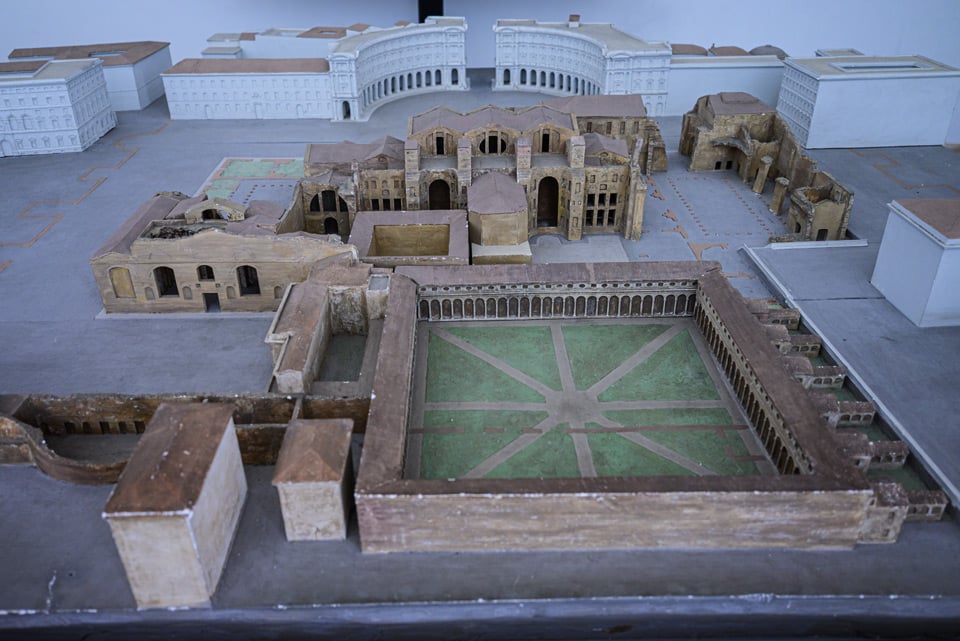
A Roman bath was never just about getting clean. It was the social center of the city, somewhere between a spa, a gym, a library, and a public square. Bathers moved through a fixed sequence of rooms — the frigidarium with its cold pool, the warm tepidarium, and the hot caldarium — alongside exercise grounds, gardens, and reading rooms. Water arrived through a dedicated branch of the Aqua Marcia aqueduct and collected in a huge cistern near what is now Termini station, which still takes its name from these thermae.
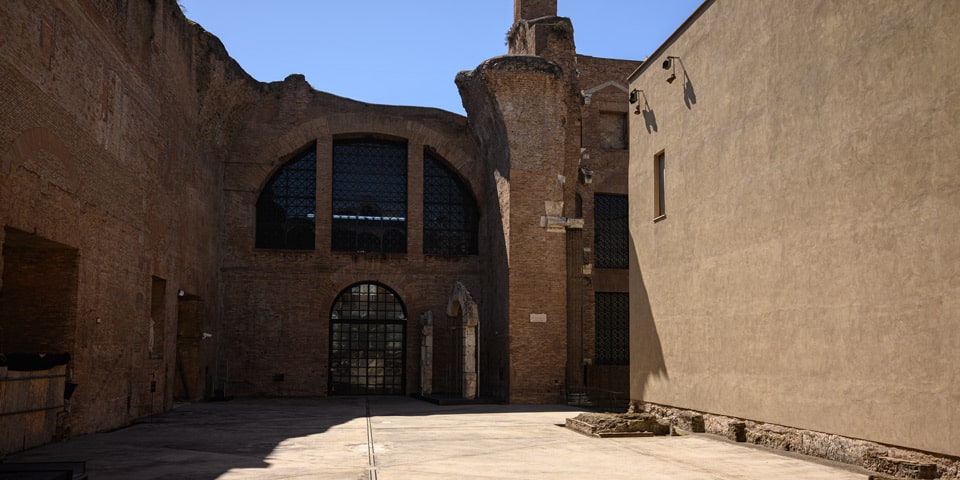
The baths stayed in use for more than two centuries, until 537 AD, when the Gothic armies besieging Rome cut the aqueducts and the water stopped flowing. Without water, the baths were finished. The vast complex fell into ruin and was gradually quarried, built over, and absorbed into the growing medieval city. What survives today is not a single ruin but a scatter of fragments reused across the centuries — a church, a museum, a cloister, and open stretches of ancient brick — and the trick to enjoying the visit is knowing how the pieces once fit together.
The largest surviving room of the baths is not a ruin at all: it is a working church. In 1561, Pope Pius IV asked the aging Michelangelo to convert the vast central hall of the baths, the frigidarium, into a basilica. Rather than hide the Roman structure, Michelangelo built inside it, keeping the soaring vaults and the colossal columns of red granite exactly where the ancient builders had placed them.
The result, Santa Maria degli Angeli e dei Martiri, is one of the most extraordinary interiors in Rome: an ancient bath hall turned church, its original columns still holding up the roof after more than 1,700 years. It is free to enter, and most people walking past on Piazza della Repubblica have no idea what they are stepping into. It is worth a stop before or after the museum.
The heart of the visit is the Great Cloister, a vast square courtyard ringed by an elegant colonnade and traditionally attributed to Michelangelo, who is thought to have designed it near the end of his life. Built as part of the Carthusian monastery that took over the ruins in the 16th century, it is one of the largest cloisters in Italy, and today it works as an open-air gallery: hundreds of ancient sculptures, columns, and fragments arranged around a green garden of box hedges and tall cypresses.
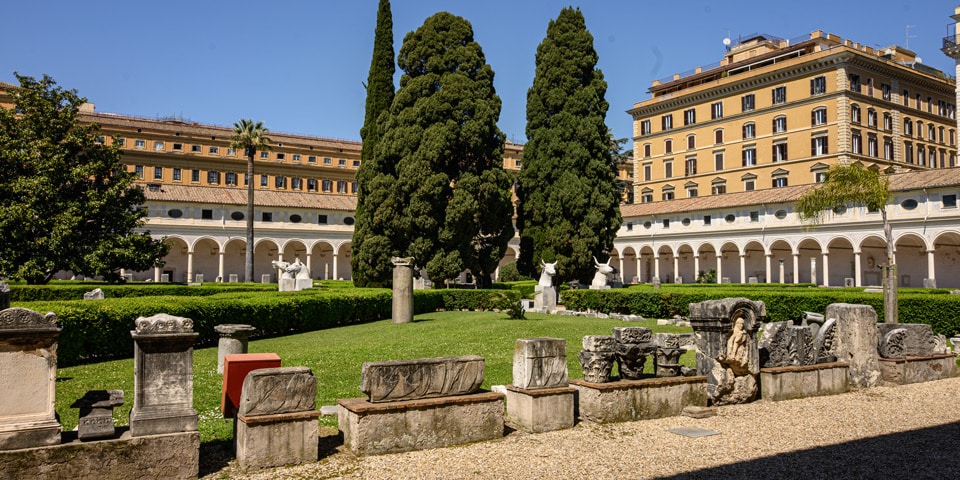
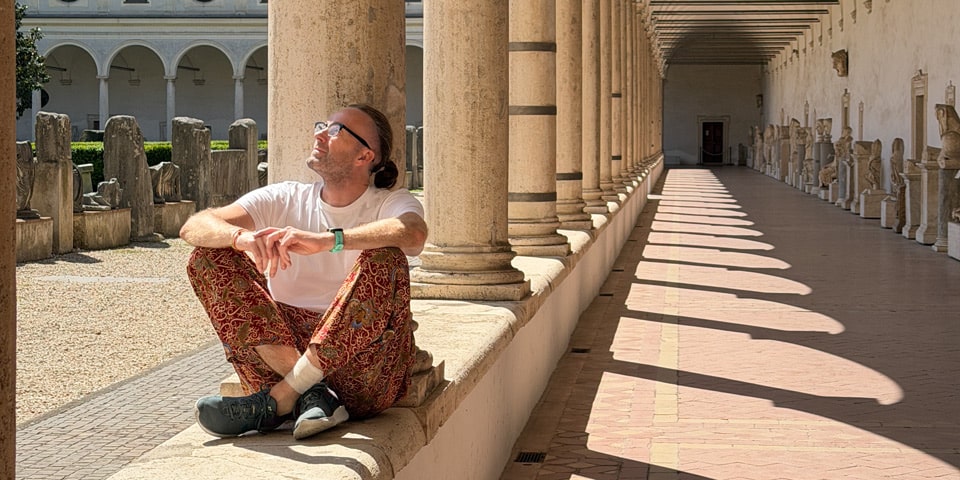
It is the calmest corner of the whole complex. Sit on a bench in the shade of the colonnade, with the sun moving across the gravel and the marble, and you understand what the place is for. This was a monastery for three centuries, and the monks knew how to build for silence.
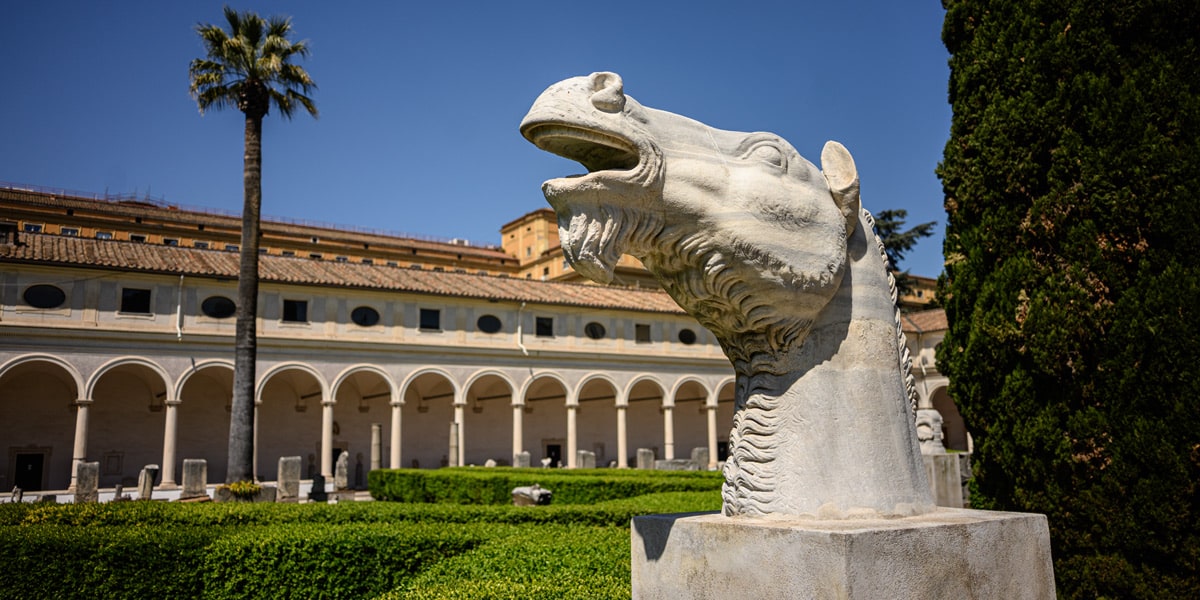
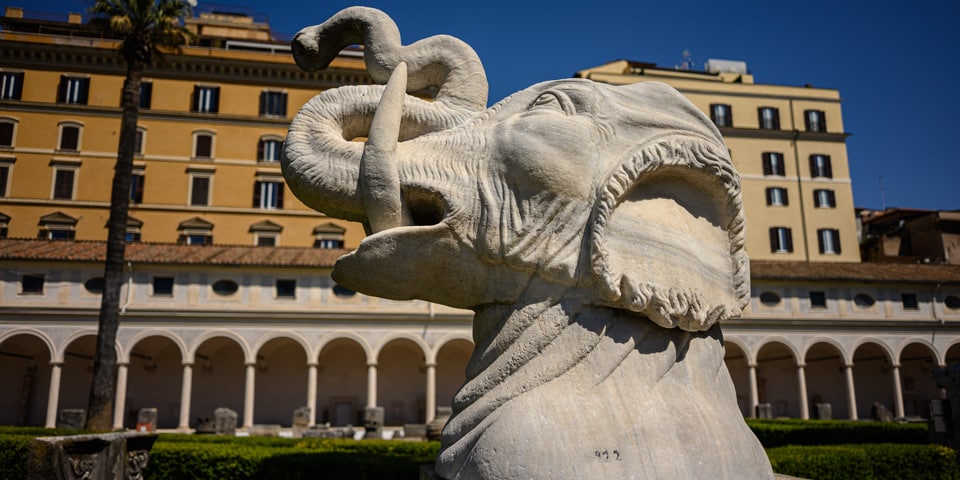
The showpieces of the cloister garden are impossible to miss: a scattering of enormous marble animal heads, each the size of a small car, mounted on plinths among the hedges. A ram, a camel, a horse, a bull, an ox, a rhinoceros, and an elephant stare out over the box hedges, and they are the most photographed things in the whole complex. What almost nobody realizes is that they have nothing to do with the baths, and only some of them are even ancient.
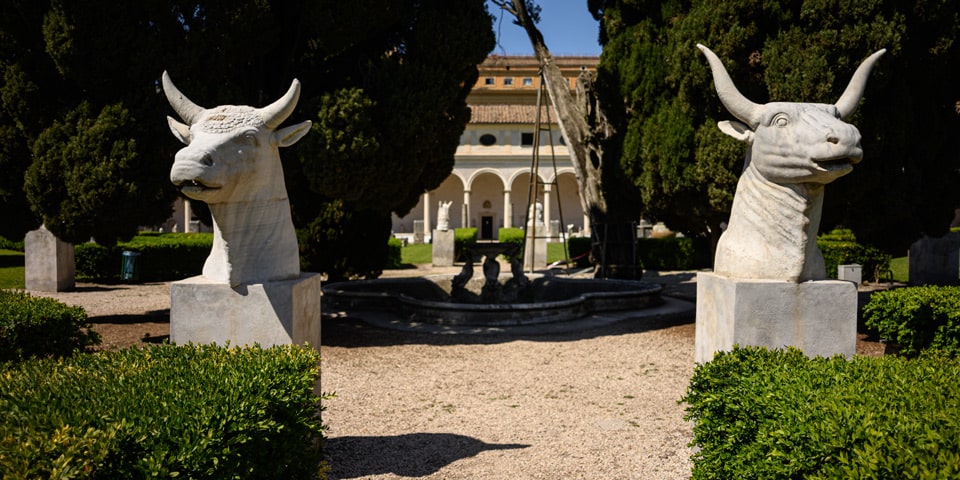
Five of the heads — the ram, camel, horse, bull, and ox — are genuinely Roman, carved for the Forum of Trajan and most likely from the Temple of the Deified Trajan that once stood there. They surfaced in 1586, dug up by accident during building work on a cardinal’s palace near Trajan’s Column. Cardinal Michele Bonelli kept them to decorate his new residence, and there they sat in a private courtyard for nearly three centuries before finally being moved here in the early 1900s and arranged around the garden fountain.
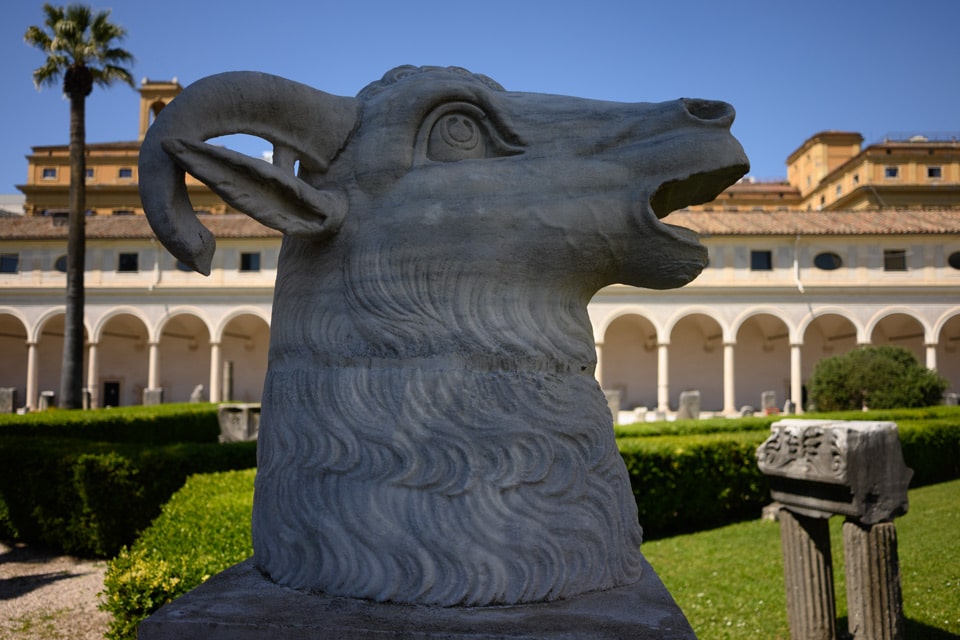
The other two are impostors, and knowingly so. When the cardinal laid out his collection, he wanted more heads than antiquity had supplied, so he had a rhinoceros and an elephant carved to fill the set. Look closely and they give themselves away — the elephant has a serpent coiling up its trunk and a softer, more decorative style that no Roman sculptor would have used. They are Renaissance additions passing themselves off as ancient, and they have been fooling visitors for four hundred years.
At the heart of the garden stands the fountain the heads were arranged around, built in 1695, its basin supported by carved dolphins twisting up toward the bowl. Four cypresses frame it, and one of them — propped up today by an iron support, its trunk hollow with age — is traditionally called the cypress of Michelangelo, said to have been planted while he worked on the basilica in the 1560s. If the story is true, the tree is over 450 years old.
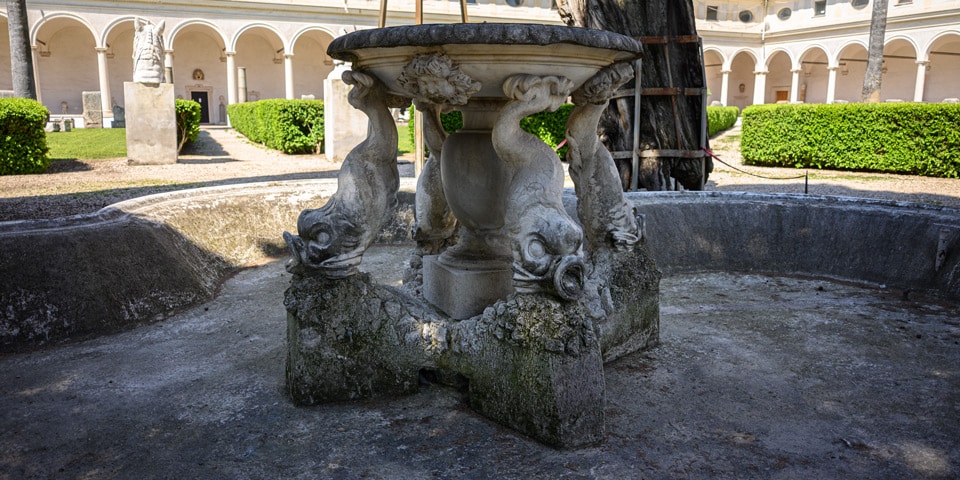
The fountain has seen better days and is often under restoration rather than running, but that hardly matters. With the colossal heads watching over the hedges and the cypresses throwing long shadows across the gravel, the cloister does exactly what it was built to do: it turns the noise of the city off.
The covered walkways that frame the cloister are where the visit slows down and becomes a stroll through time. Running for a hundred meters on each side, beneath a low vaulted ceiling, they are lined end to end with ancient marble: statues, portrait busts, funerary altars, carved urns, sarcophagi, and inscribed slabs, hundreds of pieces in all, arranged against the walls with the garden open to one side.
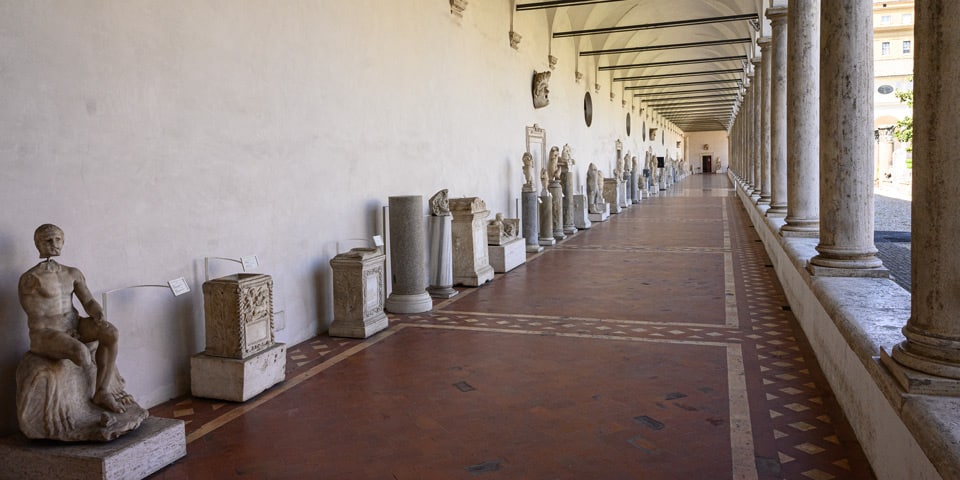
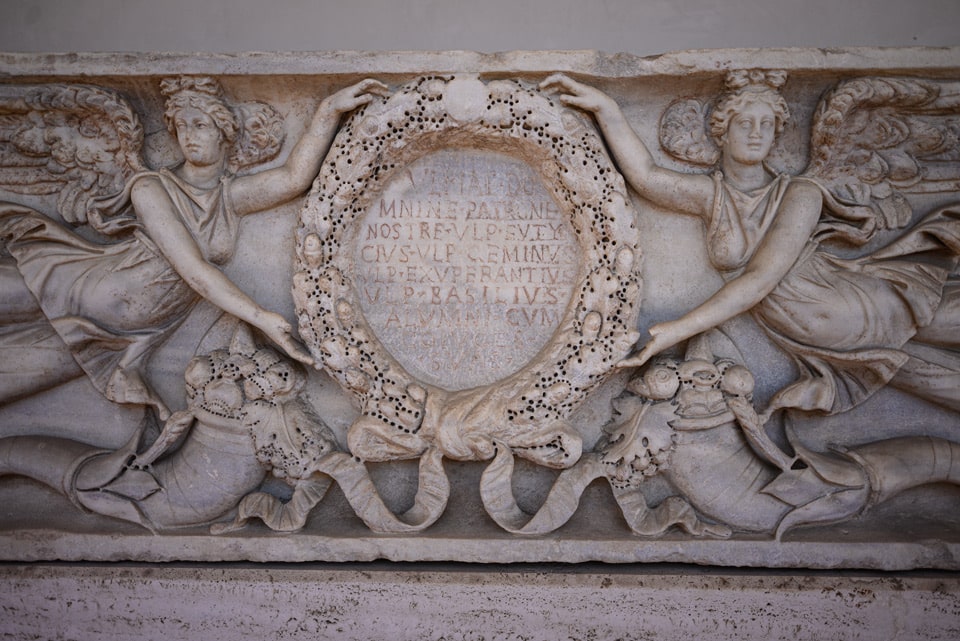
There is no set path and no crowd pressing you along. Much of this material is funerary, gathered from tombs across Rome, and it offers something the grand statues do not: the ordinary voices of ordinary Romans, freedmen and families recording their names in stone in the hope of being remembered. Look closely at pieces like the relief where two winged Victories hold up a wreath framing an inscription — a freedman’s family honoring the patroness who had once freed them. These were people who began life as slaves, earned their freedom, and cared enough about their standing to commission fine marble to mark it.
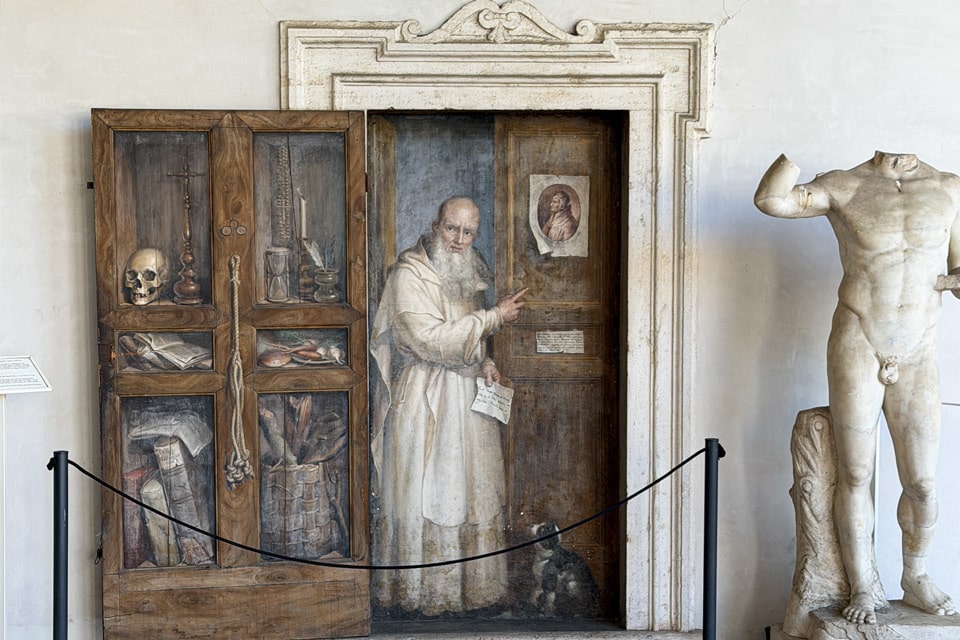
Near the entrance to the cloister, don’t walk past the door with the monk. It looks at first like a real doorway with a white-robed Carthusian leaning out of it, a slip of paper in one hand, a little dog at his feet. It is entirely painted, a trompe-l’oeil by Filippo Balbi from 1885, so convincing that visitors still slow down and look twice. Beside the monk, a painted cupboard holds a skull, an hourglass, a guttering candle, and scattered books, the old symbols of mortality that the monks who once lived here would have understood at a glance.
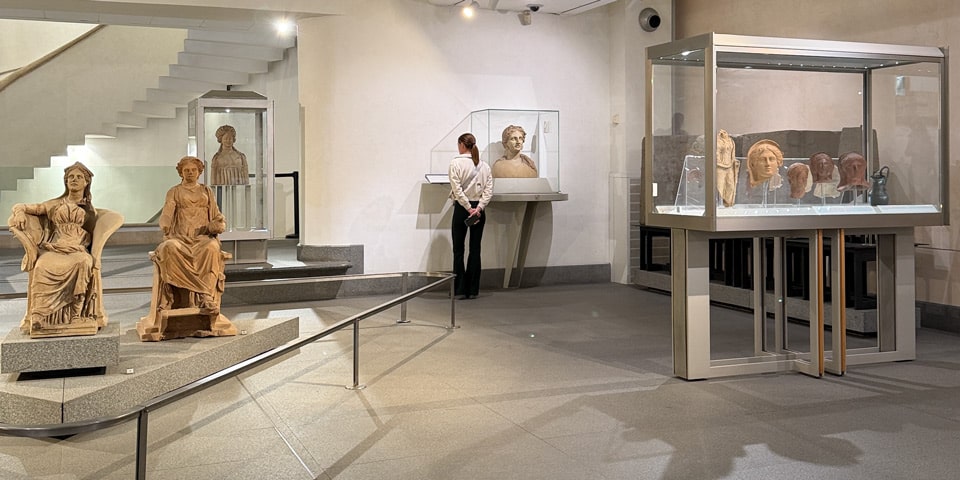
From the cloister, the visit moves indoors into the galleries of the National Roman Museum, which holds finds gathered from across the ancient city. The rooms are calm and well lit, the statues and busts displayed with space to breathe, and, again, rarely crowded.
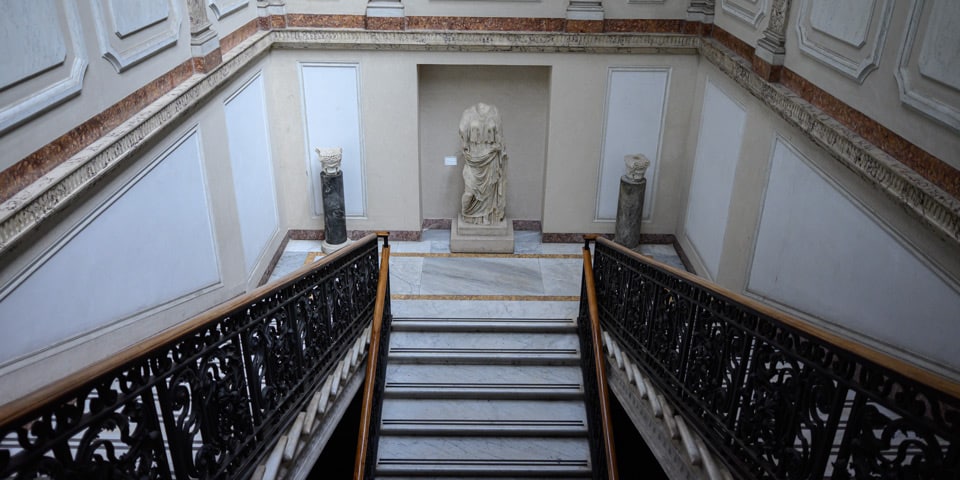
A grand marble staircase with wrought-iron railings leads between the floors, an ancient statue set in a niche at the turn. It is a reminder that this is a museum built inside a former monastery, layers of history stacked one on another.
One of the first pieces to stop you is a Roman floor mosaic with the head of Medusa at its center, snakes writhing in her hair, set in a circular medallion that radiates outward in a fan of colored stone. The craftsmanship is astonishing up close: thousands of tiny tesserae shading her face from pale skin to deep shadow.
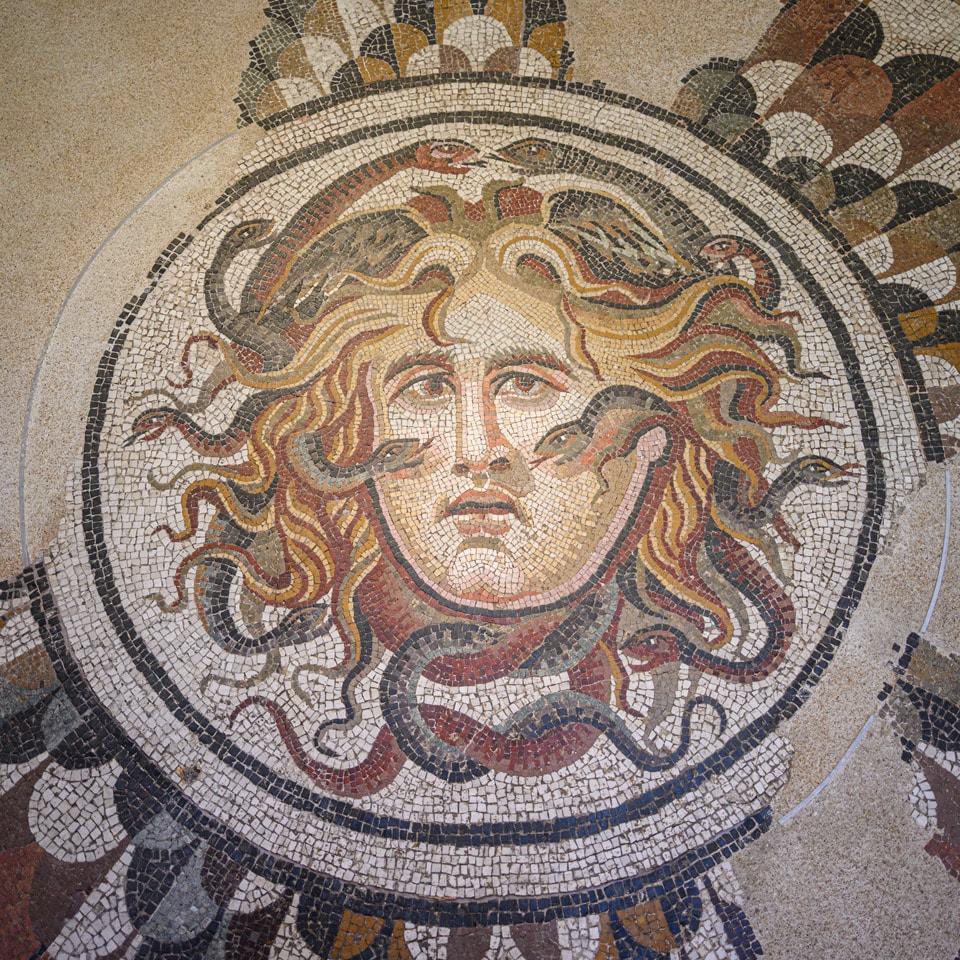
There is a reason a monster guards the floor. To the Romans, the head of Medusa — the Gorgoneion — was a protective charm, an image believed to ward off evil. They placed it on floors, doorways, shields, and armor precisely so that it would turn danger away from whoever passed. Far from decoration, this Medusa was doing a job: guarding the room and everyone who entered it.
Among the museum’s portrait heads is a small group that rewards a second look, not for who they were but for their hair. Roman hairstyles changed constantly with imperial fashion, and those changes are one of the tools archaeologists use to date a sculpture to within a few decades. A hairstyle was practically a timestamp.
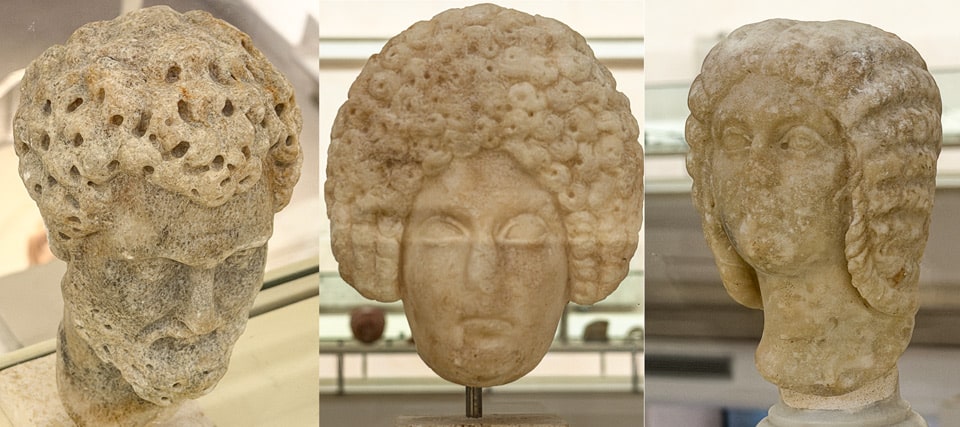
The most dramatic is the towering crown of tight, drilled curls rising in a half-circle above the forehead. This is the signature look of the Flavian era, the late 1st century AD, when aristocratic women piled their hair into a honeycomb of ringlets so tall that the satirist Juvenal joked a woman could look like a towering building from the front and a completely different person from behind. Achieving it took hours, hairpieces sewn in with needle and thread, and the daily work of a trained slave hairdresser called an ornatrix. Earlier, under Augustus, the fashion had been far plainer: hair simply parted in the middle and rolled back. Later, under Trajan and Hadrian, it grew into elaborate braided arrangements and stacked diadems.
The men are a study in contrast. Beside the women’s architectural coiffures, a Roman man’s portrait head keeps its hair short and its beard neat, with none of the same theatrical height. That difference is the whole point. Roman men could signal their rank through their clothing, but women’s dress was simple and told you little, so hair was where a woman’s status showed. A complex, artificial coiffure that clearly required hours of attention and a household of servants was a walking display of wealth and leisure; a plain, natural style was read as poor or provincial. These marble heads are not just faces. They are fashion statements frozen in stone.
One museum piece rewards a longer look than most visitors give it. Behind glass, still carrying traces of its original red paint and gold leaf, is a marble relief showing a young man in a flowing cloak and a soft peaked cap, plunging a dagger into the neck of a bull. This is Mithras, and for a few centuries his cult was one of the most widespread religions in the Roman Empire and a genuine rival to early Christianity.
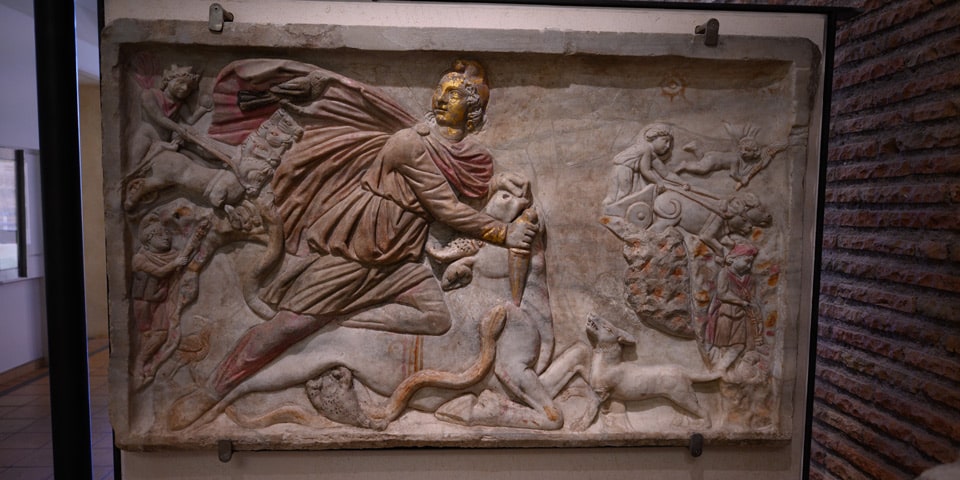
The scene is called a tauroctony, the bull-slaying, and it appeared at the heart of every temple of Mithras. Around the central figure you can pick out the supporting cast that always accompanies him: a dog and a snake lunging at the wound, a scorpion below, a raven, and the twin torch-bearers standing to either side. The killing was a symbolic, cosmic act — the death of the bull was thought to release life into the world — not a real sacrifice the worshippers performed. This particular relief comes from a mithraeum, an underground temple, that lay beneath the nearby basilica of Santo Stefano Rotondo, and it dates from the end of the 3rd century AD.
Mithraism spread fastest through the Roman army. Soldiers carried it to the frontiers of Britain, the Rhine, and the Danube, and it offered its followers secrecy, seven grades of initiation to climb, a shared ritual meal, and the promise of something beyond death — much of it strikingly close to what the early Christians were offering at the same moment. But it carried one fatal limitation: it was a men-only cult. Women were never admitted, and its appeal stayed narrow. Christianity welcomed everyone — men and women, rich and poor, slave and free — and that openness was decisive. When the empire turned Christian in the 4th century, the temples of Mithras were closed and often built over, sometimes literally, with churches raised directly on top of them.
Not every god worshipped in Rome was Roman. Among the sculptures stands a graceful marble figure of a woman in a fringed cloak knotted across her chest, her hair in long ringlets, a small crown on her head. She is Isis, an Egyptian goddess who became one of the most beloved deities in the Roman world.
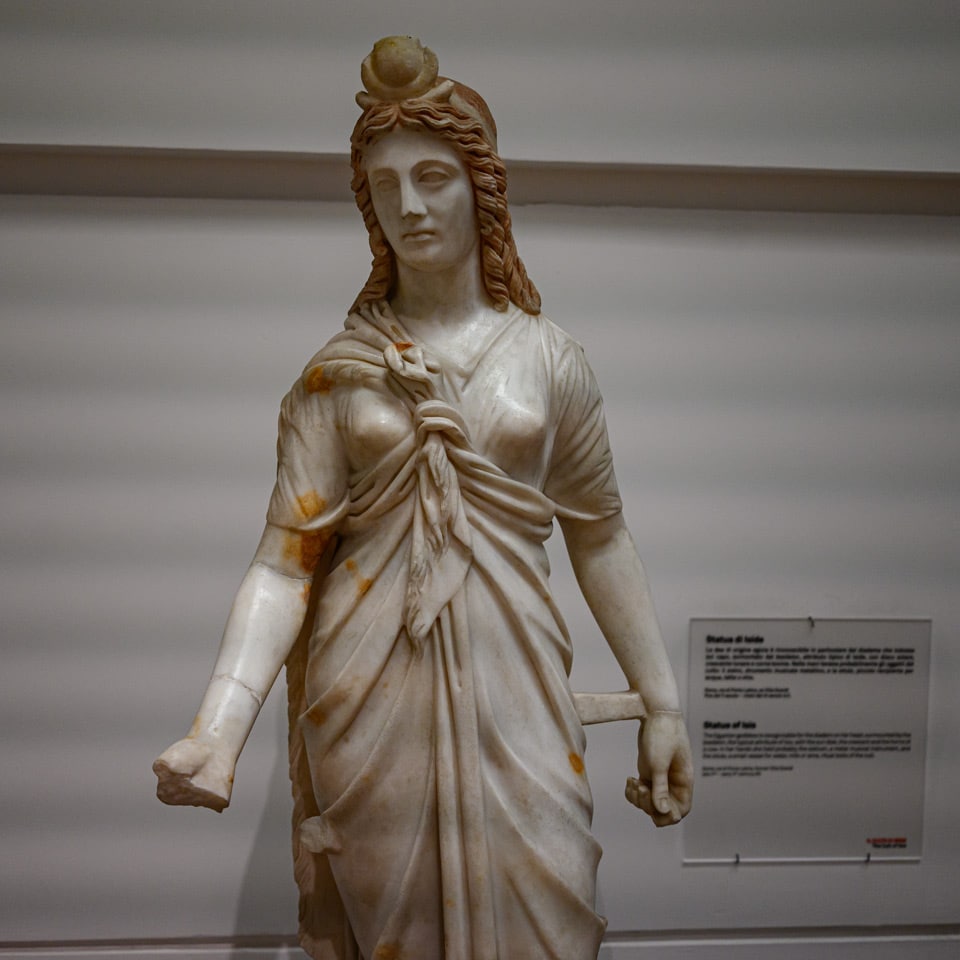
You can recognize her by the details. On her head sits the basileion, a crown of a sun disk framed by cow’s horns and a crescent moon, her signature attribute. In her hands she once held the tools of her cult: a sistrum, a metal rattle shaken during worship, and a situla, a small vessel for sacred water, milk, or wine. This statue came from a site on the Via di Porta Latina and dates from the late 2nd or early 3rd century AD.
The cult of Isis reached Rome from Egypt, where she had been worshipped since the 4th millennium BC. She was a goddess of motherhood, healing, and salvation beyond death — she had, after all, restored her murdered husband Osiris to life. That promise of eternal life gave her enormous appeal, and by the mid-1st century BC her cult had entered official Roman religion. In 43 BC the ruling triumvirs — including the future emperor Augustus — built her a great temple in the Campus Martius, the Iseum Campense.
That temple leaves a trace across Rome that most visitors walk straight past. The Egyptian obelisks scattered around the city, including the small one carried by Bernini’s marble elephant near the Pantheon, originally stood at this sanctuary of Isis. And the nearby church of Santa Maria sopra Minerva carries its name by mistake: it was built over the ruins of the Iseum, but medieval Romans wrongly credited the temple to the goddess Minerva, and the error stuck.
Beyond the great cloister lies a second, smaller courtyard, quieter and more intimate, its walkways lined with marble busts set against plain white walls, a single lemon tree at its center.
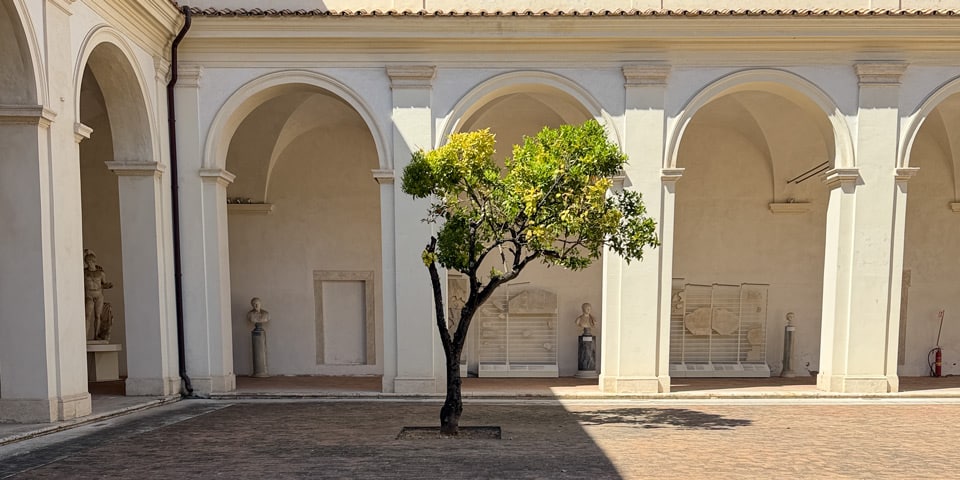
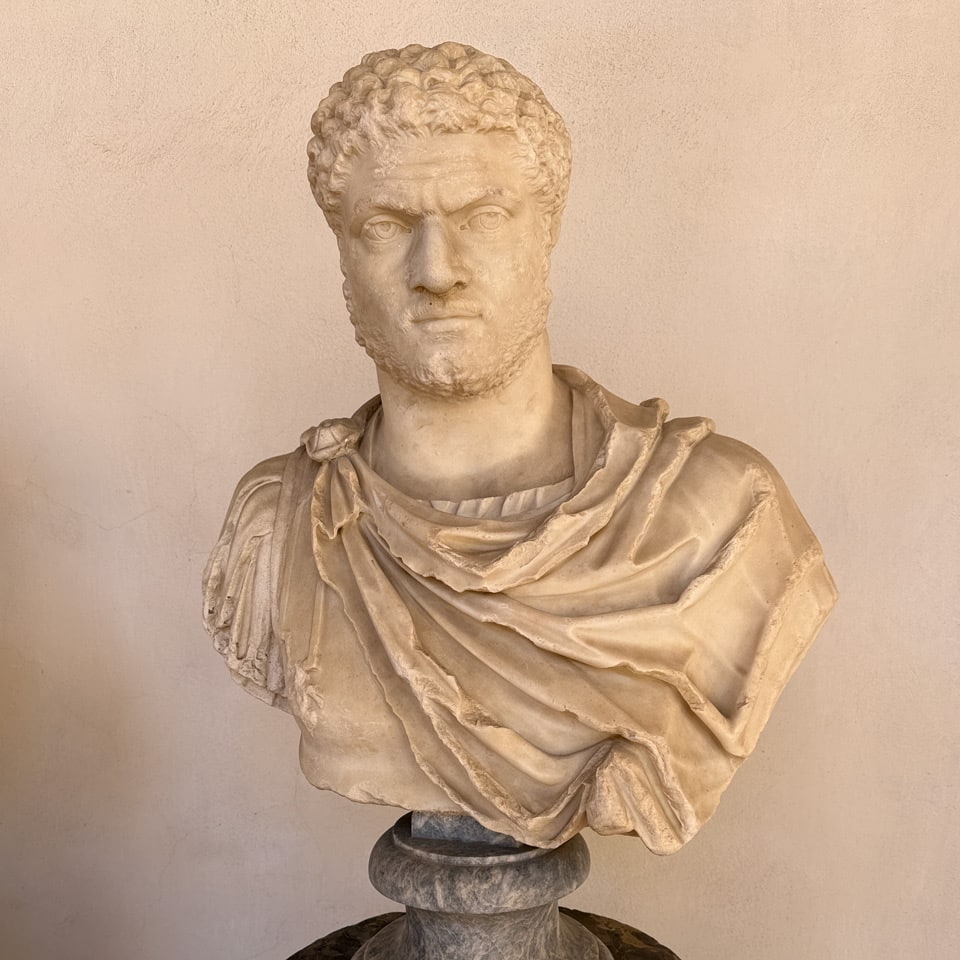
Two portraits here are worth seeking out. The first is a bust of the emperor Caracalla, carved between 209 and 211 AD and found in the House of the Vestals on the Roman Forum. There is a reason it stops people. Most imperial portraits flatter, showing calm, idealized rulers. This one shows a man scowling, brow furrowed, head turned sharply, radiating suspicion and menace. It is deliberate: Caracalla wanted to be seen as a hard soldier-emperor, and shortly after this was carved he murdered his own brother Geta to rule alone. He is also the emperor who built the other great bath complex in Rome, the Baths of Caracalla, which makes his presence in the museum of the Baths of Diocletian a fitting coincidence.
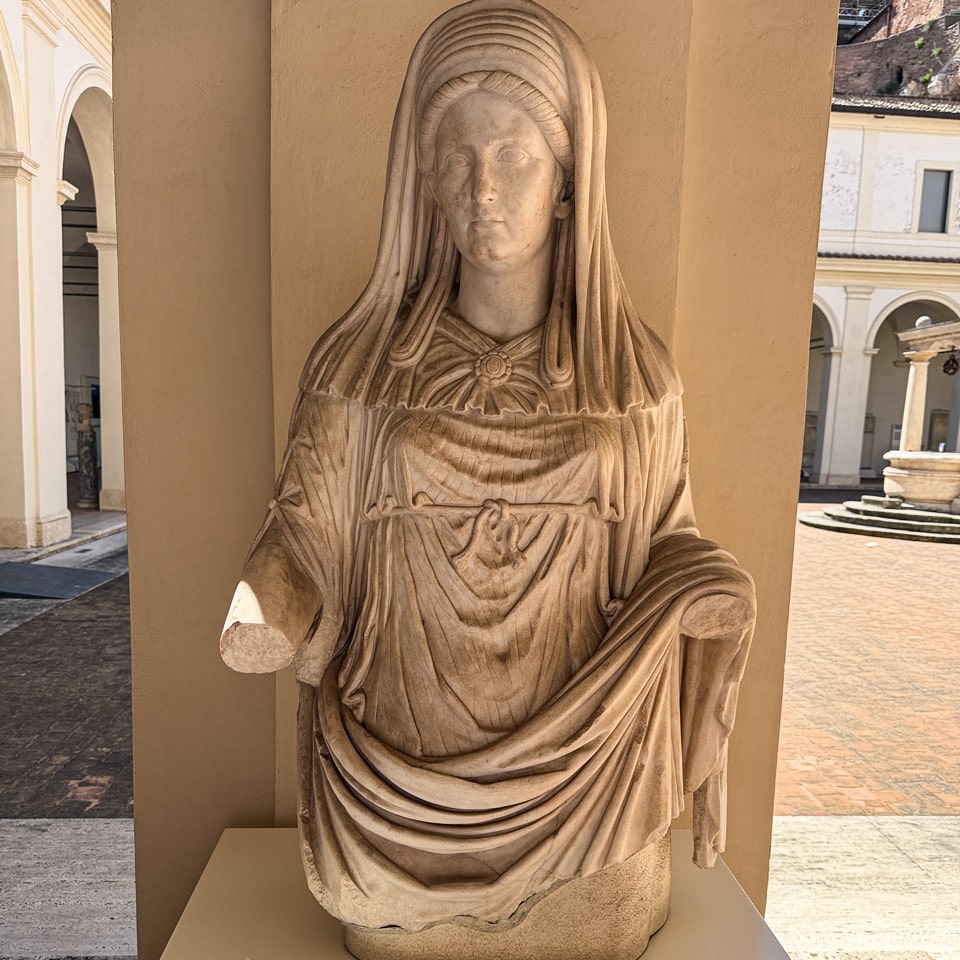
Nearby stands a statue of a very different Roman figure: a Vestalis Maxima, the chief of the Vestal Virgins, veiled and wearing a turreted crown.
The Vestals were the most respected priestesses in Rome, charged with keeping the sacred flame of the goddess Vesta burning at the heart of the Forum. They took a thirty-year vow of chastity, and in return enjoyed privileges no other Roman woman had — they could own property, make a will, and sit in the best seats at the games. Breaking the vow was punished by being buried alive. This statue, from the 2nd century AD, also came from their residence on the Forum, the House of the Vestals.
One sarcophagus in the collection is worth stopping at for the detail alone. Carved around 270 AD, its front is a crowded countryside scene: shepherds among trees and buildings, horses, cattle, and sheep worked in deep, confident relief. Standing beside it gives you the scale, a single block of marble as long as a person is tall.
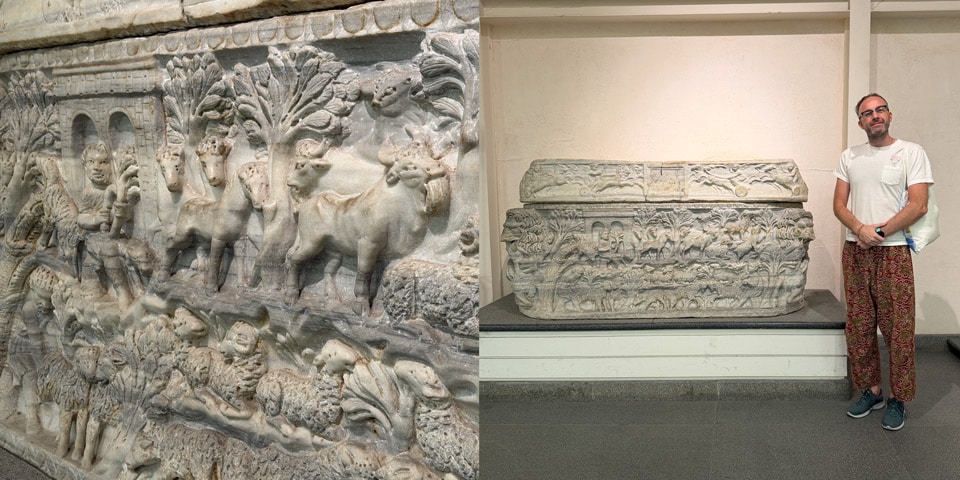
The inscription records who lay inside: a man named Iulius Achilleus, honored by his wife. He had held the rank of vir perfectissimus and run an office in the imperial chancellery before ending his career as superintendent of the Ludus Magnus, the great gladiator barracks beside the Colosseum. Like much of the collection, the piece was found elsewhere in Rome, near the Baths of Caracalla, and gathered into this museum, which draws finds from across the ancient city under one roof.
If you see one sculpture in the museum, make it this one. A near life-size marble group shows the god of war and the goddess of love standing side by side: Mars in a plumed helmet and sword-belt, Venus leaning in close against his shoulder, one hand resting on him. It is tender and strange at once, the hard soldier and the goddess of desire caught in a moment of intimacy.
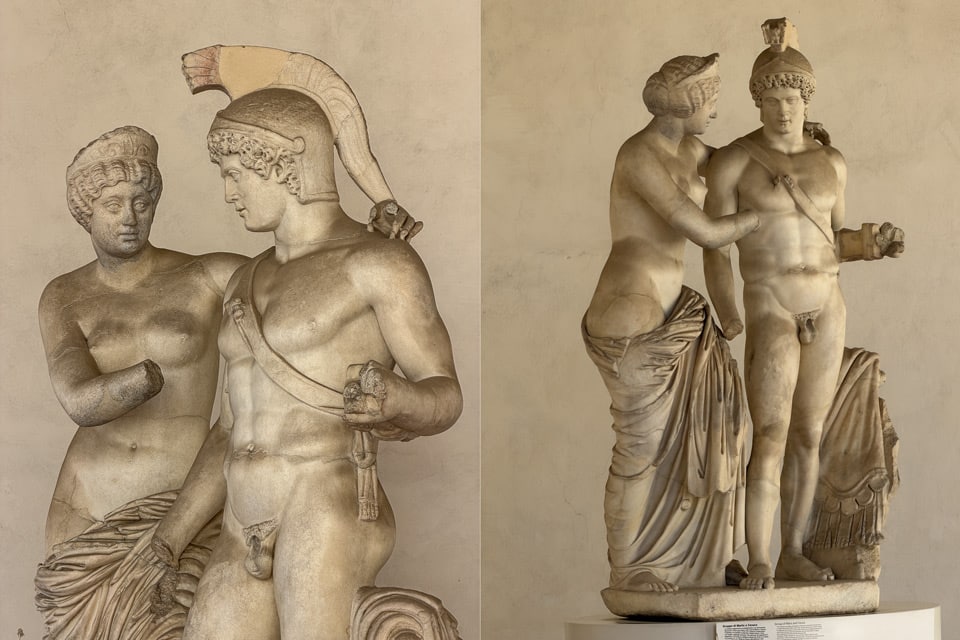
But look closer and the twist appears. These are not really the gods. The faces are portraits of a real Roman couple, a husband and wife who had themselves carved as Mars and Venus around 170 AD. This was a Roman fashion: wealthy families would commission portraits of themselves in the guise of gods, borrowing divine bodies to flatter their own. The sculptor worked from famous models, giving the man the body of the celebrated Ares Borghese statue and the woman that of the Aphrodite of Capua, then swapping in the couple’s own faces. The group probably crowned their funerary monument in Ostia, Rome’s port city, a permanent declaration that their marriage was as perfect as that of the gods.
There is something very human under the mythology. Two ordinary people, rich enough to afford the best sculptors of their day, wanted to be remembered not as they were but as they wished to be seen: beautiful, powerful, and eternally in love. Eighteen centuries later, standing in front of them, you are doing exactly what they hoped for. You are remembering them.
The baths are not a dead monument. Their vast ancient halls are regularly given over to temporary exhibitions of contemporary art, and there is a real thrill in seeing a modern installation suspended inside two-thousand-year-old brick walls, the old and the new sharpening each other.
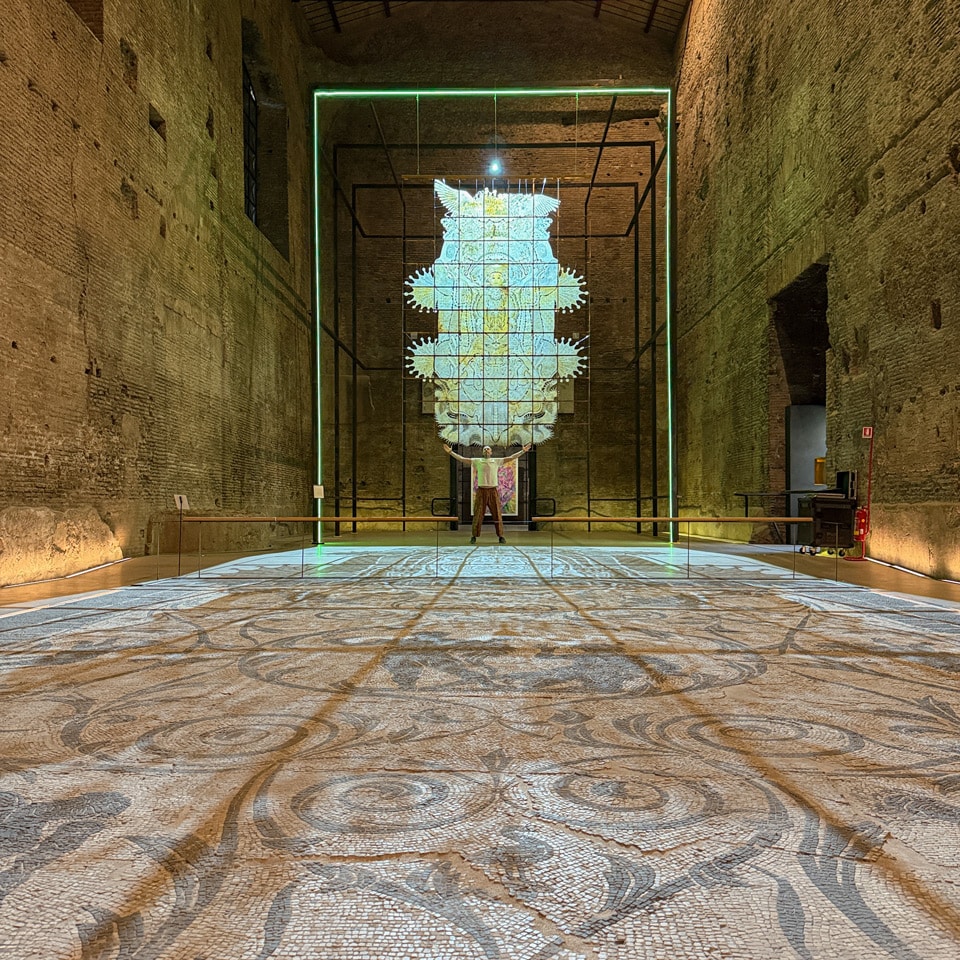
Whatever happens to be showing when you visit, the setting alone justifies the detour into these larger halls. It is a reminder that this place has been reinvented over and over — tomb of a bathing culture, monastery, museum, gallery — and is still being reinvented now.
Yes, and for a specific kind of traveler especially. If you love ancient sculpture and Roman history, this is one of the best-value, lowest-stress visits in the city: a great collection, a beautiful Michelangelo cloister, and room to breathe, all a two-minute walk from Termini. If you are racing through Rome in a single day and don’t care much for museums, it will matter less to you than the headline sights, and that is a fair call.
Budget around two hours. And here is the practical tip that makes the visit even better value: your ticket to the Baths of Diocletian is a combined ticket for the National Roman Museum, valid for a week and covering three other sites — Palazzo Massimo directly across the street, home to the finest collection of Roman frescoes and mosaics in the world; Palazzo Altemps near Piazza Navona; and the Crypta Balbi (currently closed for works). Two, even three, world-class museums on one ticket, and all of them far quieter than the crowds fighting for space at the Colosseum. For anyone who wants to actually look at ancient Rome rather than queue for it, that is hard to beat.
Rome.us © 2026. Created with love by Roman experts and guides.