

31072 views
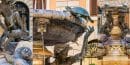
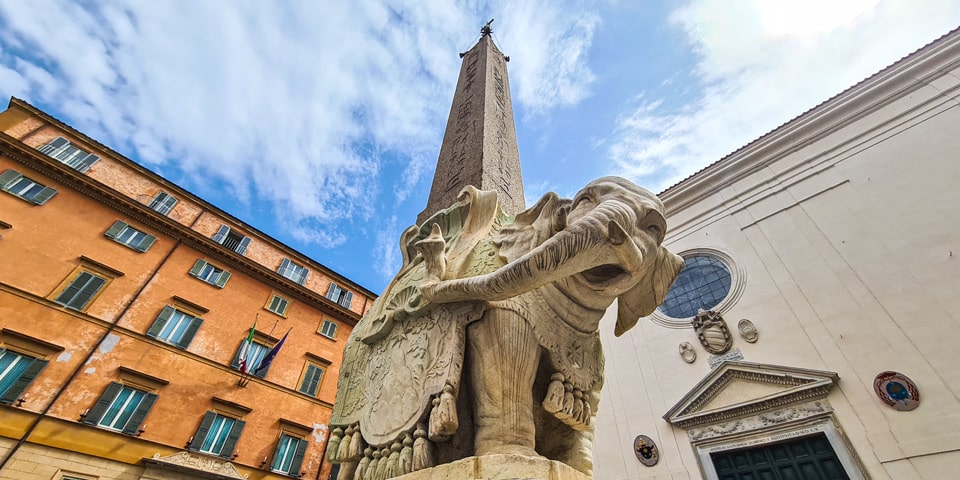
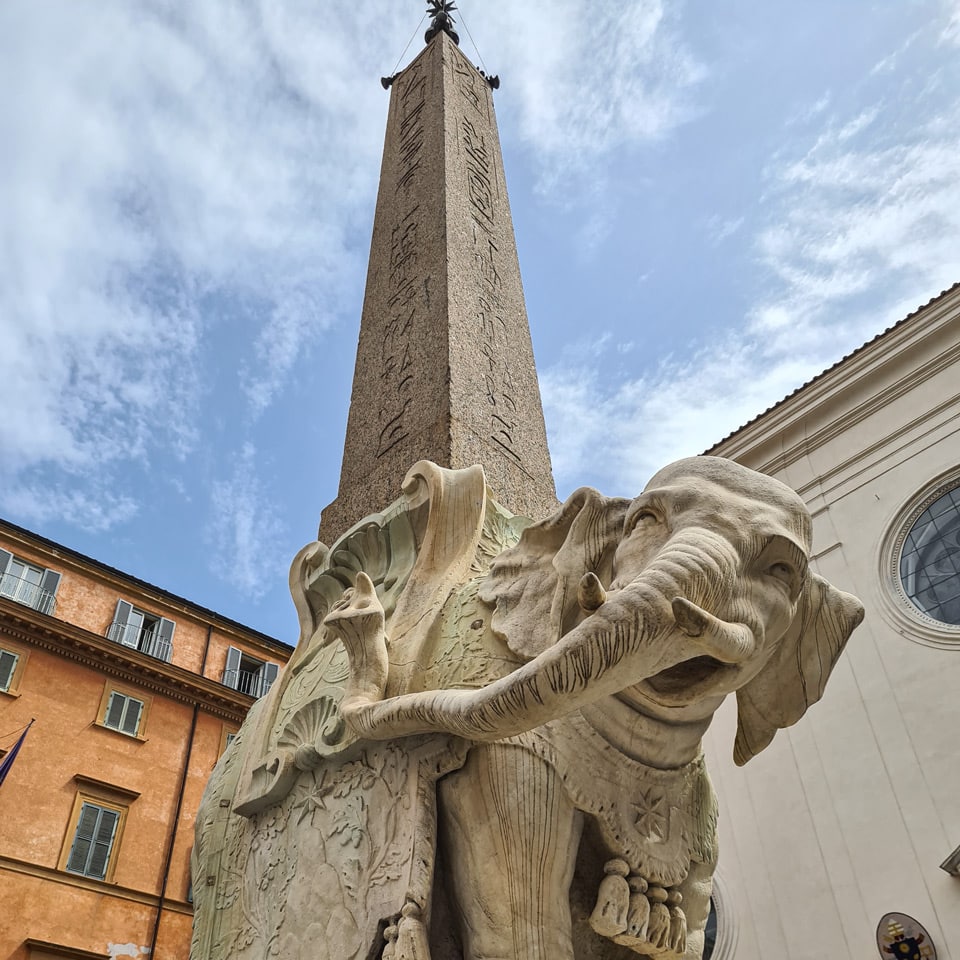
A few minutes from the Pantheon, a marble elephant carries an Egyptian obelisk through a small Roman square. Romans call it the Pulcino della Minerva, or Minerva’s Chick. The name sounds strange. Walk around the monument and its origin becomes clearer: short legs and heavy drapery give the elephant a squat body, while its raised tail supplies the joke.
Gian Lorenzo Bernini designed the ensemble for Pope Alexander VII, while his pupil Ercole Ferrata translated the master’s model into marble before the finished monument was unveiled in Piazza della Minerva in 1667. The ensemble is compact, but it joins an Egyptian pharaoh, a Renaissance dream book, Dominican friars, papal heraldry, and one of Rome’s best-known artistic quarrels.
Piazza della Minerva occupies part of the ancient Campus Martius near the Iseum Campense, a large sanctuary dedicated to the Egyptian gods Isis and Serapis. Several small obelisks connected with the sanctuary have been found around the church and its former Dominican convent.
The name Santa Maria sopra Minerva means “Saint Mary above Minerva.” It reflects the old belief that the Christian church stood over a temple of the Roman goddess. The archaeology is more complicated. Shrines linked to the Roman Minerva stood nearby, as did sanctuaries of Isis and Serapis.
The Basilica of Santa Maria sopra Minerva is worth entering after you see the elephant. It preserves Rome’s only substantial medieval Gothic church interior, although nineteenth-century restoration changed much of its appearance. Michelangelo’s Risen Christ stands near the high altar. Saint Catherine of Siena is buried beneath the altar, while the Dominican painter Fra Angelico has a tomb in the church.
The red granite shaft was made for Pharaoh Apries in the first half of the sixth century BC. It originally stood at Sais in the Nile Delta and measures only about 5.5 meters without its modern base. This makes it the shortest ancient Egyptian obelisk standing in Rome.
It probably reached Rome during the imperial period to decorate the sanctuary of Isis. The stone later fell and disappeared beneath the ground. Dominican friars found it intact in 1665 while working in their convent garden. Alexander VII then ordered a new setting for it in front of the church.
The obelisk once had a matching partner. That companion is now in Urbino, not outside the Pantheon. The small obelisk on the Fountain of the Pantheon came from the same Roman sanctuary but was carved for Ramesses II at Heliopolis. The distinction is easy to miss because both stones were found near Santa Maria sopra Minerva.
Bernini’s elephant recalls an illustration in the Hypnerotomachia Poliphili, a densely allegorical book printed in Venice in 1499. Its hero encounters a stone elephant carrying an obelisk during a dreamlike journey through imaginary ruins. Alexander VII owned an annotated copy, so the pope may have helped choose the image.
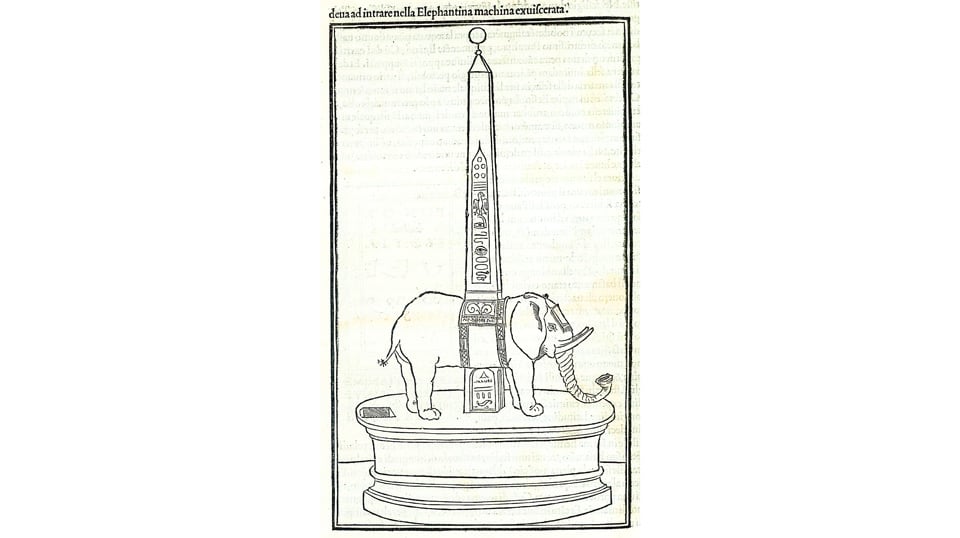
The idea was already familiar to Bernini. He had prepared an unrealized design for another elephant-supported obelisk decades earlier. For Piazza della Minerva, he developed the composition while Ercole Ferrata executed the marble under his direction.
The elephant represented physical and intellectual strength. That symbolism made it a suitable bearer of the hieroglyph-covered stone, which the seventeenth-century papal court interpreted as a monument to Egyptian wisdom.
Its Roman nickname began less politely. The compact body and short-looking legs reminded people of a small pig, so they called it the Porcino della Minerva. In Roman speech, porcino became purcino and eventually pulcino, the Italian word for a chick.
One face of the pedestal records that Alexander VII dedicated the ancient obelisk to divine wisdom in 1667. It describes the stone as a monument of Egyptian knowledge raised in a square “formerly of Minerva, now of the Mother of God.”
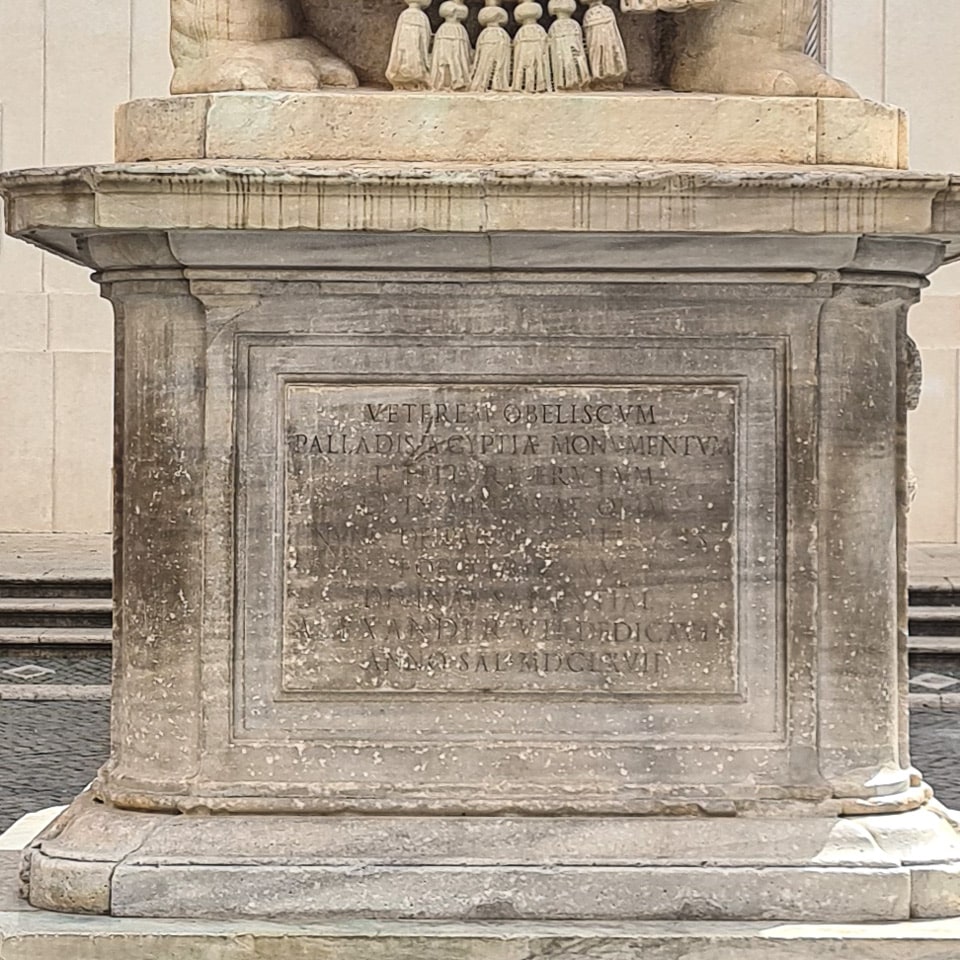
The inscription on another side provides the key to the composition. A clear English translation is:
Whoever sees here the images of Egyptian wisdom carved on the obelisk and carried by the elephant, strongest of beasts, should understand this as proof that a robust mind is needed to sustain solid wisdom.
The elephant therefore represents the strong mind, while the obelisk represents knowledge. The cross above the ancient hieroglyphs places both within a Christian interpretation created for the pope.
Alexander also inserted his family identity throughout the monument. The Chigi coat of arms contains six hills beneath an eight-pointed star. These emblems appear on the elephant’s saddlecloth, around the pedestal, and at the top of the obelisk below the cross.
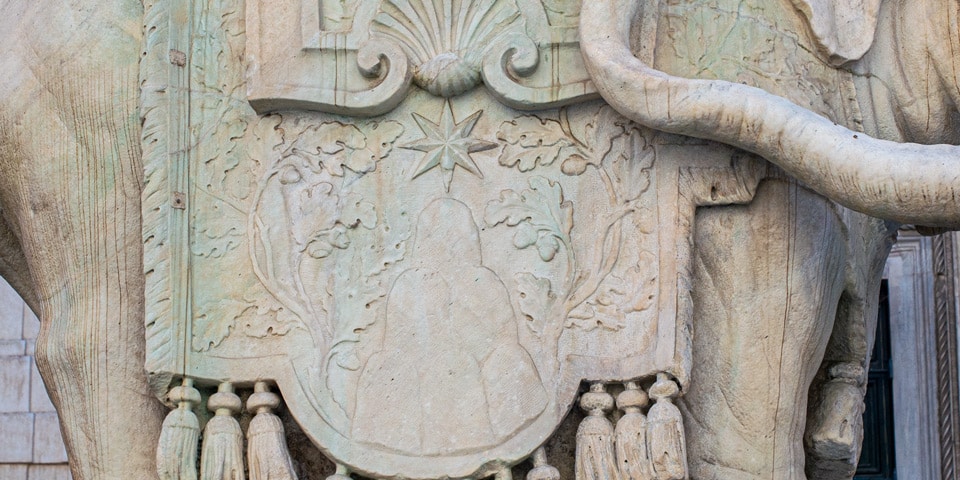
The heavy cloth hanging between the elephant’s legs conceals a solid stone support. Bernini wanted the obelisk’s weight carried through the animal’s four legs, a daring arrangement comparable to the open rock structure beneath the obelisk in his Fountain of the Four Rivers.
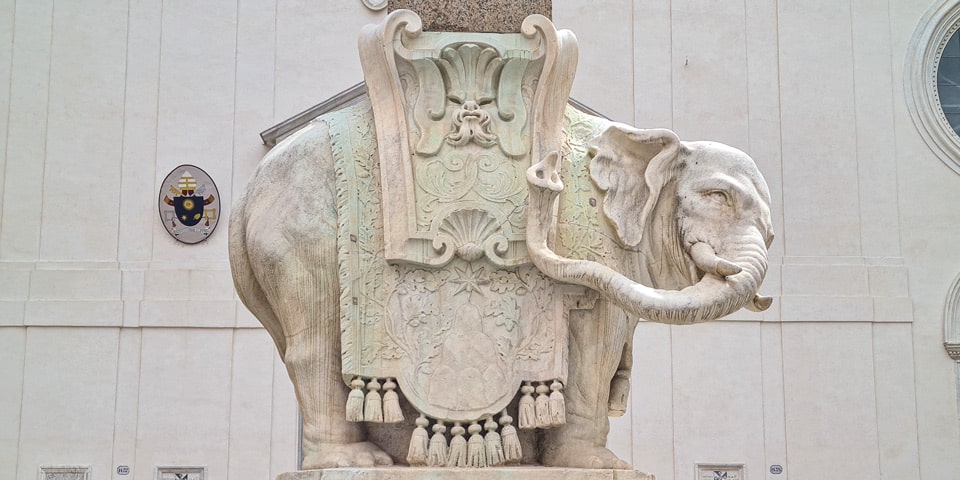
Dominican advisers, particularly Father Giuseppe Paglia, objected that a vertical load should not stand over an empty space. Their preferred solution won papal approval. Ferrata concealed the resulting block beneath an elaborate saddlecloth, which made the animal look stockier and helped inspire its nickname.
The elephant presents its rear to the former Dominican convent, with its tail lifted and trunk curved backward. A popular Roman story treats the pose as Bernini’s revenge for the friars’ interference. The quarrel over the support is documented, but the insulting intention belongs to the monument’s later folklore. It is best enjoyed as a plausible joke rather than quoted as Bernini’s recorded explanation.
The tip of the left tusk has broken more than once. Vandals damaged it in 2016, and the same section detached again in February 2026. The fragment was recovered and the Sovrintendenza Capitolina reattached it on February 23, 2026. The piece itself dates from a 1977 restoration rather than from Ferrata’s original carving.
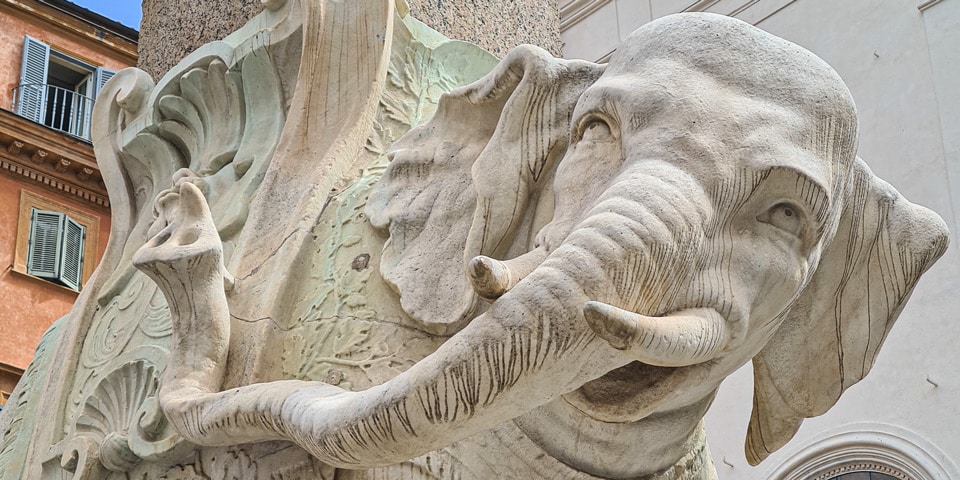
Allow five minutes to circle the monument. Begin on the church side and locate the Chigi hills and star. Move to the flanks to read the inscriptions, then stand behind the elephant to see why the story about the Dominicans has survived.
Finally, look from the animal upward. The order is deliberate: elephant, papal inscription, pharaonic hieroglyphs, Chigi star, and Christian cross. The monument compresses more than two millennia of changing religious and political meaning into a structure barely taller than the surrounding buildings.
Rome.us © 2026. Created with love by Roman experts and guides.