

Rome.us
  • TAXI FARES CALCULATOR
  • ABOUT US
  • HOW TO GET
    • Fiumicino Airport
    • Ciampino Airport
    • Termini Railway Station
    • Public Transport
    • To Venice
    • To Florence
    • To Ostia Antica
    • To Naples
    • To Milan
    • To Pisa
    • To Siena
  • TIPS
    • TOP Attractions
    • Tickets to Vatican museums
    • Rome Three Day Itinerary
    • Rainy Days in Rome
    • Buying a Sim Card in Italy
    • Renting a Car in Rome
    • Apps for Tourists
    • Free Things to Do
    • Unusual Things to do
    • ASK US
    • Instagram
    • Pinterest
  • ANCIENT SITES
    • Arch of Constantine
    • Castel Sant’Angelo
    • Catacombs
    • Colosseum
    • Mamertine Prison
    • Mouth of Truth
    • Pantheon
    • Roman Forum
    • Theater of Marcellus
  • WHERE TO STAY
    • How to Choose a Hotel in Rome
    • Hotels with Best Views
    • Hotels near Termini
    • Hotels near the Colloseum
    • Best Hostels
    • Hotels near Navona Square
    • 3 Star Hotels
    • 4 Star Hotels
    • 5 Star Hotels
    • Apartments For Rent
  • VATICAN CITY
    • St Peter’s Basilica
    • Sistine Chapel
    • Vatican Museums
    • Raphael’s Rooms
    • Michelangelo’s Pieta
    • St Peters Dome
    • St Peter’s Square
    • Vatican Military
    • Swiss Guard
    • Pilgrims of Hope Jubilee
  • MUSEUMS
    • Ara Pacis Augustae
    • Borghese Gallery
    • Capitoline Museums
    • Caravaggio’s Paintings
    • Great Synagogue
    • Palazzo Farnese
    • Spada Gallery
  • PARKS
    • Appian Way
    • Orange Garden
    • Park of the Aqueducts
    • Pincio Terrace
    • Villa Ada
    • Vatican Gardens
    • Villa Borghese
    • Villa Celimontana
    • Villa Torlonia
    • Zoo
  • CHURCHES
    • Capuchin Crypt
    • Holy Stairs
    • Sant’Agnese in Agone
    • San Giovanni in Laterano
    • Santa Maria Maggiore
    • Saint Paul Outside the Walls
    • St Peter in Chains
    • St. Ignatius of Loyola
  • FOUNTAINS & SQUARES
    • Navona Square
    • Spanish Steps
    • Trevi Fountain
    • Altar of The Fatherland
    • Fontana della Barcaccia
    • Fountain of the 4 Rivers
    • Fountain of the Pantheon
    • Piazza del Popolo
    • Piazza Venezia
    • Turtle Fountain
    • Triton Fountain
  • HILLS
    • Aventine
    • Capitoline
    • Janiculum
    • Palatine
    • Pincian
  • DAY TRIPS
    • To Tivoli
    • To Ostia Antica
    • Beaches near Rome
    • To Alberobello
  • WEATHER
    • January
    • February
    • March
    • April
    • May
    • June
    • July
    • August
    • September
    • October
    • November
    • December
  • WHERE TO EAT
    • Famous Roman Dishes
    • Best Pizza Places
    • Best Pasta Places
    • Local Italian Food
    • Best Gelato Places
    • Best Rooftop Bars
  • NEIGHBORHOODS
    • Campo Marzio
    • Jewish Ghetto Quarters
    • Quartiere Coppedè
    • Monti
    • Sant’Eustachio
    • Trastevere
    • Trevi
  • Shopping
    • Castel Romano Outlet
    • Farmers Markets
    • Souvenirs from Rome
  • EMPERORS
    • Good Emperors
    • Marcus Aurelius
    • Gaius Julius Caesar
    • Nero
    • Octavian Augustus
    • Caligula
    • Hadrian
    • Vespasian
    • Commodus
    • Trajan
Home / Parks and Gardens /

Ciceruacchio Statue on Janiculum Hill

Written by: Artur Jakucewicz

Statue of Ciceruacchio with his thirteen-year-old son Lorenzo on the Janiculum in Rome
Address Passeggiata del Gianicolo, 3, Roma

The bronze man is not shielding the boy behind him. He is pulling open his shirt and offering his chest to a firing squad; the boy, Lorenzo, is thirteen and about to die beside him. This is the Ciceruacchio statue, one of the most emotionally direct monuments on Janiculum Hill.

Unlike the rows of marble patriots along the promenade, this is not a formal portrait. Sculptor Ettore Ximenes built the final moments of two lives into the pose. The artwork then acquired a political story of its own, moving around Rome for more than a century before reaching the Janiculum in 2011.


Contents

Toggle
  • Who Was Ciceruacchio?
  • A Father and Son Before the Firing Squad
  • The Sculpture Was First Designed for a Cemetery
  • It Was Supposed to Face the Vatican
  • Where to Find the Ciceruacchio Statue
  • Best Value Hotels Near Father-Son Monument
  • Nearby Attractions

Who Was Ciceruacchio?

Ciceruacchio was the nickname of Angelo Brunetti, a Roman born into a working-class family in Campo Marzio in 1800. His father was a blacksmith, and Brunetti began as a carter carrying wine from the Castelli Romani into the city. He eventually built a successful transport business and earned unusual influence in Rome’s working-class neighborhoods, especially after helping people during the cholera epidemic of 1837.

His politics were more complicated than the label “revolutionary” suggests. When Pius IX was elected in 1846, Brunetti organized popular demonstrations in support of the new pope’s promised reforms. Only as those hopes collapsed did he move toward open opposition. During the Roman Republic of 1849, he was given responsibility for internal barricades and food supplies — unglamorous work, but essential in a city under siege.

After French troops defeated the republic, Brunetti joined Garibaldi’s retreat from Rome and tried to reach Venice. He never made it.

Even his nickname has no single accepted origin. One explanation connects Ciceruacchio to Cicero and Brunetti’s ability to speak to a crowd. Another treats it as a childhood nickname formed from Roman words referring to his round, stocky appearance. The honest answer is that both traditions survive.

A Father and Son Before the Firing Squad

Brunetti’s group was captured near the Po and taken to Ca’ Tiepolo. On the night of August 10, 1849, Austrian soldiers shot Angelo, his sons Luigi and Lorenzo, and five companions. Lorenzo was only thirteen.

The sculpture shows just Angelo and the younger boy. Brunetti plants one foot forward, bares his chest, and looks directly at the unseen rifles. Lorenzo presses close behind him, one hand raised beside his father’s shoulder. From the front, the adult figure dominates the bronze; from below, the frightened child changes its entire meaning.
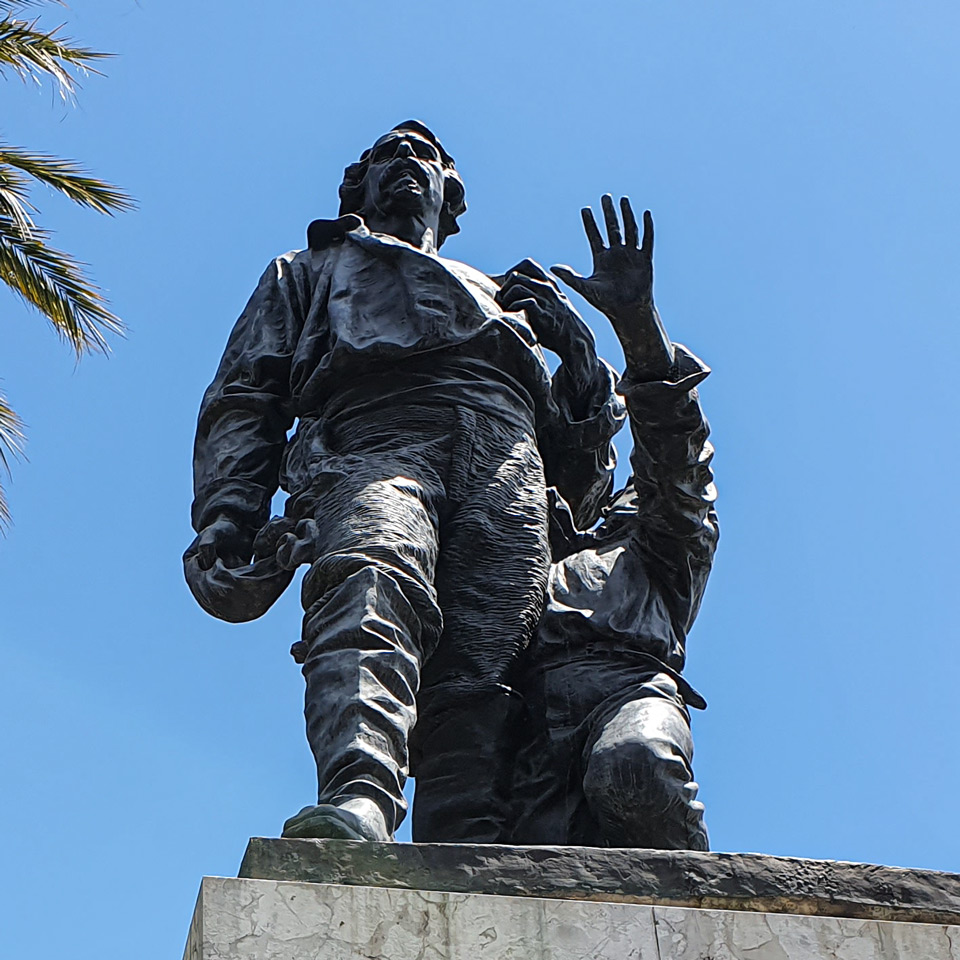
Close view of Ciceruacchio baring his chest as his son Lorenzo stands behind him

Luigi died with them but does not appear. Surviving documentation does not give a certain reason for Ximenes’s decision, so it is safer to see the group as a deliberately concentrated image of a father and his youngest son, not a complete record of everyone executed that night.


The Sculpture Was First Designed for a Cemetery

Ximenes created the original plaster group in Florence in 1879 under the title Ciceruacchio col figlio Lorenzo — Ciceruacchio with his son Lorenzo. It was intended for a funerary monument at Rome’s Verano Cemetery, but that project was never completed. The model was exhibited and awarded at the National Fine Arts Exhibition in Turin in 1880.

More than a decade later, the Società dei Carrettieri and the Circolo Angelo Brunetti revived the idea of a public memorial. A popular committee opened a public subscription in 1892. That origin still feels present on the pedestal: beneath the bronze, the spare inscription pairs “CICERUACCHIO” with “IL POPOLO” — “the people.”

It Was Supposed to Face the Vatican

The committee wanted the monument placed where Ciceruacchio could face the Vatican, deliberately setting the Roman popular leader against papal authority. The bronze was cast in 1900, but when it was finally installed near Ponte Margherita in 1907, the figure looked toward the city instead. It was a visible political compromise.

The memorial moved to Lungotevere in Augusta in 1959–1960 and was then turned toward the Vatican, belatedly fulfilling the committee’s intention. Its last transfer came in March 2011. After restoration, the seven-meter-high monument was installed on the Janiculum for the 150th anniversary of Italian unification, joining the hill’s larger landscape of Garibaldian memory.

Where to Find the Ciceruacchio Statue

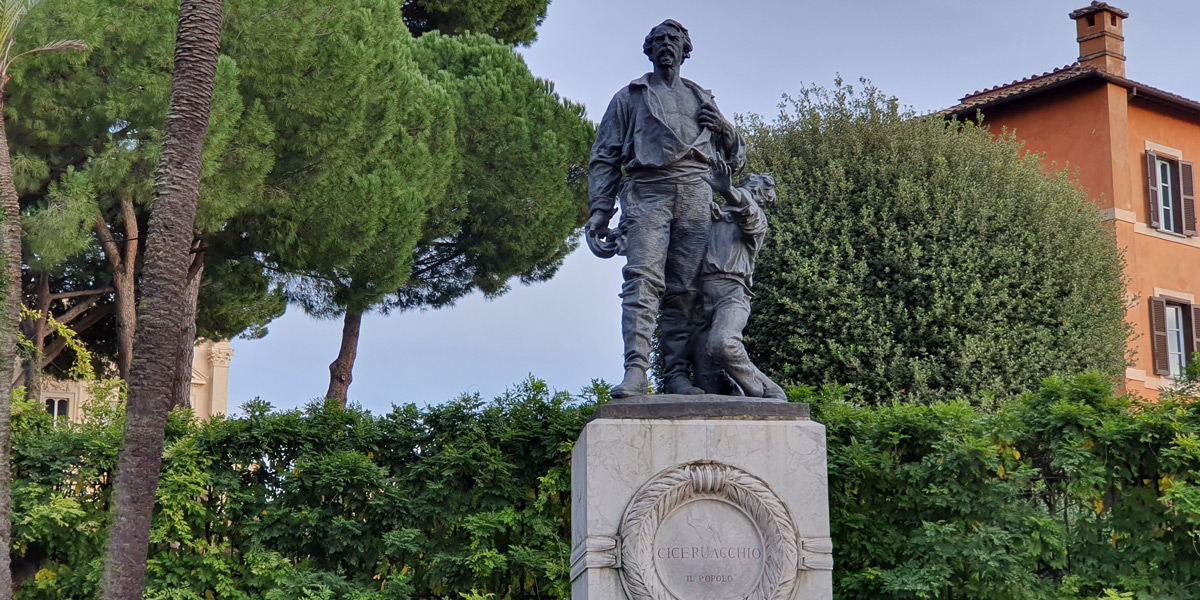
From Piazzale Garibaldi, follow the tree-lined Passeggiata del Gianicolo south toward Porta San Pancrazio. The monument appears a few minutes later on the right, set back among the trees beside Viale Lorenzo Brunetti. It stands outdoors and requires no ticket.
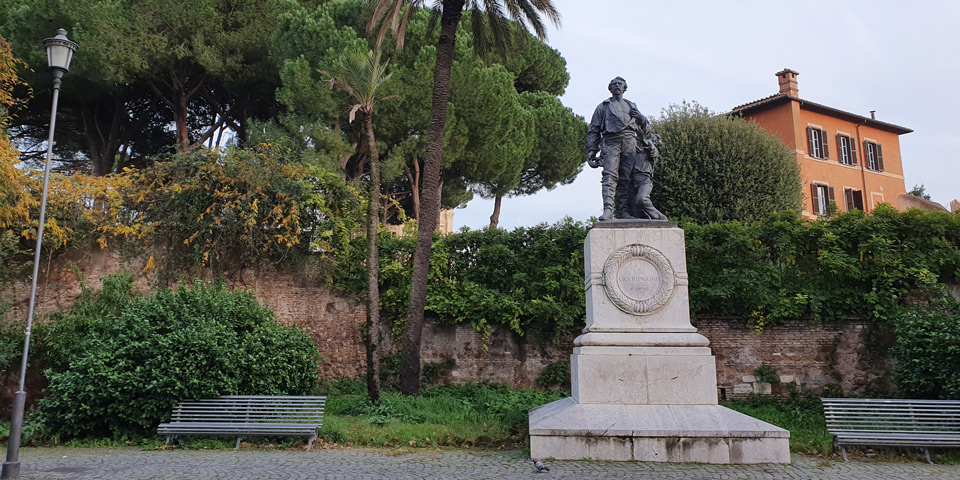
Full Ciceruacchio monument beside the tree-lined Janiculum Promenade in Rome


View it first from across the path, where Angelo reads as a defiant public hero. Then walk to the base and look up at Lorenzo. The smallest figure in the group is the one that turns a political monument into a human tragedy.

Best Value Hotels Near Father-Son Monument

Lorenz Suites
9 min
1509 ft
460 m
Intra Residenza
17 min
2789 ft
850 m
Suitedream Vatican
20 min
3281 ft
1 km
Trilussa Palace
21 min
3510 ft
1.1 km
Boutique Atelier 800
25 min
4101 ft
1.3 km

Nearby Attractions

Fountain of Acqua Paola
5 min 750 ft 230 m
Daily Noon Cannon Firing
6 min 920 ft 280 m
Monument to Giuseppe Garibaldi
6 min 950 ft 290 m
Janiculum Hill
6 min 950 ft 290 m
Piazzale Garibaldi - Panoramic Terrace
6 min 980 ft 300 m
Garibaldi Ossuary Mausoleum
7 min 1210 ft 370 m
Palazzo Corsini
14 min 2260 ft 690 m
Basilica Santa Maria in Trastevere
15 min 2430 ft 740 m
Villa Farnesina
15 min 2530 ft 770 m
Trilussa Square
17 min 2720 ft 830 m

Author: Artur Jakucewicz

Artur Jakucewicz

I have lived in Rome for over 10 years and am glad to share my experience and knowledge. I love ancient history and architecture — author of travel guides in Italy for independent travelers.

Dive Deeper into Rome's Stories

Fiumicino Airport Terminal 3

28465 views

How to Get from Fiumicino Airport to Rome City Center

Visiting Sistine Chapel

937360 views

Sistine Chapel

The Borghese Gallery and Museum The Ultimate Guide for Visitors

17195 views

The Borghese Gallery and Museum

Vatican Museums Guide

993050 views

The Vatican Museums

The Colosseum

145273 views

Colosseum

Visiting Pantheon in Rome

35870 views

Pantheon

Roman Forum in Rome Italy

49176 views

Roman Forum

What to See in Rome

38011 views

What to See in Rome: A Walking Route Through 30 Top Attractions

Hotels with best views in Rome

18717 views

Hotels with Best Views in Rome

Show more

About us

About us ROME.US Authors Kate Zusmann and Artur Jakucewicz
We're Kate and Artur, a duo bound by our shared fascination with the Eternal City – Rome. Our paths, driven by a mutual passion for its timeless stories and architectural marvels, converged in a way we had never imagined.

Explore Rome

  • Visiting Sistine Chapel

    Sistine Chapel

  • Caelio Hill Villa Celimontana

    Caelian Hill

  • why the colosseum has holes

    Why the Colosseum has Holes?

  • Florence Rome

    How to Get from Florence to Rome

  • San Carlo alle Quattro Fontane Rome Francesco Borromini

    San Carlo alle Quattro Fontane

Rome.us
  • social logo
  • social logo
  • social logo
  • social logo

This website uses cookies. For more info read the cookies policy

Rome.us © 2026. Created with love by Roman experts and guides.