

28549 views
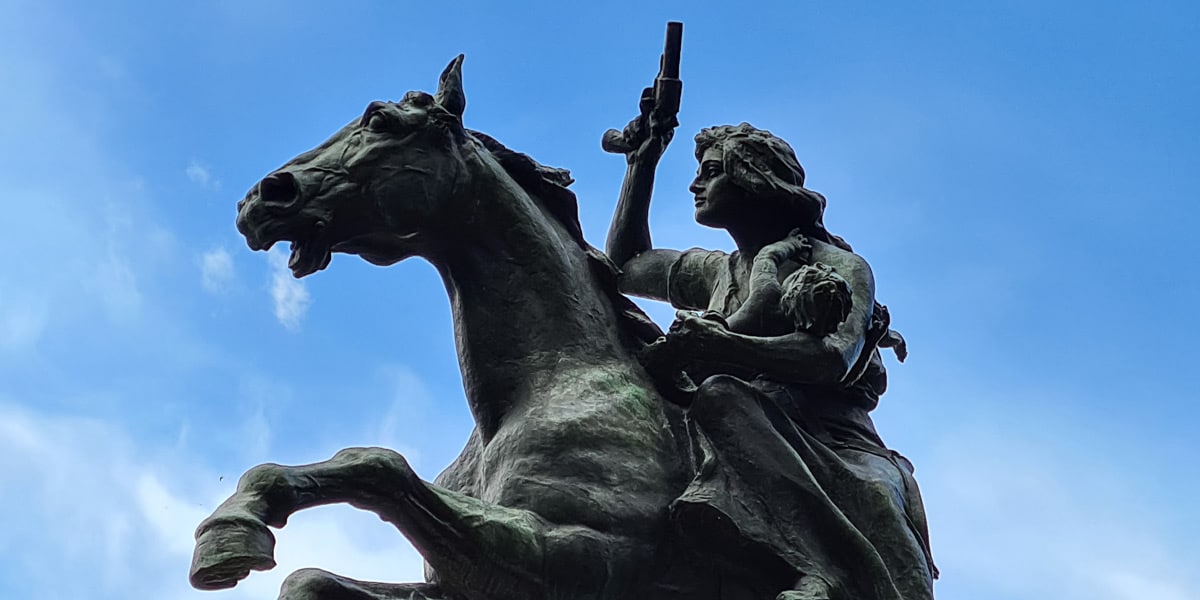
Rome’s monument to Anita Garibaldi looks almost too dramatic to be true: a rearing horse, a pistol raised against the sky, and an infant held against his mother’s body. Then the pedestal changes the story. Anita’s remains are inside it.
The work is an action scene, a politically constructed image, and a tomb at the same time. Sculptor Mario Rutelli compressed separate episodes from Anita’s life into one explosive pose; the government that commissioned it reshaped her as both warrior and mother. The reliefs below restore some of the complicated biography that the figure above turns into myth.
Anita was Brazilian, not Italian. She was born Ana Maria Ribeiro da Silva in Santa Catarina in 1821 and married Manuel Duarte de Aguiar at fourteen. The later fate of her first husband is uncertain. When she met the exiled Italian sailor Giuseppe Garibaldi near Laguna in 1839, southern Brazil was in the middle of the Farrapos War, a republican revolt against the Brazilian Empire.
Garibaldi’s memoirs turned their meeting into a story of instant destiny. The historical record is less tidy and more interesting. Anita left her existing life, joined a mobile revolutionary force, and began a decade marked by fighting, flight, childbirth, and repeated displacement between two continents.
During the fighting at Curitibanos in 1840, she was captured by imperial troops. She escaped on a stolen horse while pregnant and made a long ride to rejoin Garibaldi’s forces. Their first son, Menotti, was born at Mostardas on September 16 of that year. Not long afterward, another attack forced her to flee with the newborn.
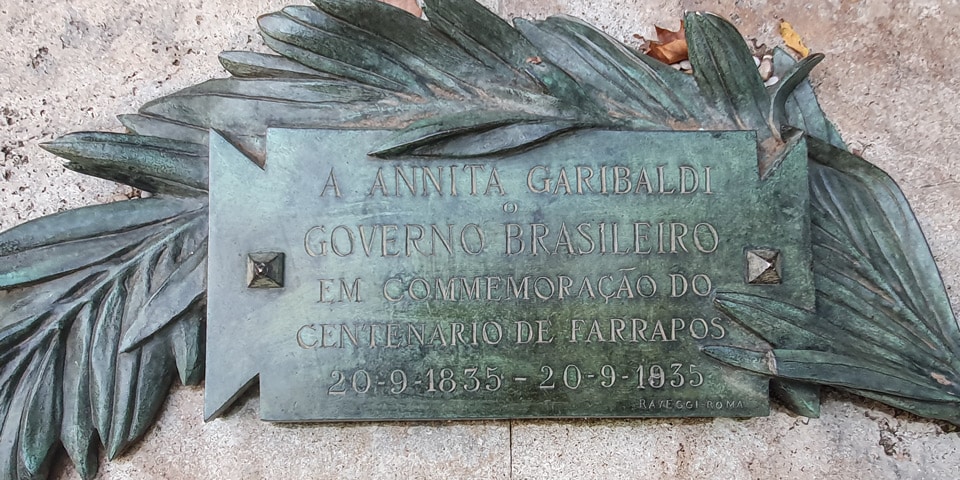
A Portuguese plaque at the monument preserves the Brazilian half of her identity. It reads: “To Anita Garibaldi, from the Brazilian Government, in commemoration of the centenary of the Farrapos Revolution, 20 September 1835–20 September 1935.” The dates mark the beginning and centenary of the revolt, not a day in Anita’s own life.
Anita and Giuseppe moved to Montevideo in 1841 and married there on March 26, 1842. She returned to Europe with their children at the end of 1847. In June 1849, pregnant again, she joined Giuseppe during the final defense of the Roman Republic and then followed his retreat toward Venice. She died near Ravenna on August 4, probably from malaria. She was twenty-seven.
The official interpretation places the mounted scene in 1840, shortly after Menotti’s birth. The infant is secured against Anita with a cloth; her left hand grips the horse’s mane while her right raises a pistol as she escapes imperial soldiers.
No single documented episode contains every part of that image. Anita’s long horseback escape after Curitibanos happened while she was pregnant. Her flight from an attack with the newborn came later. Rutelli fused those consecutive events, turning months of danger into a single moment that can be understood from the ground in seconds.
That distinction does not make the monument less compelling. It makes it more revealing. The bronze tells us both what Anita endured and how twentieth-century Italy wanted her to be remembered.
The effort to build a monument to Anita began in 1905, in preparation for the centenary of Giuseppe Garibaldi’s birth two years later. Two competitions followed. None of the first forty-three proposals, or the later invited designs, satisfied the organizers, and the project stalled for more than two decades.
Ezio Garibaldi, a grandson of Giuseppe and Anita, revived it in the late 1920s. The commission eventually went to Mario Rutelli, the Sicilian sculptor responsible for the provocative figures of Rome’s Fountain of the Naiads. His 1929 model already showed Anita on a racing horse with a pistol, but there was no child in her arms.
Menotti appears to have been added after Benito Mussolini took a close personal interest in the project. The change was small in physical terms and enormous in meaning. Anita was no longer only a modern Amazon. She became a warrior-mother: armed, fearless, and still defined by maternity.
The monument was unveiled in June 1932 during celebrations marking fifty years since Giuseppe Garibaldi’s death, which also coincided with the tenth anniversary of the Fascist regime. Mussolini used the ceremony to claim a line of continuity between Garibaldi’s Redshirts and Fascism’s Blackshirts while stripping the earlier movement of much of its democratic and internationalist meaning. The pose above the pedestal is therefore not politically neutral, even though the woman it honors cannot be reduced to the regime that appropriated her.
The bronze group is about 4.5 meters high and weighs roughly four metric tons. Rutelli designed the rearing horse as a two-point composition, with both front legs lifted and the original support concentrated through the hind legs. It is a far more demanding solution than placing all four hooves on the base or disguising a third support as a tail, tree, weapon, or defeated enemy.
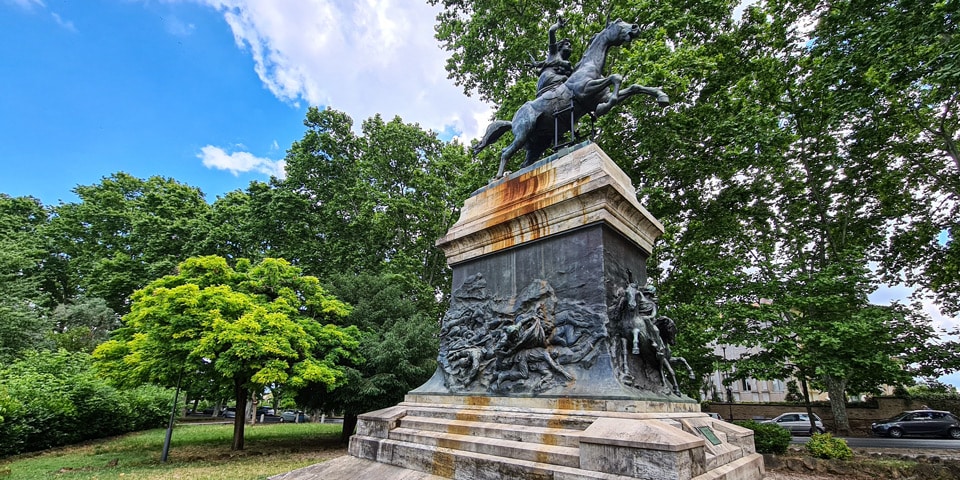
The metal support visible beneath the horse is not part of Rutelli’s intended silhouette. Water infiltration and corrosion repeatedly affected the internal iron structure, while vertical cracks developed along the rear legs. During the restoration completed in 2025, Rome installed a reversible steel prop with a padded saddle beneath the horse so the bronze could be protected and its stability monitored.
Rutelli was not the first sculptor to place a historical woman on a rearing horse supported by its rear hooves. A comparable equestrian Joan of Arc was erected in Montebourg, France, in 1899. That cast-iron design was later reproduced in several other towns. The comparison makes the engineering no less impressive, but it rules out the tempting claim that Anita is the only female equestrian statue of its kind.
What makes the monument exceptional is not the rearing horse alone, but the combination: a historical woman, a pistol, an infant child, a daring equestrian structure—and Anita’s actual tomb inside the pedestal.
Bronze high relief covers all four sides of the travertine pedestal, but the monument tells three main stories. The first episode continues around a corner, from the short front face onto the long right side. Rutelli expanded the reliefs to include approximately sixty-five figures because he feared the colossal groups on the nearby monument to Giuseppe Garibaldi would make Anita’s memorial look insignificant.
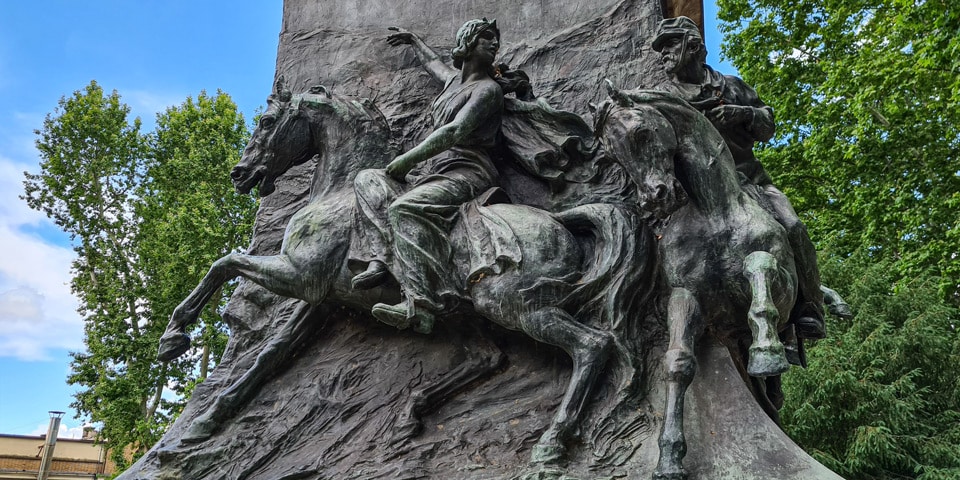
At the head of the first scene, Anita rides forward and points the way during the fighting at Curitibanos. A bearded horseman follows immediately behind her. His features may be intended to evoke Giuseppe, but surviving descriptions identify the riders collectively as Garibaldian or republican fighters rather than naming this figure. The safer reading is that Anita, not the man behind her, commands the composition.
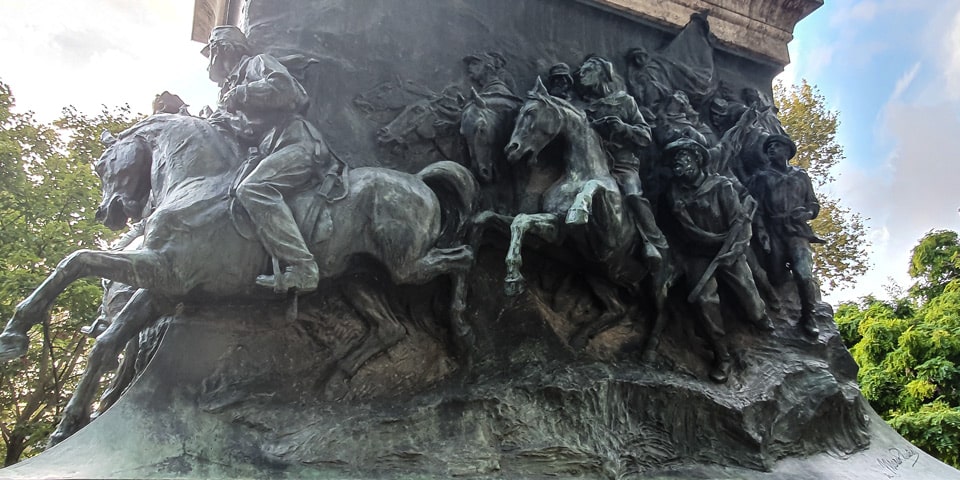
The column continues around the corner in a crush of horses, riders, hats, weapons, and windblown fabric. What can look like a second battle from one viewing angle is the continuation of the same event. Walking around the base is therefore part of reading it: Rutelli made the narrative move before the visitor does.
The long left side turns movement into aftermath. It follows the traditional account that, after being captured at Curitibanos and fearing Giuseppe had been killed, Anita searched for him among the bodies on the battlefield before escaping on horseback.
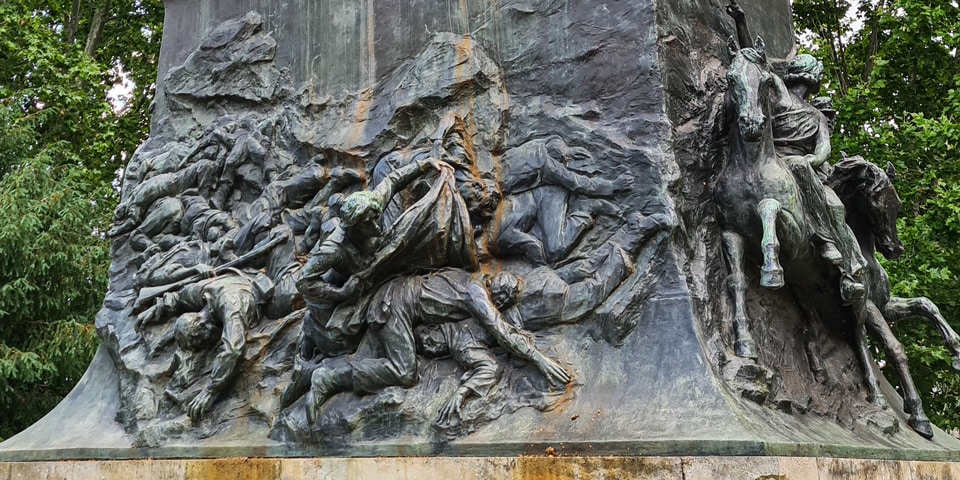
The mounted Anita appears at the right while dead and wounded men collapse across the rest of the bronze. Her capture and escape are well established; the search among the bodies belongs more clearly to the heroic account preserved by Garibaldi and later retellings. The relief records that memory rather than functioning as evidence that every detail happened exactly as shown.
The rear side jumps nine years forward, from South America to the retreat after the fall of the Roman Republic. Giuseppe carries the exhausted Anita through the pinewoods near Ravenna toward the Guiccioli farm, where she died. The sculpture should not be taken as proof that her final breath came literally in his arms; it condenses the last stage of the journey just as the equestrian group condenses her earlier escapes.
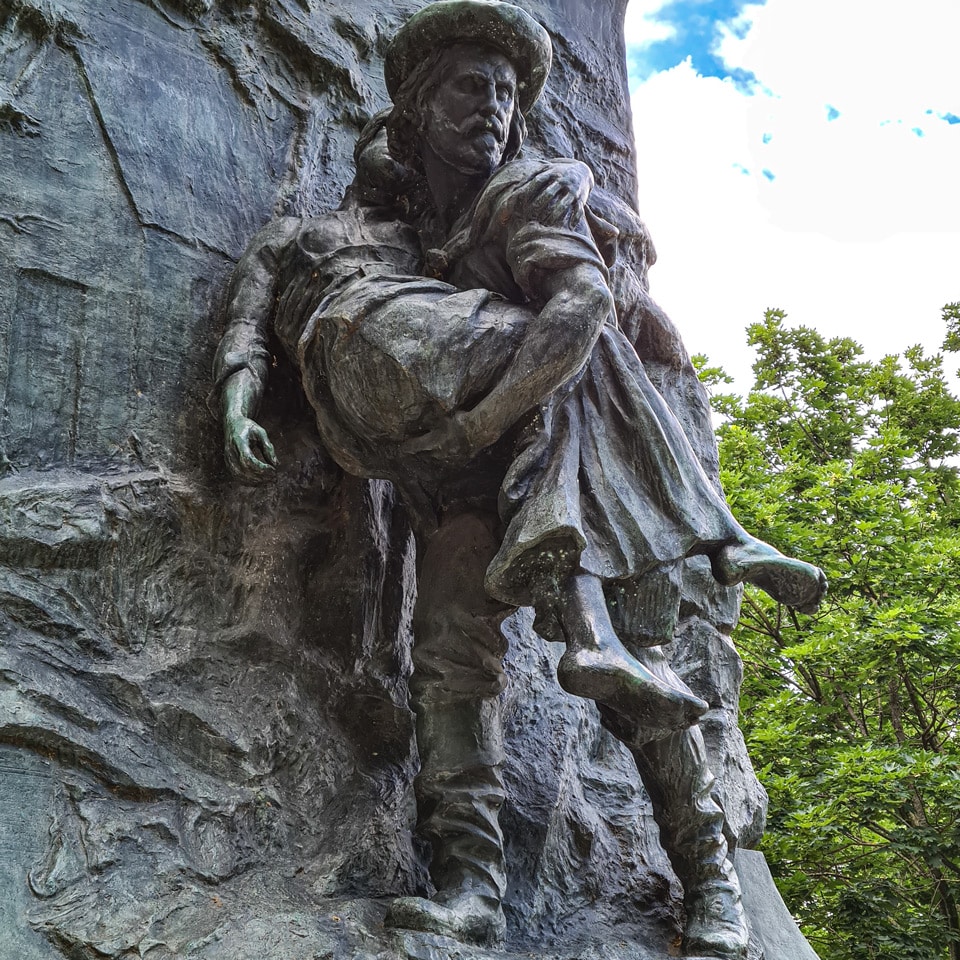
The top and bottom of the monument now answer each other. Above, Anita supports her infant while controlling a horse and raising a weapon. Below, her arm and legs hang loose as Giuseppe supports her. The story begins with a mother carrying a child and ends with a husband carrying the mother.
Anita’s body did not travel directly from Ravenna to Rome. After a hurried burial near the farm, her remains were recovered and reburied in the local parish cemetery. Giuseppe arranged their transfer to Nice in 1859. The Fascist government requested another transfer in 1931; the remains passed through the Staglieno Cemetery in Genoa before being placed inside the Janiculum monument in 1932.
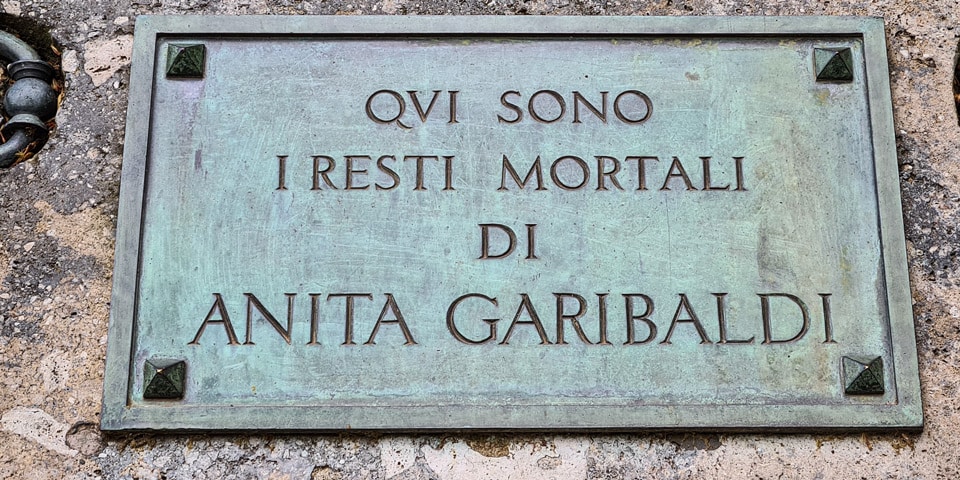
The bronze tablet states the fact without ceremony: QVI SONO I RESTI MORTALI DI ANITA GARIBALDI — “Here lie the mortal remains of Anita Garibaldi.” QVI is not a spelling error. The Italian inscription uses the monumental Roman convention of writing V in place of U.
The horse and the first reliefs look back to Brazil, but the location belongs to the last year of Anita’s life. The Janiculum was the decisive defensive ground of the Roman Republic of 1849. It later became Rome’s landscape of Garibaldian memory, with Giuseppe above the city, rows of patriot busts along the promenade, and the Garibaldi Ossuary Mausoleum preserving the dead of the struggles for Rome.
Anita’s monument deserves a complete circuit rather than a glance at the horse. One side presents a leader; another turns victory into a field of bodies; the last shows a woman being carried toward death. The nearby statue of Giuseppe presents the commander. Rutelli’s monument does something stranger and more revealing: it holds a Brazilian revolutionary above her own tomb, caught forever between lived history and the image Italy made from it.
Rome.us © 2026. Created with love by Roman experts and guides.