

28655 views
Rome has a lighthouse on a hill far from any harbor. It has never guided a ship. Its beam was meant to cross the city—and, symbolically, the Atlantic.
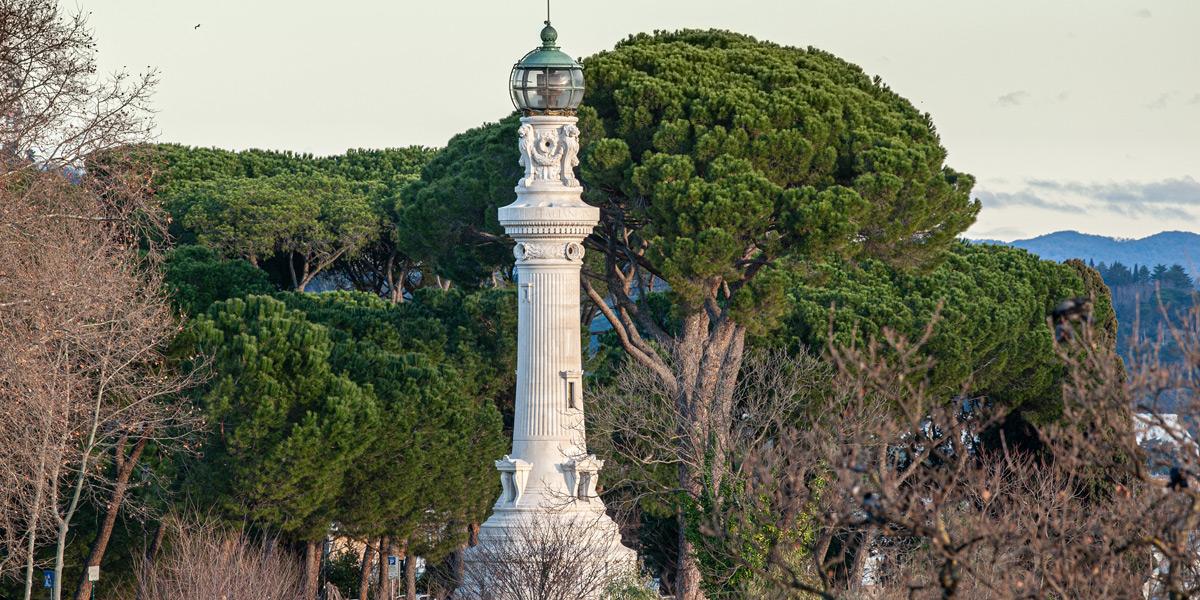
The Faro del Gianicolo was a gift from Italians who had built new lives in Argentina but still regarded Rome as the capital of their homeland. Its tricolor lantern, monumental inscription, and view toward a Roman prison give this small landmark a story much larger than its footprint.
The monument’s full name is the Faro degli Italiani d’Argentina, the Lighthouse of the Italians of Argentina. The Italian community in Buenos Aires funded it for the fiftieth anniversary of Italian unification and as a declaration of loyalty to Rome as the national capital.
Completed in 1911, it formed part of celebrations centered on September 20. That date marked the anniversary of Italian troops entering Rome through Porta Pia in 1870, the event that ended papal rule over the city and completed the process of unification.
The location carried an earlier layer of national memory. The Janiculum had been the principal battlefield in the defense of the Roman Republic of 1849. By the time the lighthouse appeared, the ridge had become a public memorial landscape of Garibaldi monuments and busts. The nearby Museum of the Roman Republic explains the siege that gave the hill this identity.
Placed here, the lighthouse did not point toward the coast. It marked a route across history: from the failed republic of 1849, through the unification of Italy, to the large Italian communities living overseas.
Architect Manfredo Manfredi gave the lighthouse a neoclassical form rather than the practical profile of a coastal tower. That choice suited his career. Manfredi had designed the tomb of Victor Emmanuel II inside the Pantheon and worked on the Vittoriano, also known as the Altar of the Fatherland.
The structure is 20 meters high and rests on a circular base 10 meters in diameter. Its white Botticino stone—the same type of limestone used extensively on the Vittoriano—makes it stand out against the dark umbrella pines of the Janiculum Hill.
Above the fluted column is an altar-like circular element decorated with four lion heads connected by carved festoons. The large glass lantern crowns the composition. Inside the monument, a spiral staircase rises through the column, followed by a steep iron ladder leading to the light. This interior is functional space, not a public observation deck.
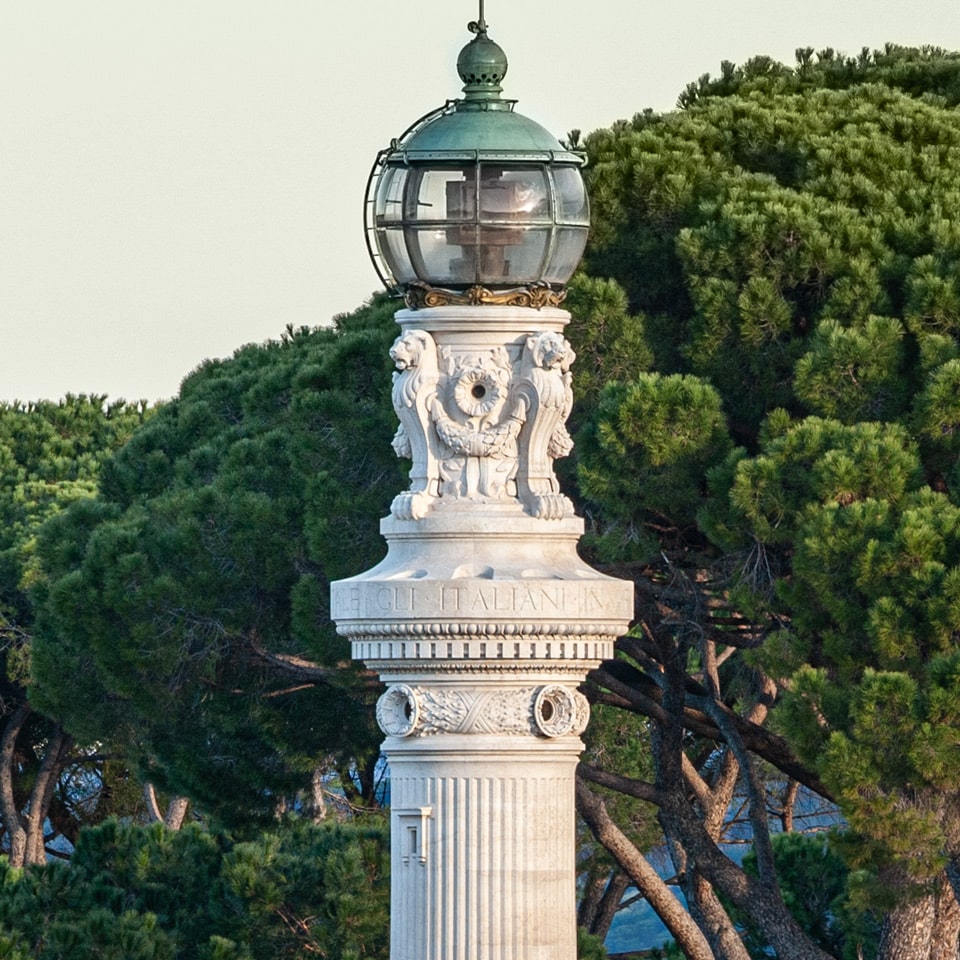
The dedication runs around the stone below the lions:
A ROMA CAPITALE GLI ITALIANI D’ARGENTINA. MCMXI
In English: “To Rome, the capital, from the Italians of Argentina. 1911.” The Roman numeral MCMXI records the year. Only part of the sentence can be seen from any single close viewpoint because the words follow the circular structure.
The lantern was designed to illuminate Rome in green, white, and red. A contemporary account of its first tests described the three colors changing at intervals of about twenty minutes, casting light across the city’s roofs, domes, and columns. This was spectacle rather than navigation: the Italian flag translated into moving light.
The display left a trace in Roman speech. Sembri er faro der Gianicolo—“You look like the Janiculum Lighthouse”—became a teasing description of someone dressed in unusually bright, flashy, or mismatched colors.
The tricolor is no longer a nightly feature. The lantern is switched on for selected national anniversaries and commemorations. For several years a fault in the original mechanism meant its lights could operate only in a fixed position. Technicians restored the historic rotating machinery in 2024, allowing the moving display to work again.
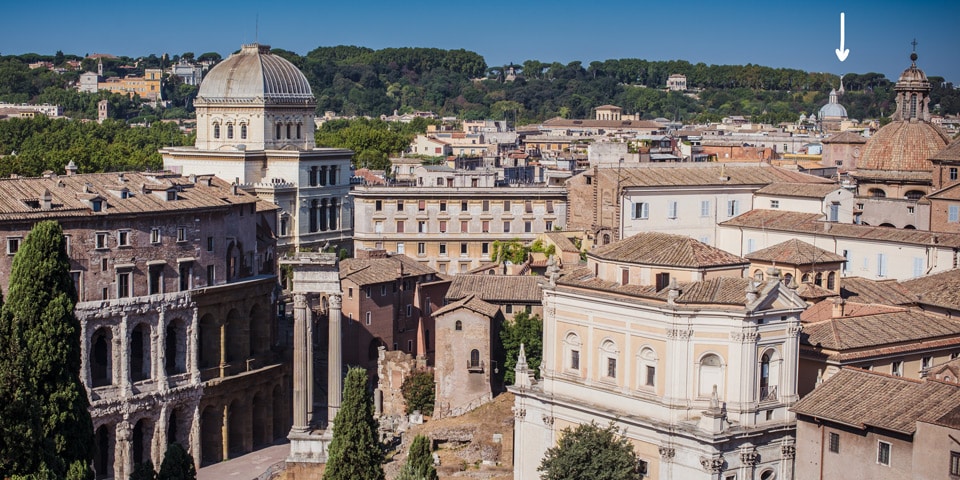
From close range, the white column is unmistakable. From central Rome, it almost disappears into the umbrella pines. The trick is to look for the glass lantern projecting just above the dark horizontal line of trees rather than searching for a conventional lighthouse beside the horizon.
The photograph below was taken from Capitoline Hill. The arrow marks the tiny lantern on the wooded Janiculum ridge beyond the domes and rooftops. Once you recognize its round glass top and narrow white base, the same silhouette becomes much easier to find from other elevated places in Rome.
It is also visible from the Pincio Terrace in Villa Borghese. From there, scan the wooded ridge to the left of St. Peter’s dome. It is easy to overlook because distance compresses the pale stone into the trees, but spotting it turns the lighthouse into a useful reference point for understanding where the Janiculum lies in relation to the historic center.
The most human story connected with the lighthouse has nothing to do with national ceremonies. The terrace faces Regina Coeli, Rome’s major prison, lower down near the Tiber. Families once gathered here to shout urgent news to relatives behind its walls.
Messages and responses traveled by voice, gesture, and agreed signals. The practice was prohibited, but authorities sometimes tolerated essential family announcements such as a birth or death. From the prisoners’ side, a strip of hillside beneath a patriotic monument became an improvised connection with the city outside.
That history changes the way the viewpoint feels. The panorama was not always used simply to admire Rome. For some visitors, being visible or audible from below was the entire reason to climb the hill.
The monument’s relationship with Argentina did not end with the immigrant generation that paid for it. Rome has repeatedly illuminated the lighthouse on March 24, Argentina’s Day of Remembrance for Truth and Justice, in memory of the people abducted and disappeared under the military dictatorship of 1976–1983.
The modern ceremony gives the original gift a new meaning. A structure commissioned to express emigrants’ attachment to Italy now allows Rome to acknowledge Argentina’s history in return. The light still travels symbolically between the two countries, but its subject has expanded from national pride to human rights and remembrance.
The lighthouse is not a destination around which I would build an entire day. You cannot normally climb the lantern, and the monument takes only a few minutes to examine from outside. Its value comes from knowing what the details mean.
It is, however, an excellent stop on the Janiculum promenade. From the views and monuments of Piazzale Garibaldi, the walk continues among umbrella pines toward the lighthouse. The hill’s famous noon cannon can be incorporated into the same route rather than treated as a separate excursion.
Look closely at the lions, follow the dedication around the column, and remember that this object was never supposed to save sailors from rocks. It began as a message sent from Buenos Aires to Rome, later carried family messages toward Regina Coeli, and today still speaks through light. That is why a city without a harbor has kept its lighthouse.
Rome.us © 2026. Created with love by Roman experts and guides.