

28389 views
The Trevi Fountain is two minutes away, and that is exactly the problem. Everyone stops at the Trevi. Almost nobody turns down the quiet street beside it, walks past a plain yellow doorway that looks like the entrance to an accountant’s office, and steps into what may be the most beautiful room in the center of Rome. You need no ticket and pay nothing to walk in — it is completely free. It is almost always empty, and most people leave the city without ever knowing it was there.
This is Galleria Sciarra — a four-story courtyard painted from its marble floor to its iron-and-glass roof, one of the very few Art Nouveau interiors in the old center, and the best five-minute detour you can make from the Trevi crowds.
The reason Galleria Sciarra stays a secret is the same reason it lands like a discovery: nothing outside prepares you for it. The passage runs between Via Marco Minghetti and Piazza dell’Oratorio, and from the street it reads as one more ochre wall in a city full of them. There is no grand portal, no ticket booth, no line. Locals cut through it as a shortcut. Tourists walk straight past the mouth of it on their way to the fountain.
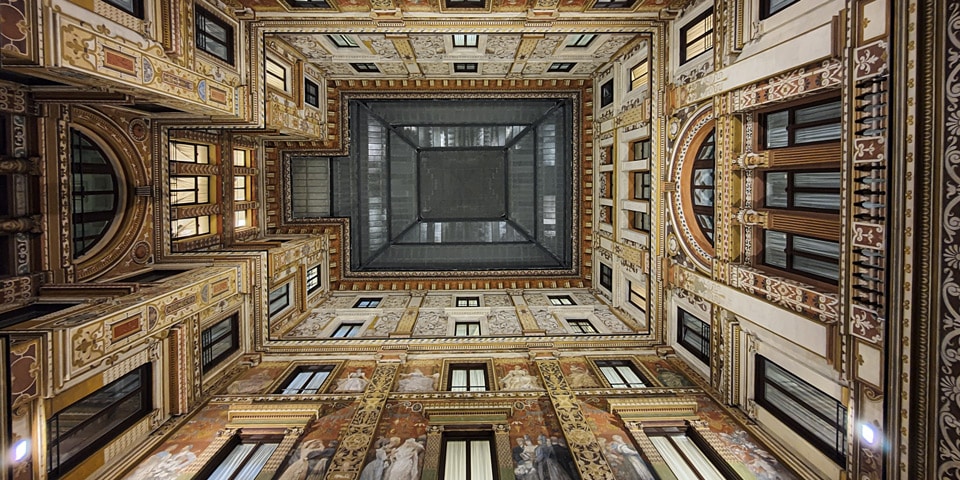
Then you step inside and look up, and the walls detonate — four stories of frescoed women, gilded scrollwork, painted columns and Latin mottoes, all rising to a flat vault of iron and glass that drops clean daylight into the middle of the space. That roof is the quiet piece of genius here. Because the glass keeps the rain out, the courtyard never needed drains or sloped paving, which is precisely why the floor could be laid in polished marble rather than practical stone. The whole room is a luxury made possible by an engineering trick that was cutting-edge in the 1880s.
The courtyard was built between 1885 and 1888 for Prince Maffeo Barberini-Colonna di Sciarra, and his story is the one the guidebooks leave out. He was not a dusty aristocrat living off inherited land; he was a modern media baron. He owned La Tribuna, one of Rome’s best-selling newspapers, and bankrolled the literary magazine Cronaca Bizantina. He hired the architect Giulio De Angelis — the same man who built him the nearby Teatro Quirino — to thread a covered passage through his tangle of properties and turn it into something Rome had never seen: a luxury shopping arcade, glassed over and painted like a palace.
It never worked as a mall. Within a few years the prince’s finances collapsed, caught in the wave of speculation and banking scandal that broke over Rome in the early 1890s. He gave up the newspaper, the arcade’s grand commercial idea quietly died, and the property eventually passed into the hands of a bank, which is the unglamorous reason a masterpiece today sits wrapped inside an ordinary office block. The man built one of the loveliest interiors in Rome and lost nearly everything he owned in the process.
The paintings are the reason to look up for a long time. They were done between 1885 and 1888 by Giuseppe Cellini, working in encausto — pigment bound in hot wax — to a program devised by the poet and critic Giulio Salvadori. The theme is announced with total confidence: the Glorification of Women.
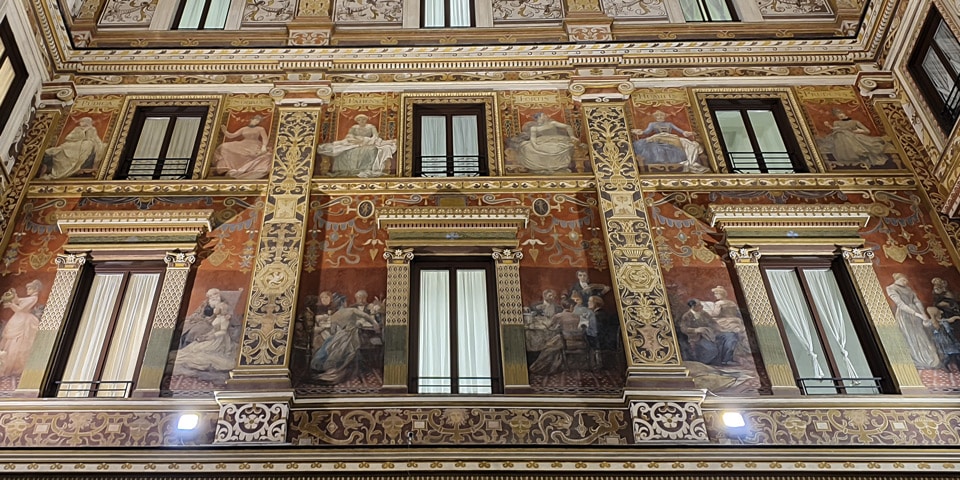
Read the upper band and you are reading a list of virtues, each seated female figure labeled in Latin: Pudica (Modest), Sobria (Sober), Patiens (Patient), Fortis (Strong), Humilis (Humble), Prudens (Prudent). Below them runs a lower register of ordinary bourgeois life as the late 1800s imagined a good woman’s world — tending a garden, minding children, conversation, a family lunch, a small act of charity. It is a portrait of an ideal, not a real, woman, and that is worth knowing before you decide how you feel about it.
There is a private message hidden in all this public virtue. The whole cycle is a tribute to the prince’s mother, Donna Carolina Colonna di Sciarra, and her initials — CCS — are woven through the decoration, alternating with her son’s monogram, MS. Look closely at one of the domestic scenes, the one called The Courteous Conversation, and you will find a real person among the allegories: the young poet Gabriele D’Annunzio, whom the prince mentored and published, painted onto the wall of a building where his own magazine kept its offices.
Here is the detail that no other guide to Galleria Sciarra will give you, because it takes reading the walls rather than photographing them. The mottoes carved and painted on the pillars are not decorative filler. They are Virgil, chosen line by line to match the scenes beneath them.
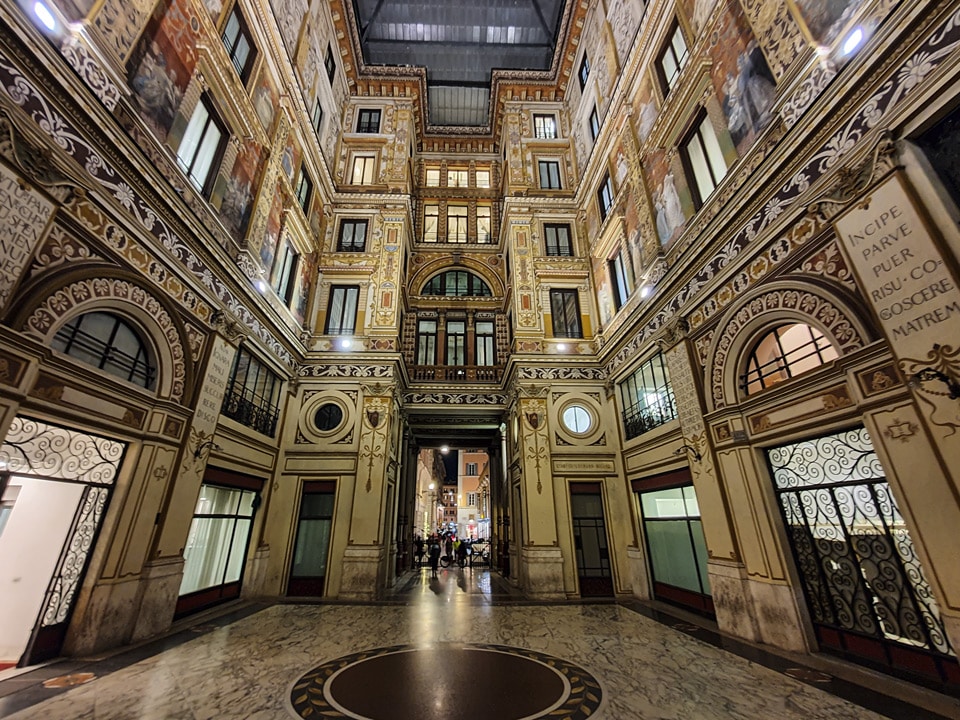
On one pillar: Incipe, parve puer, risu cognoscere matrem — “Begin, little boy, to know your mother by her smile.” It comes from Virgil’s fourth Eclogue, and its placement is deliberate to the point of tenderness: a line about a child recognizing his mother, set into a courtyard built to honor the patron’s own mother. That same Eclogue carried a strange afterlife too. For over a thousand years, Christian readers took its prophecy of a wondrous newborn as a pagan foretelling of Christ — so the prince chose, for his mother’s monument, one of the most famous lines in all of Latin poetry.
A second pillar answers it with a line from the Aeneid: Non ignara mali, miseris succurrere disco — “No stranger to misfortune myself, I am learning to help those who suffer.” These are Queen Dido’s words to the shipwrecked Aeneas, and they hang directly above the fresco panel of charity. Whoever designed this room paired a scene of a woman helping the poor with the single most quoted line about compassion in Roman literature. That is not decoration. That is a scholar’s joke, told in stone, for anyone who bothers to look up and translate.
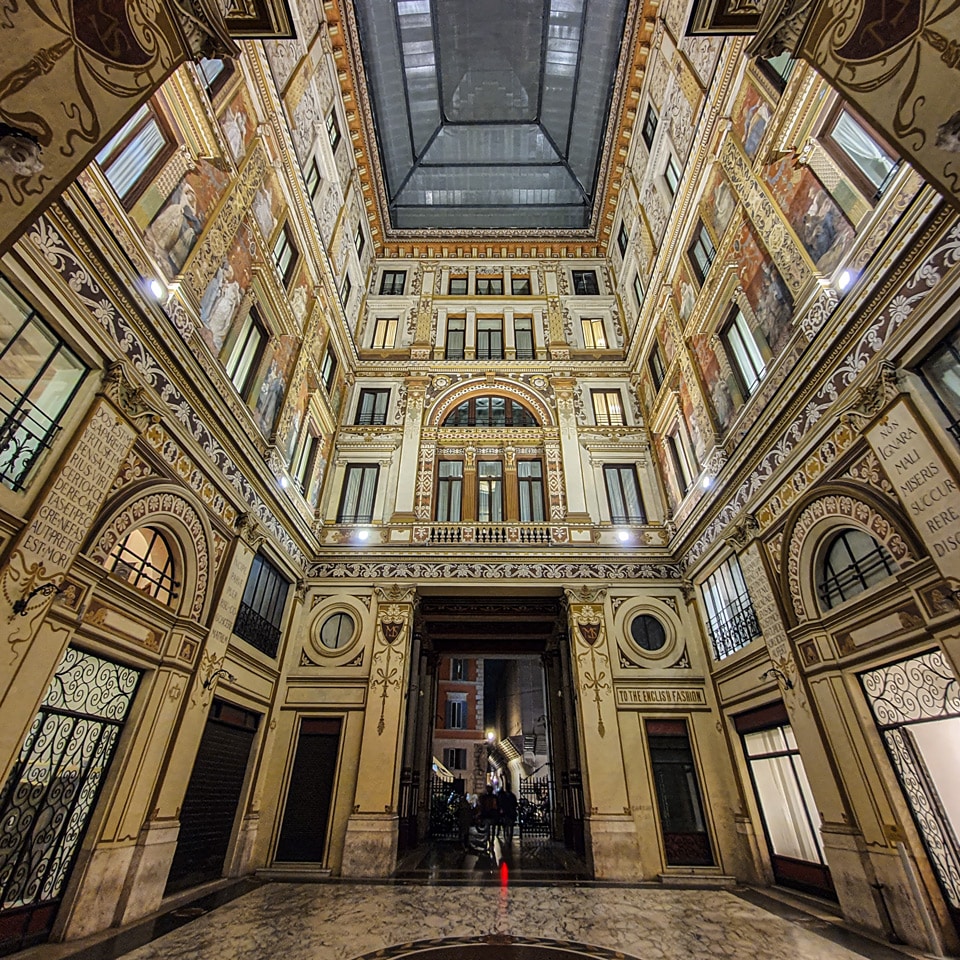
In the same frame you can read a much later inscription, painted in English above a shopfront at the far end: “To the English Fashion.” It is a reminder that this was always meant to be a place of commerce, and that beneath the Virgil and the gilt, it is still a working passage with a tailor’s sign and people cutting through on their way home.
Getting here is easy; noticing it is the hard part. From the Trevi Fountain, walk west along Via delle Muratte for a couple of minutes to the corner with Via di Santa Maria in Via, where a McDonald’s makes an unmissable landmark, and the entrance to the gallery is right there. The passage also opens onto Piazza dell’Oratorio on its other side.
There are no tickets and nothing to book. During business hours you can walk straight through the passage from one street to the other; outside those hours the gates are shut, but you can still step up to the railing and look into the painted courtyard from the threshold. It is a working office building, so it keeps business hours rather than tourist hours, and it is quietest and best lit in the middle of a weekday — check current opening times before you go. Treat it as a five-to-fifteen-minute stop, not a museum visit, and fold it into the walk you are already making: the Pantheon is about six minutes away, the Spanish Steps around eleven.
Yes — with one honest caveat. This is a single courtyard, not an attraction you cross the city for. You will see it fully in ten or fifteen minutes, it sits inside a functioning office, and if you arrive expecting a museum you will be briefly confused. Set the right expectation and it becomes one of the best-value stops in the whole center.
Because the real value is what it offers that the Trevi Fountain no longer can: quiet, space, and something genuinely beautiful you can stand under alone. Two minutes from the most crowded spot in Rome, you can look up at a painted sky, read Virgil off the walls, and have the whole room to yourself, for free. A prince went broke building a shopping mall that never opened, wrote a hymn to his mother in the language of the Aeneid, and put a young D’Annunzio on the wall — and today almost nobody walks in to see it. Be one of the few who does.
Rome.us © 2026. Created with love by Roman experts and guides.