

27471 views
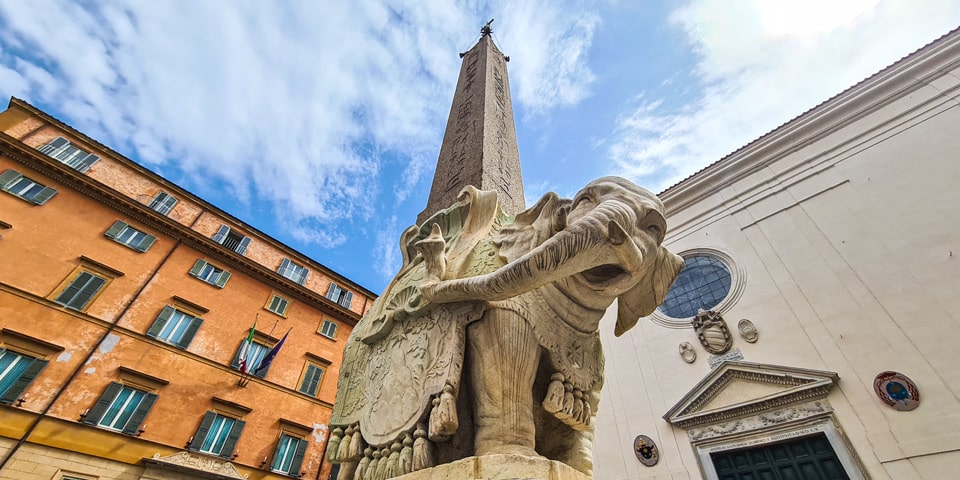
A four-minute walk from the Pantheon, in a quiet square that most people cross without slowing down, stands one of the oddest things in Rome. A marble elephant carries a small Egyptian obelisk on its back, and Romans have called it Pulcino della Minerva — Minerva’s little chick — for more than three centuries. It was the last major work Bernini designed before his death, and almost every part of it, from the animal underneath to the hieroglyphs on top, answers a question worth asking before you visit.
The square sits on top of ancient sacred ground. In Roman times this corner of the Campus Martius held a large sanctuary devoted to the Egyptian goddess Isis, whose cult had spread through Rome by the first century AD. A second shrine to the god Serapis stood beside it, and the name Minerva, the Roman goddess of wisdom, attached itself to the area as well. The Romans tended to blur Isis and Minerva together because both stood for wisdom, and that association is the reason the church and the square still carry Minerva’s name today.
When Christianity replaced the old cults, a church rose directly over the ruins. Its name says so plainly. Santa Maria sopra Minerva means “Saint Mary above Minerva,” the new faith built quite literally on the foundations of the old. The same thread of meaning runs through the whole site, from the Egyptian goddess of wisdom, to the Roman one, to the Virgin Mary, each understood in her own age as a guardian of divine wisdom.
The building the elephant faces deserves a stop of its own. Santa Maria sopra Minerva is the only Gothic church in Rome, an unusual sight in a city built of brick, travertine, and Baroque curves. Behind its plain Renaissance front lies a vaulted blue ceiling scattered with gold stars, the kind of interior you would expect in Florence or Siena rather than here.
Inside stands Michelangelo’s marble statue of Christ the Redeemer, carved in the 1520s, and beneath the high altar rests the body of Saint Catherine of Siena, one of the patron saints of Italy. The early Renaissance painter Fra Angelico is buried here as well. Many visitors photograph the elephant and never walk through the door a few steps away, which is a genuine loss.
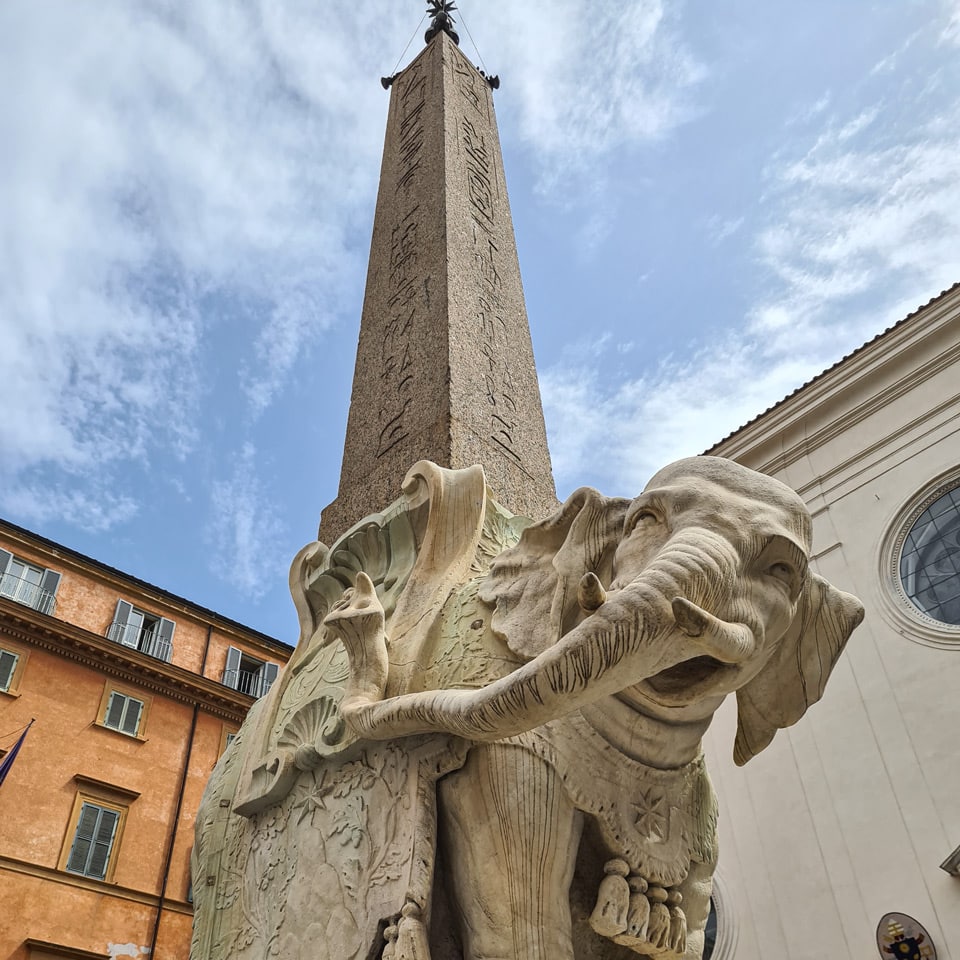
The red granite obelisk is far older than anything around it. A pharaoh named Apries had it carved around 580 BC for the Egyptian city of Sais, which makes it roughly 2,600 years old and one of the smallest of Rome’s ancient Egyptian obelisks. It began life as one of a matching pair. Its twin now stands a couple of hundred meters away on the Fountain of the Pantheon, the two stones reunited in the same neighborhood after travelling the same long road out of Egypt.
That road ran through the emperor Domitian, who brought the obelisk to Rome in the first century AD and set it up at the Temple of Isis, the very sanctuary whose ruins lie under the square. When the temple collapsed, the obelisk went down with it and lay buried for centuries. Dominican friars rediscovered it in 1665 while digging in the garden behind their church. Pope Alexander VII decided the find deserved a worthy setting and gave the work to the most celebrated artist in the city.
The elephant was not an arbitrary flourish. Bernini drew the idea from a strange and famous Renaissance book, the Hypnerotomachia Poliphili, printed in 1499, which included a woodcut of an elephant carrying an obelisk as an emblem of strength supporting wisdom.
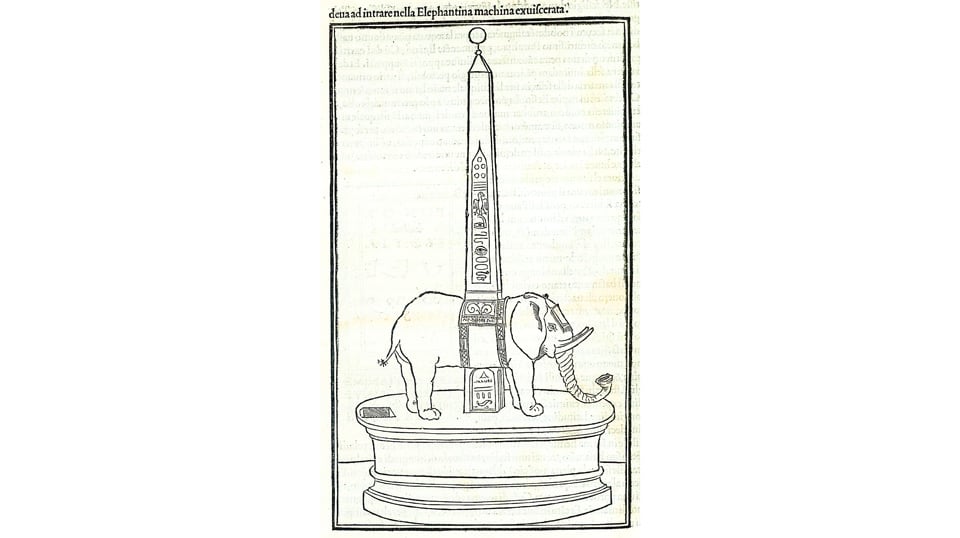
That image had circulated among educated Romans for over a century, so anyone learned enough to read the Latin on the base would have caught the reference at once.
The animal carried its own weight of meaning too. Ancient Romans regarded the elephant as the wisest and most pious of beasts. Pliny the Elder wrote that elephants came closest to human intelligence, understood the customs of their homeland, and seemed to worship the sun and moon. By placing ancient wisdom on the back of the creature antiquity itself thought wisest, Bernini built the monument’s whole argument into the choice of animal. One detail confirms how far this was from life study.
Bernini had never seen a real elephant and worked entirely from drawings and travelers’ accounts, which is why the creature looks a little dreamlike up close, and why early Romans thought it resembled a piglet, porcellino, a nickname that softened over time into the affectionate Pulcino it carries today.
The pedestal speaks on more than one side, and the texts reward a minute of attention. The dedication records that Alexander VII set up this ancient obelisk, a monument of Egyptian wisdom, in the year of salvation 1667, in the square that once belonged to Minerva and now to the Mother of God.
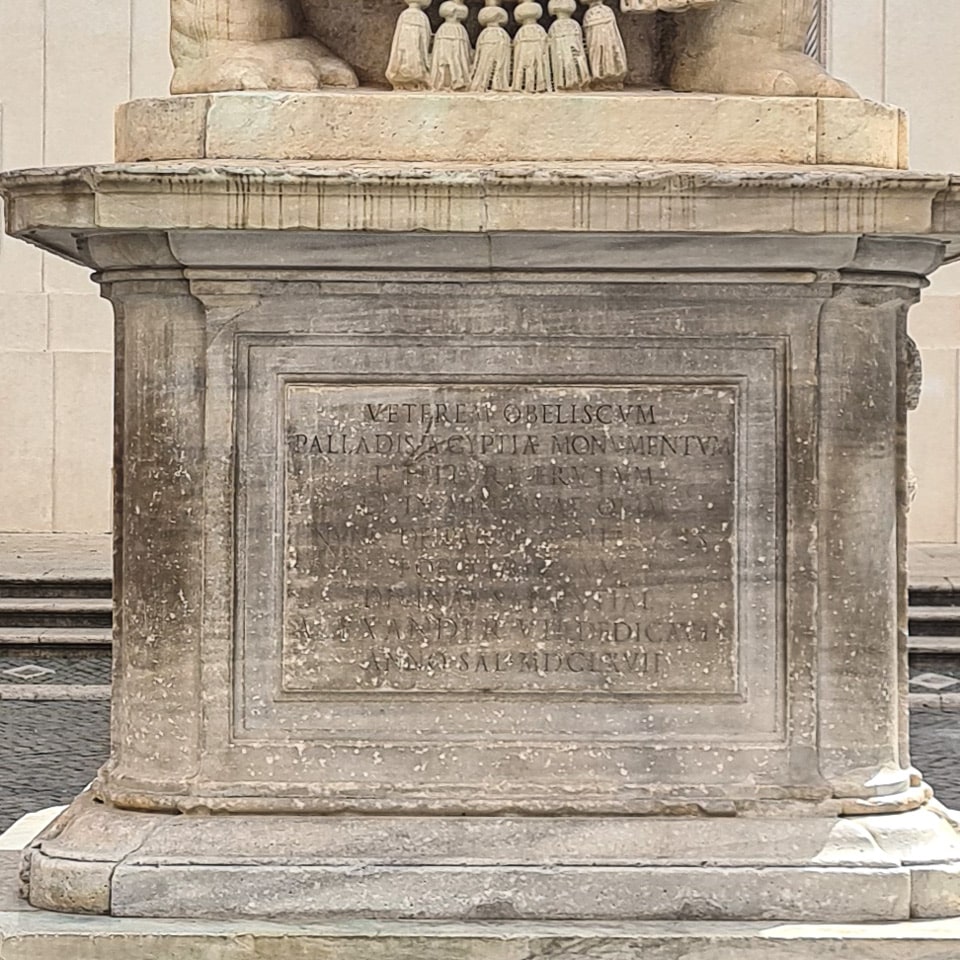
A second inscription explains what the whole thing means. In translation it reads, “Whoever you are who sees here the carved images of the wisdom of Egypt, borne by the elephant, strongest of beasts, understand this as proof that it takes a robust mind to support solid wisdom.” The elephant stands for the strong mind, the obelisk for ancient knowledge, and the cross on the summit claims that knowledge for the Church. Three civilizations are stacked in a single line of thought.
Alexander VII made certain no one would forget his part in it.
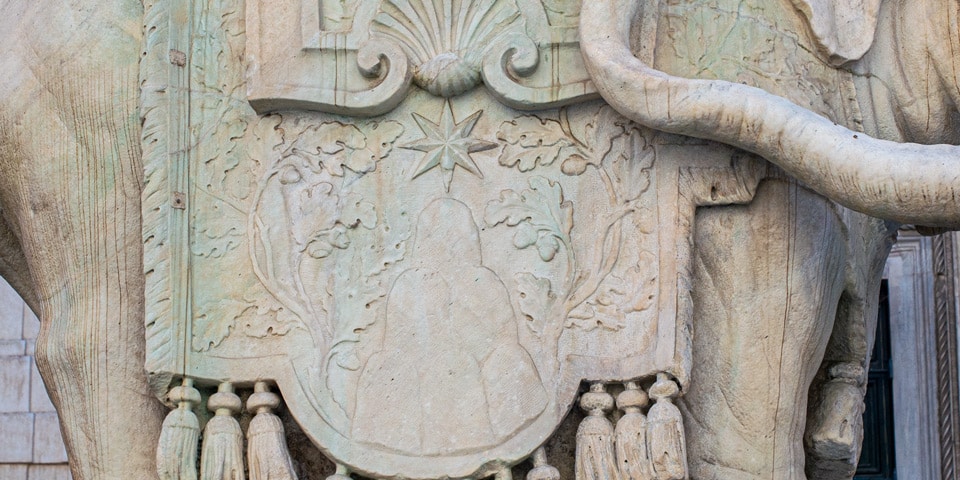
His family arms, the six Chigi hills beneath an eight-pointed star, appear on the saddlecloth, on the faces of the pedestal, and again at the very top of the obelisk beneath the cross.
Look at the elephant for a moment and something seems off. A heavy fringed cloth hangs over its body, filling the gap between its legs and leaving the animal squat and a little clumsy. That cloth hides an argument Bernini lost.
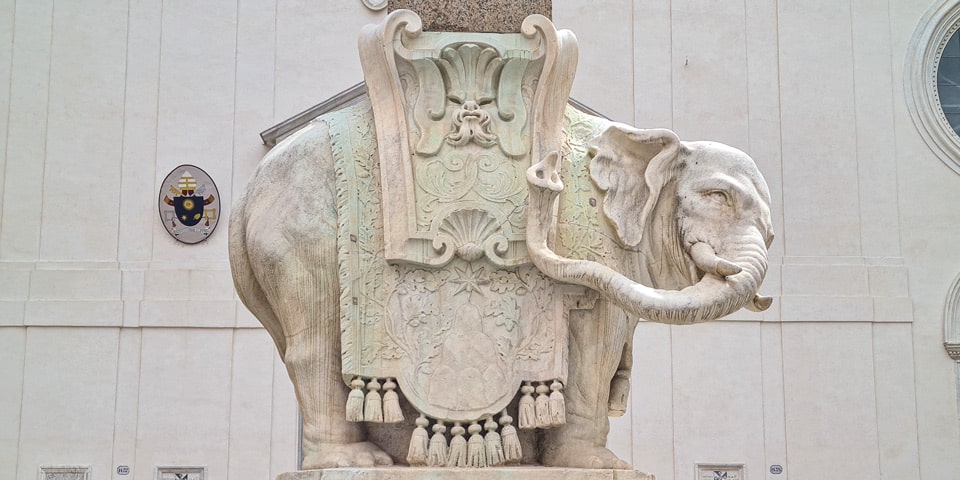
Bernini wanted the elephant to stand on its own four legs. The Dominican friars overseeing the project insisted the obelisk needed a solid support beneath the belly, and they prevailed, leaving the elephant with a bulky cube under its midsection. Bernini’s own engineering said no such crutch was needed, and the centuries have proved him right, but he was overruled all the same. His pupil Ercole Ferrata, who carved the marble, disguised the unwanted block under that elaborate drapery.
Bernini took his revenge in stone. The elephant turns its hindquarters squarely toward the Dominican headquarters, tail swept aside, muscles bunched in a pose no one could mistake for dignity. A satirist of the day, Cardinal Lodovico Sergardi, wrote a short verse in which the elephant explains that it points its rear at the friars in order to show its “respect.” Tellingly, when Bernini later looked back over his career, this monument appeared on none of his own lists of best work. The Dominican interference had soured it permanently.
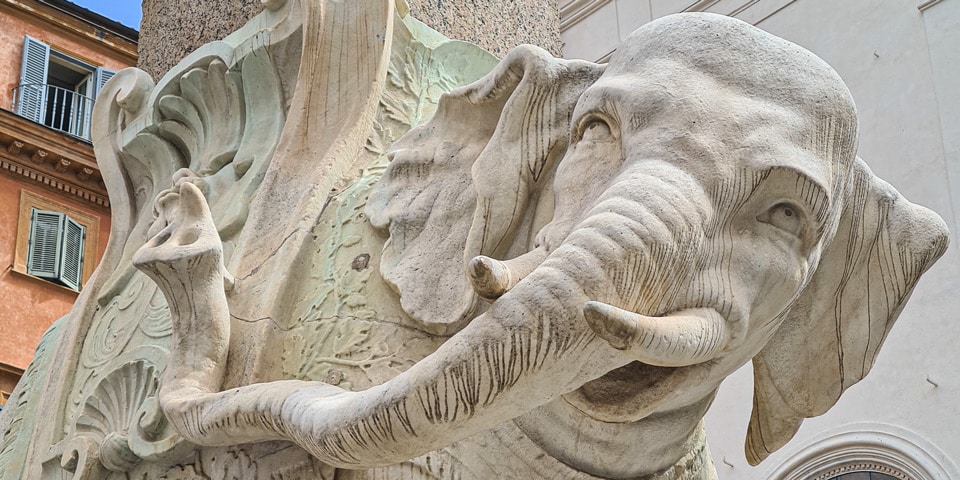
The elephant has a recurring injury. The tip of its left tusk has broken off more than once, most recently in February 2026, and before that during an act of vandalism in 2016. There is a small consolation in the damage. Restorers believe the broken fragment was not part of Bernini’s original carving but a piece added during a restoration in the 1970s, so what keeps snapping off is the repair rather than the 17th-century marble itself. Each time, the fragment has been recovered nearby and reattached.
Give the monument five minutes rather than a glance. Stand in front first, where the elephant faces the church, and find the Chigi hills and star worked into the saddlecloth. Walk around to the back to read the famous pose for yourself, knowing now why a 69-year-old master at the height of his fame bothered to insult a rival in marble. Step close to the pedestal to pick out the Latin, the dedication on the church side and the line about wisdom and strength on the side facing the square. Then look up.
The hieroglyphs running up the shaft name the pharaoh Apries, and at the summit sit the Chigi star and the Christian cross, the newest layer pressed onto the oldest. Pharaoh, Isis, Minerva, the Virgin, a feuding sculptor, and a triumphant pope all share one small monument, which is about as concise a portrait of Rome as the city allows.
Rome.us © 2026. Created with love by Roman experts and guides.