28607 views
Written by: Artur Jakucewicz
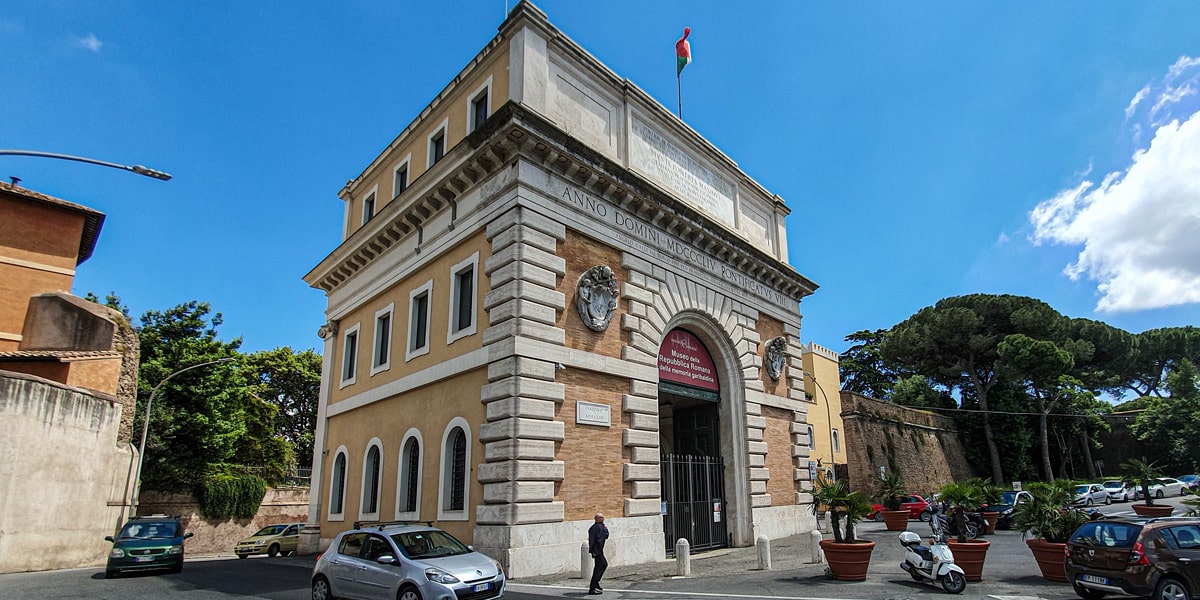
Porta San Pancrazio is easy to mistake for a monumental traffic island. Cars circle its nineteenth-century façade, while walkers moving between Villa Doria Pamphilj and the Janiculum pass around it without necessarily noticing that the building is a museum.
What waits inside is not a large art collection. It is a compact account of the Roman Republic of 1849, told through portraits, prints, weapons, red shirts, scale models, and multimedia reconstructions. Its real advantage is the address: the museum occupies the gate that French artillery destroyed during the siege it explains.
That makes the building more important than any single object in it. Outside, inscriptions celebrate the pope restored to power after the Republic fell. Inside, the galleries commemorate the people who defended that Republic. Few museums in Rome begin with such a visible contradiction.
The route through Rome’s Aurelian Walls once crossed the Janiculum through an ancient Porta Aurelia, later known as Porta San Pancrazio after the nearby basilica. Pope Urban VIII replaced the older defenses in the seventeenth century with the larger Janiculum Walls and had a new gate constructed here in 1642.
That Urban VIII gate stood directly in the path of the French assault on the Roman Republic. Fighting concentrated on the high ground west of the city, around Villa Pamphilj, Villa Corsini, the Vascello, and Porta San Pancrazio. By the end of June 1849, sustained cannon fire had damaged the gate beyond repair.
After papal rule returned, Pius IX commissioned Virginio Vespignani to replace it. Work began in 1854 and continued until 1857. The present building—with two lateral wings, four internal levels, and a central connecting hall—is therefore not the gate through which the republican defenders fought. It is the papal reconstruction of their ruined battlefield.
The upper façade is a condensed building history. The two coats of arms identify the two popes responsible for its principal phases. On the viewer’s right, three bees mark the Barberini arms of Urban VIII, builder of the 1642 gate. The weathered shield on the left belongs to Pius IX of the Mastai-Ferretti family, who ordered the post-siege reconstruction. Both are crowned with the papal tiara and crossed keys.
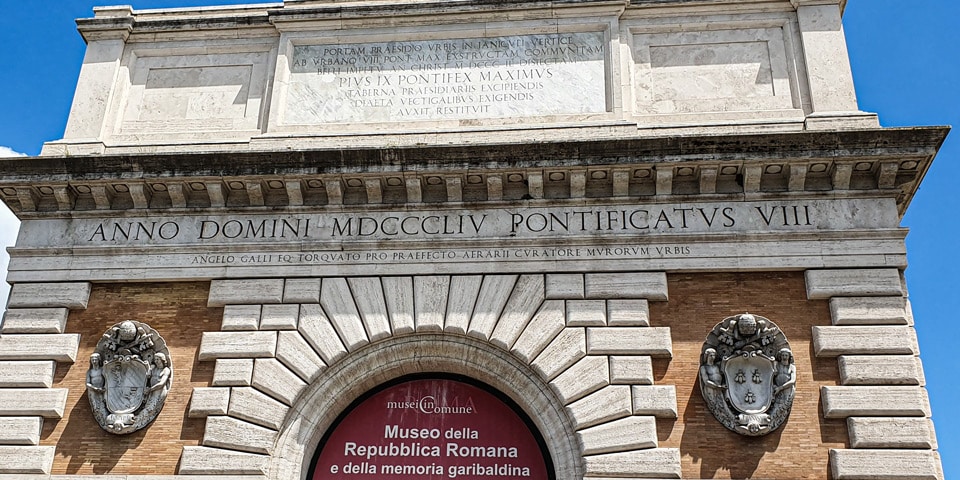
The main inscription preserves the monumental spelling in which V is used for U:
PORTAM PRAESIDIO VRBIS IN IANICVLI VERTICE
AB VRBANO VIII PONT MAX EXSTRVCTAM COMMVNITAM
BELLI IMPETV AN CHRIST M DCCC IL DISIECTAM
PIVS IX PONTIFEX MAXIMVS
TABERNA PRAESIDIARIIS EXCIPIENDIS
DELETA VECTIGALIBVS EXIGENDIS
AVXIT RESTITVIT
In English: “The gate built and fortified by Urban VIII, Supreme Pontiff, on the summit of the Janiculum for the defense of the city, and shattered by the violence of war in the year of Christ 1849, Pius IX, Supreme Pontiff, enlarged and restored, removing the quarters used to accommodate the garrison and adapting it for the collection of duties.”
The stone writes 1849 as M DCCC IL. The final IL is an unusual compact subtractive form; the normalized Roman numeral would be MDCCCXLIX. More revealing than the number is the neutral phrase belli impetu, “by the violence of war.” It avoids saying that a French army sent to restore Pius IX destroyed the gate while attacking Roman republicans.
The larger line below reads ANNO DOMINI MDCCCLIV PONTIFICATVS VIII: “In the year of Our Lord 1854, in the eighth year of the pontificate.” The date is 1854, not 1864: MDCCCLIV ends in 54, while 1864 would require MDCCCLXIV. Pius IX had been elected in June 1846, so the two dating systems agree.
A smaller administrative credit names the official responsible for the work: ANGELO GALLI EQ TORQVATO PRO PRAEFECTO AERARII CVRATORE MVRORVM VRBIS—“Under Angelo Galli, decorated knight, acting prefect of the Treasury and superintendent of the city walls.” Galli was the supervising official; the architect was Vespignani.
The museum begins before the siege, with the revolutions that spread across Europe in 1848. Pius IX had initially encouraged liberal hopes by granting reforms in the Papal States. Those hopes collapsed after he refused to support the Italian war against Austria. His prime minister, Pellegrino Rossi, was assassinated in November 1848, and the pope fled Rome for Gaeta.
An elected constituent assembly then declared an end to papal temporal government and proclaimed the Roman Republic on February 9, 1849. Giuseppe Mazzini became one of its three governing triumvirs. The new regime attempted to create a secular, representative state and reform taxation, justice, education, and relations between church and civil power.
It had almost no time. Pius IX appealed to Catholic powers, and the French Republic sent an expedition under General Nicolas Oudinot to restore him. Republican forces led by Giuseppe Garibaldi repelled the first French attack on April 30. After reinforcements arrived, the assault resumed on June 3 and developed into a siege that lasted for the rest of the month.
The museum’s most effective installation is its multimedia reconstruction of Rome in 1849. A model and projected panorama identify the city, the Janiculum villas, and the positions contested during the French advance. The geography explains what a list of dates cannot: whoever controlled this ridge could fire down toward Trastevere and the center of Rome.
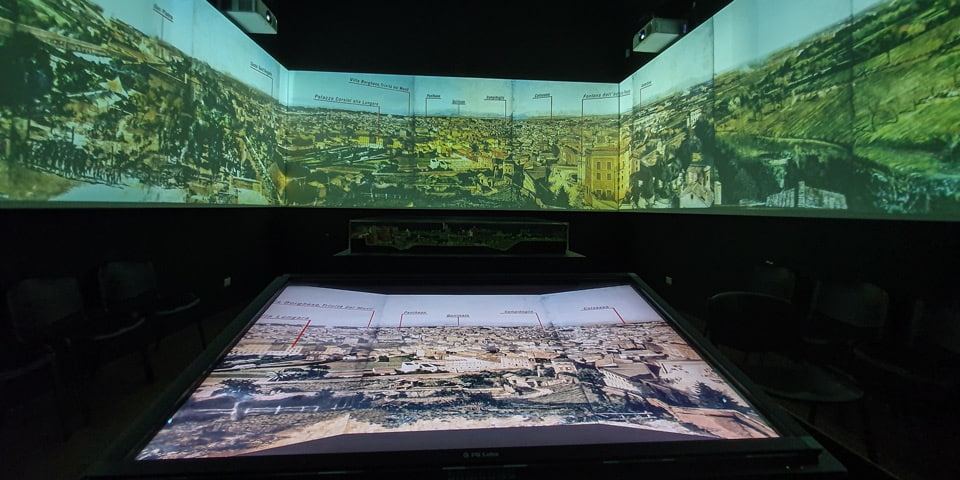
The exhibition continues through four floors in chronological sections: the European revolutions of 1848, the early reforms and retreat of Pius IX, the birth of the Republic, its young defenders, the siege, and the Constitution. Paintings, prints, films, and maps carry most of the explanation. Visitors expecting rooms full of masterpieces may find the collection modest; visitors trying to understand why this part of the Janiculum is crowded with Garibaldian memorials will find the sequence useful.
The section on the defenders avoids presenting 1849 as Garibaldi’s story alone. Mazzini shaped the political project, Carlo Pisacane worked on military organization, and volunteers arrived from across the Italian states. Several of the best-known dead—including Goffredo Mameli, Luciano Manara, Emilio Morosini, and Enrico Dandolo—were still in their twenties.
One of the largest paintings shows Giuseppe Garibaldi beside the dying Anita during the retreat that followed the Republic’s defeat. The scene is arranged like a historical drama: Anita lies at the center, attendants bend over her, and Garibaldi gestures from the edge of the room.
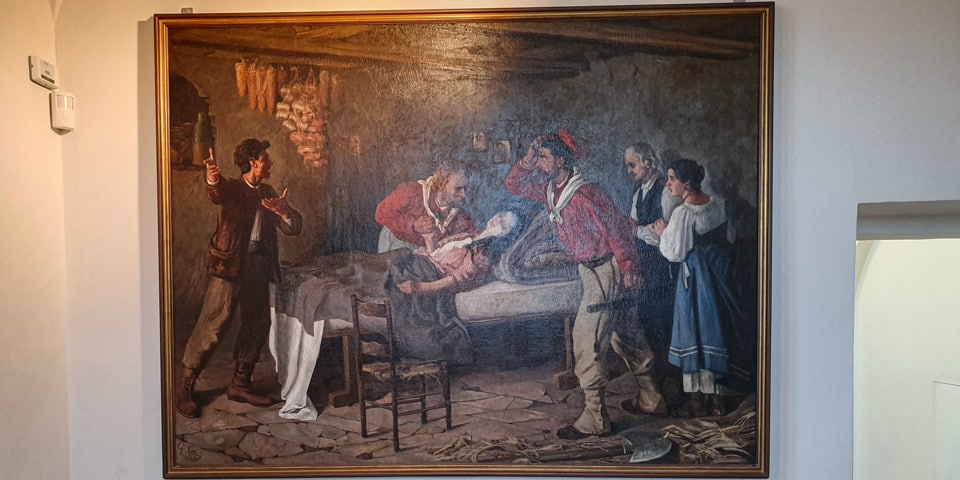
It should be read as memorial art rather than a literal record of her final moments. Anita had joined the retreat while pregnant and gravely ill, and she died near Ravenna on August 4, 1849. Later images transformed that private death into part of Italy’s national epic. The nearby monument and tomb of Anita Garibaldi performs the same transformation in bronze, combining the historical woman with the warrior-mother created by public memory.
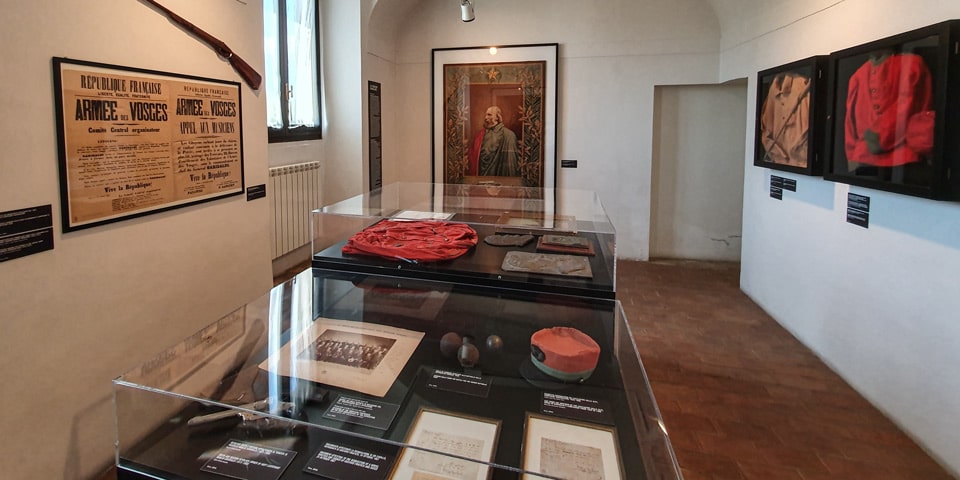
The red garments are visually the strongest objects in the museum. Garibaldi’s followers had adopted red shirts during the South American campaigns, before the color became inseparable from the volunteers who fought for Italian unification. It was never simply a decorative uniform. A red shirt made an irregular volunteer recognizable and eventually turned participation in Garibaldi’s campaigns into an identity that could be displayed, preserved, and inherited.
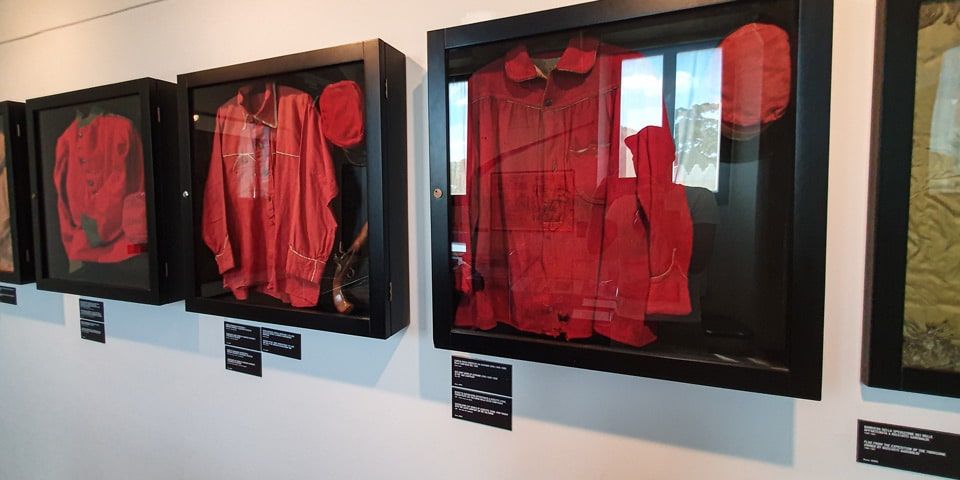
The surrounding portraits, rifles, pistols, caps, letters, and personal objects shift the final rooms away from the five-month Republic and toward memoria garibaldina—the culture of Garibaldian remembrance. The distinction in the museum’s full name matters. One half documents a political experiment in 1849; the other follows the people, symbols, and relics through which later generations turned that experiment into national history.
The most important object in the story is not a weapon. The Constitution of the Roman Republic was proclaimed on the Capitoline Hill on July 3, 1849, when French troops had already entered Rome and the Republic could no longer enforce it.
Its principles included popular sovereignty, equality before the law, a social responsibility to improve citizens’ material and moral conditions, and a clear distinction between religious authority and civil government. The text could not save the Republic, but it explains why the episode occupies a larger place in Italian democratic memory than its short duration might suggest.
This is also where the museum corrects the architecture outside. The façade presents 1849 as damage repaired by a pope. The galleries show that something more than a gate was destroyed: an unfinished attempt to define what a modern Roman state might be.
The gate may look familiar even to viewers who know nothing about 1849. In Spectre (2015), the beginning of the film’s Rome sequence follows James Bond’s Aston Martin DB10 along Via di San Pancrazio toward the gate. This is not the movie’s opening—the story begins in Mexico City—but it is the establishing approach to Bond’s Rome.
The same landscape carries another cinematic association. The opening of Paolo Sorrentino’s The Great Beauty takes place at the nearby Fontana dell’Acqua Paola, where a tourist collapses after looking across the city. The two films use the Janiculum differently, but both treat the ridge as a theatrical entrance to Rome rather than an ordinary neighborhood.
For a general visitor, the exterior is likely to be the most memorable part. The gate has stronger architecture, inscriptions, heraldry, and historical irony than any individual object inside. This is a specialist museum, and much of its value comes from reading maps and following a political chronology rather than encountering famous works of art.
That is not a reason to skip it when the door is open. Admission is free, and the building already lies on a natural walk from Villa Doria Pamphilj toward the Janiculum. From the gate, the Ciceruacchio statue is almost immediate; continuing along the promenade leads to the panorama and monuments of Piazzale Garibaldi. Another branch leads toward the Acqua Paola.
The museum works best as context for that walk. It explains why the ancient and papal wall systems meet here, why so many young patriots are commemorated nearby, and why the Janiculum became Rome’s landscape of republican memory. You may spend more time examining the façade than the collection, but after seeing the exhibition, the façade no longer says what it appeared to say when you arrived.
Rome.us © 2026. Created with love by Roman experts and guides.