
29666 views
Written by: Artur Jakucewicz
As you walk through Rome, Latin is everywhere: across church facades, above fountains, on ancient monuments, and on the floors and walls inside churches. Roman numerals appear beside names and titles, often recording a calendar year or a year of a pope’s reign. At first, these inscriptions can look more like decoration than readable text.
This practical guide concentrates on the patterns you are most likely to meet. With seven numeral symbols and a small working vocabulary, you can often identify the date and the authority behind the text. An action word then shows whether the monument was built, restored, or dedicated. Full translation still requires grammar and context, but these clues usually reveal the part that matters while you are standing in front of the stone.
Even a partial reading changes the experience of a monument. It is a satisfying skill to share with your companions and an easy way to become the unofficial Rome expert of the group. When I show these rules to families, children often spot the dates before the adults do.
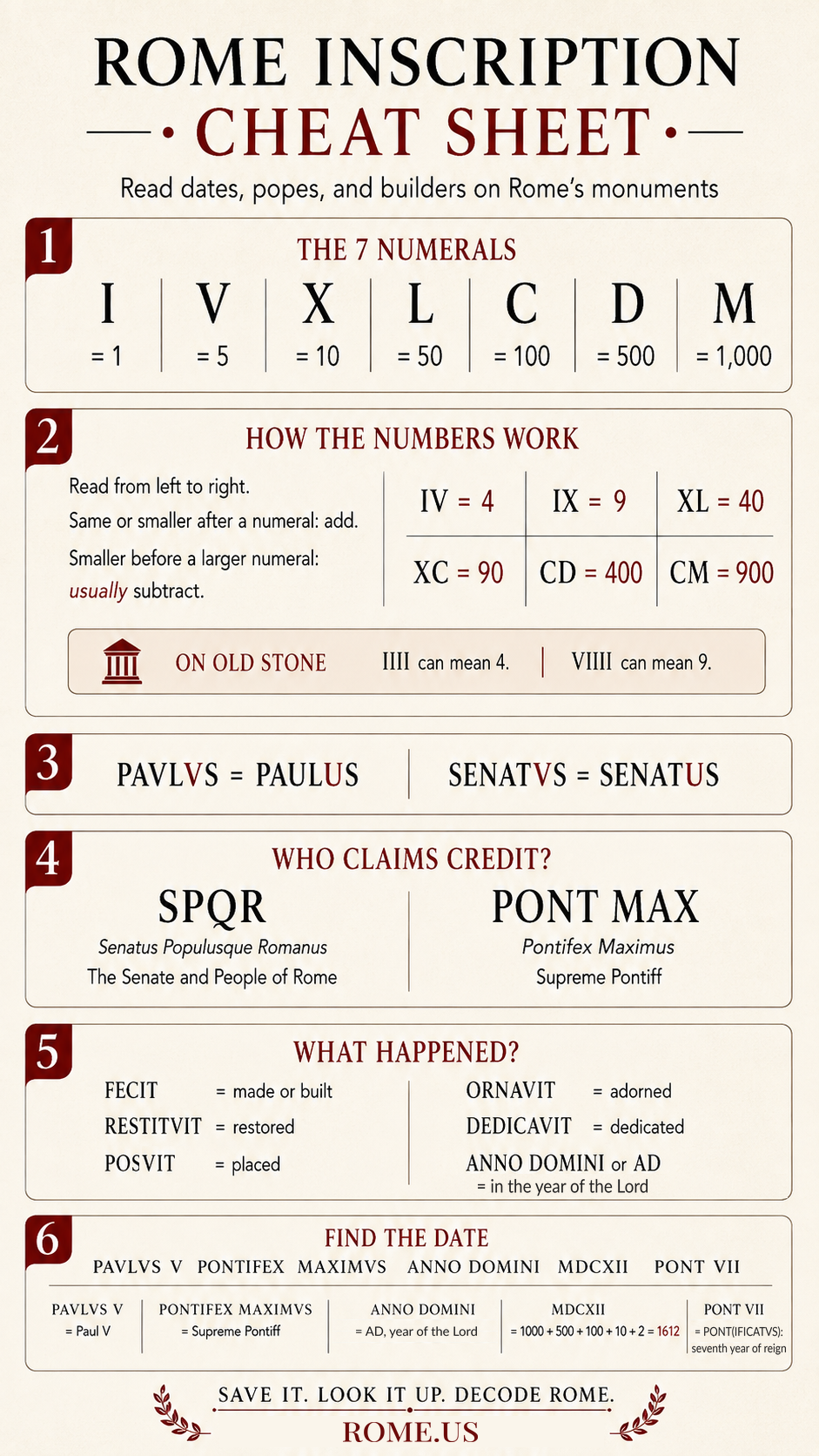
At the end, you can download a one-page Rome Inscription Cheat Sheet infographic to keep on your phone while exploring the city.
Roman numerals use seven basic symbols:
| Roman numeral | Value |
|---|---|
| I | 1 |
| V | 5 |
| X | 10 |
| L | 50 |
| C | 100 |
| D | 500 |
| M | 1,000 |
Read the symbols from left to right. When a symbol is followed by one of equal or lower value, add it. MDL is 1,000 + 500 + 50, so it equals 1550.
A smaller symbol placed before a larger one usually signals subtraction. Modern school rules use six standard pairs:
One of my favorite churches in Rome is San Carlo alle Quattro Fontane, the small and unusually restless Baroque church designed by Francesco Borromini. Romans call it San Carlino. Its facade bends inward and outward, but the date carved across it is surprisingly easy to read.
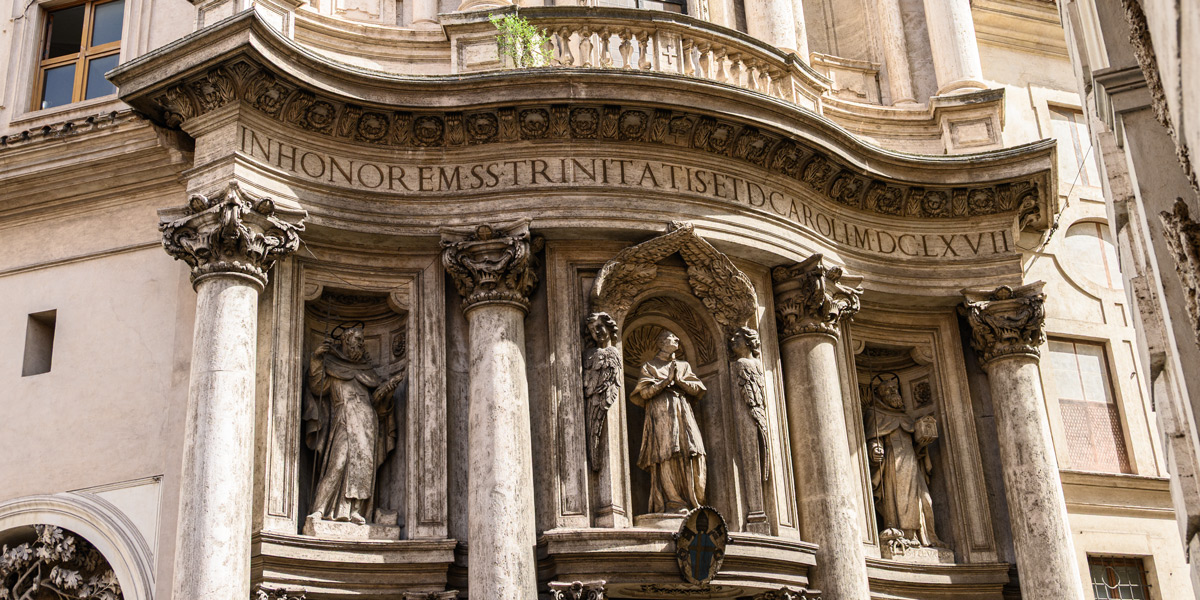
The inscription ends with MDCLXVII. Split it into M + D + C + L + X + V + II: 1,000 + 500 + 100 + 50 + 10 + 5 + 2 = 1667. Every value is added, so this example requires no subtractive pair.
Do not treat 1667 as the construction date of the entire church. Borromini had erected the lower level of the facade when he died that year, but his nephew Bernardo later finished the upper level. The numeral dates this stage of the facade rather than the whole building.
The school pattern does not cover every ancient inscription. Roman carvers sometimes wrote numbers entirely by addition. Four may appear as IIII instead of IV, while nine may appear as VIIII instead of IX. Both systems could occur in the same inscription.
The Colosseum turns these rules into a practical lesson. Its ground level had 80 entrances. Seventy-six arches were numbered to direct spectators toward their assigned routes, while four principal entrances stood outside that numbered sequence. The carved numbers were highlighted in red, and spectators followed routes indicated on entrance tokens. Twenty-nine ancient numbers remain visible along the northern side.
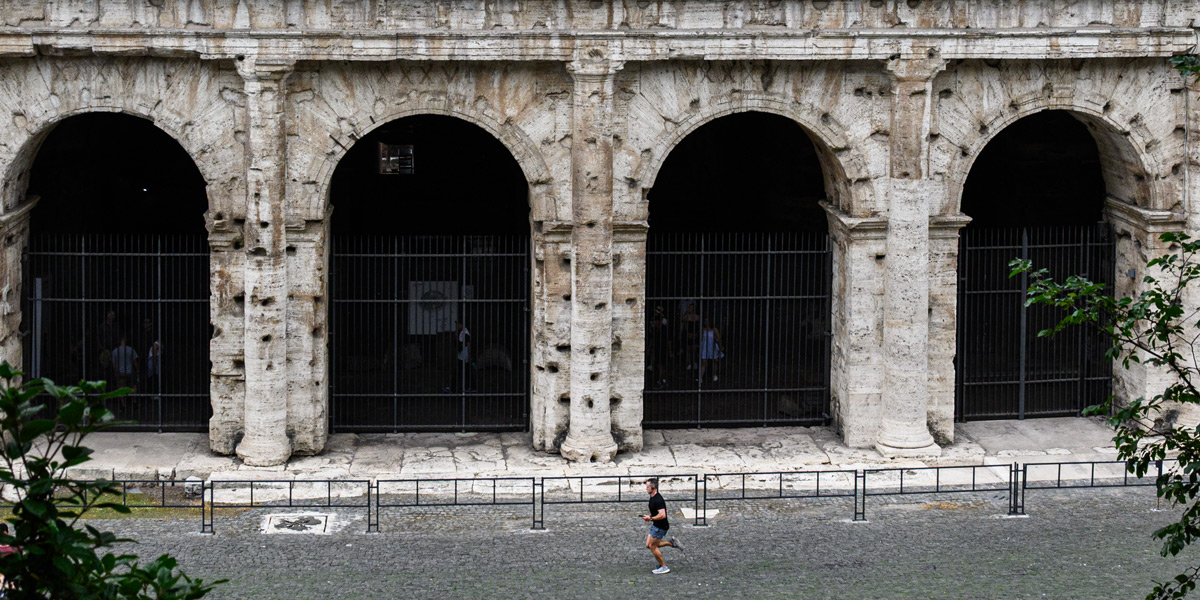
This photograph shows four consecutive arches numbered XXXV, XXXVI, XXXVII, and XXXVIII, or 35 through 38. The runner in front gives a useful sense of the entrances’ height and width. Read the sequence by addition: XXX is 30, V adds 5, and each following I adds one more.
The same numbered series preserves the historical exception. Arch 44 is written XLIIII: XL gives 40, followed by four I symbols. A modern converter may expect XLIV, but the ancient carving is perfectly intelligible.
You may hear that Romans avoided IV because those letters begin IVPPITER, a monumental spelling of Jupiter. Surviving evidence does not support a general religious ban; addition and subtraction forms simply coexisted.
Classical monumental lettering did not distinguish the vowel U from the consonant V in the way modern English does. When a carved word looks impossible, replace its V with U and try again.
The centered dots between words are called interpuncts. Treat them as spaces rather than decimal points. A carver might use dots consistently, place them only in part of a text, or omit them. Abbreviations saved space and could help a carver balance the layout.
Instead of translating an inscription in its carved order, begin by identifying who is speaking. The following abbreviations reveal a name or authority and explain what a nearby numeral measures:
| On the stone | Expanded Latin | Useful meaning |
|---|---|---|
| SPQR | Senatus Populusque Romanus | The Senate and People of Rome |
| PONT MAX | Pontifex Maximus | Supreme Pontiff, a papal title on later monuments |
| AN or ANNO | Anno | In the year |
| PONT followed by a numeral | Pontificatus | The numbered year of a pontificate |
D.O.M. often appears at the top of a tomb or memorial, including tablets on church walls and slabs set into the floor. Do not add D as 500 and M as 1,000. Here the letters abbreviate Deo Optimo Maximo, “To God, the Best and Greatest.” They introduce a Christian dedication, and the name of the deceased normally follows below.
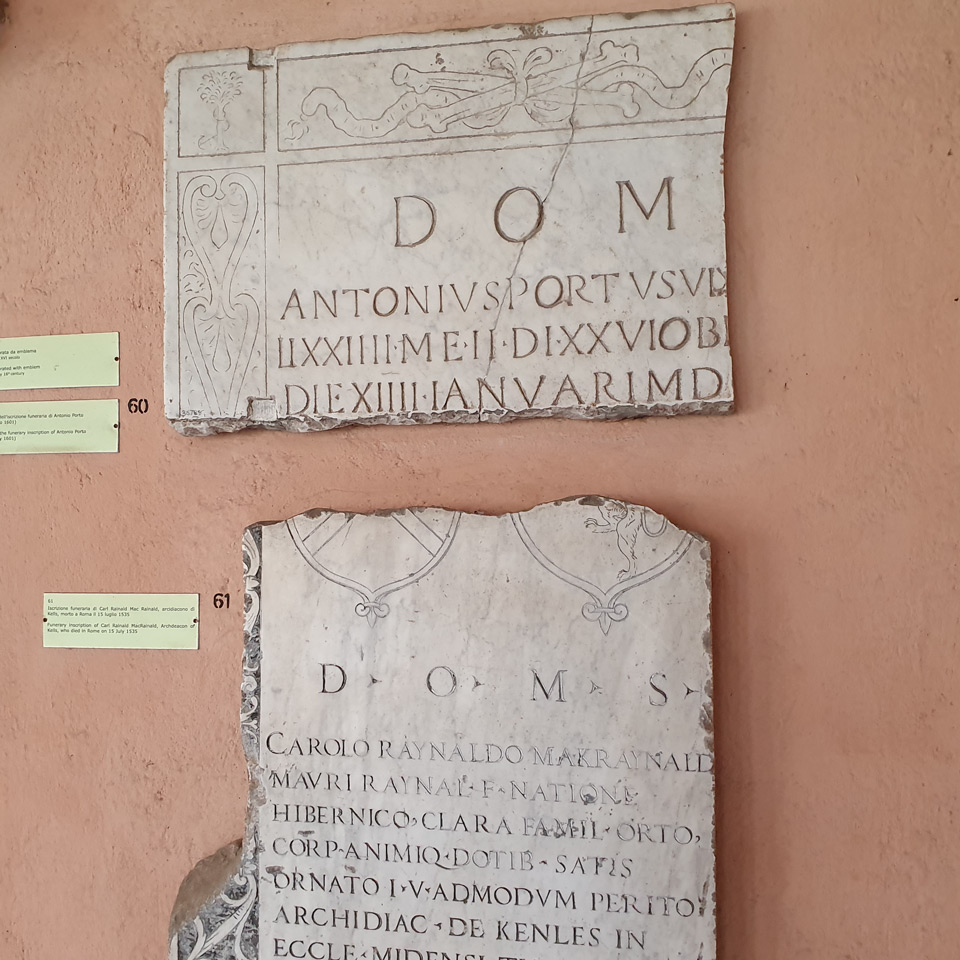
The upper stone in the photograph begins D O M. The lower one uses D O M S, in which the final S normally expands to sacrum, “sacred.” The fuller formula is therefore Deo Optimo Maximo Sacrum, “Sacred to God, the Best and Greatest.” Dots, small diamonds, or wider spaces may separate the letters.
The wording echoes the ancient title Iovi Optimo Maximo, addressed to Jupiter, but Christian D.O.M. refers to God. Do not confuse it with the older D.M. or D.M.S. on Roman tombs. Those usually mean Dis Manibus or Dis Manibus Sacrum, formulas addressed to the spirits of the dead.
The verb usually gives the most useful information:
| Latin | Meaning to remember |
|---|---|
| FECIT | Made or built |
| FIERI FECIT | Had it made |
| RESTITVIT | Restored |
| POSVIT | Placed |
| ORNAVIT | Adorned |
| DEDICAVIT | Dedicated |
| PERFECIT | Completed |
PONT MAX identifies a pope; it does not say that he personally built the object. The action word states the claim being made.
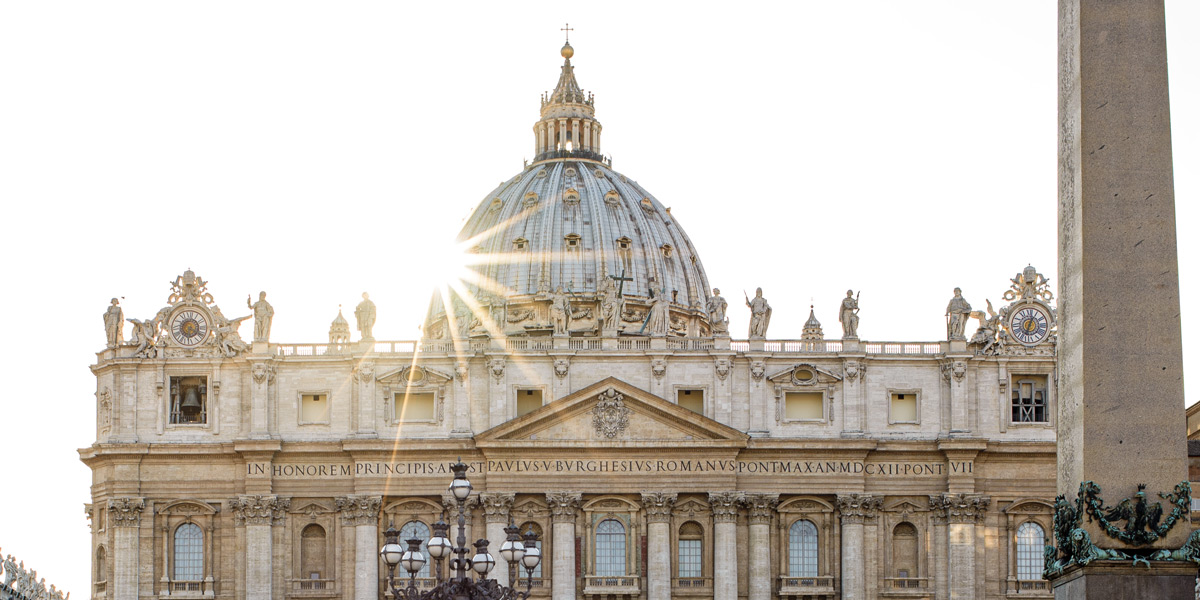
The inscription across St Peter’s Basilica is a complete exercise in one line:
IN HONOREM PRINCIPIS APOST PAVLVS V BVRGHESIVS ROMANVS PONT MAX AN MDCXII PONT VII
Begin with PAVLVS V, which identifies Pope Paul V. BVRGHESIVS is his Latinized family name and identifies the Borghese family. ROMANVS means Roman. PONT MAX supplies his title.
The date follows AN, an abbreviation of anno. MDCXII equals 1612. The final PONT VII records the seventh year of Paul’s pontificate. The opening words dedicate the work to the Prince of the Apostles, Saint Peter.
Notice what is missing: the stone contains no explicit verb. English translations often supply “erected” from context.
Now look above the text. The shield carries the Borghese eagle and dragon, with the papal tiara and crossed keys above it. The inscription names the family, while the coat of arms repeats the same claim as an image.
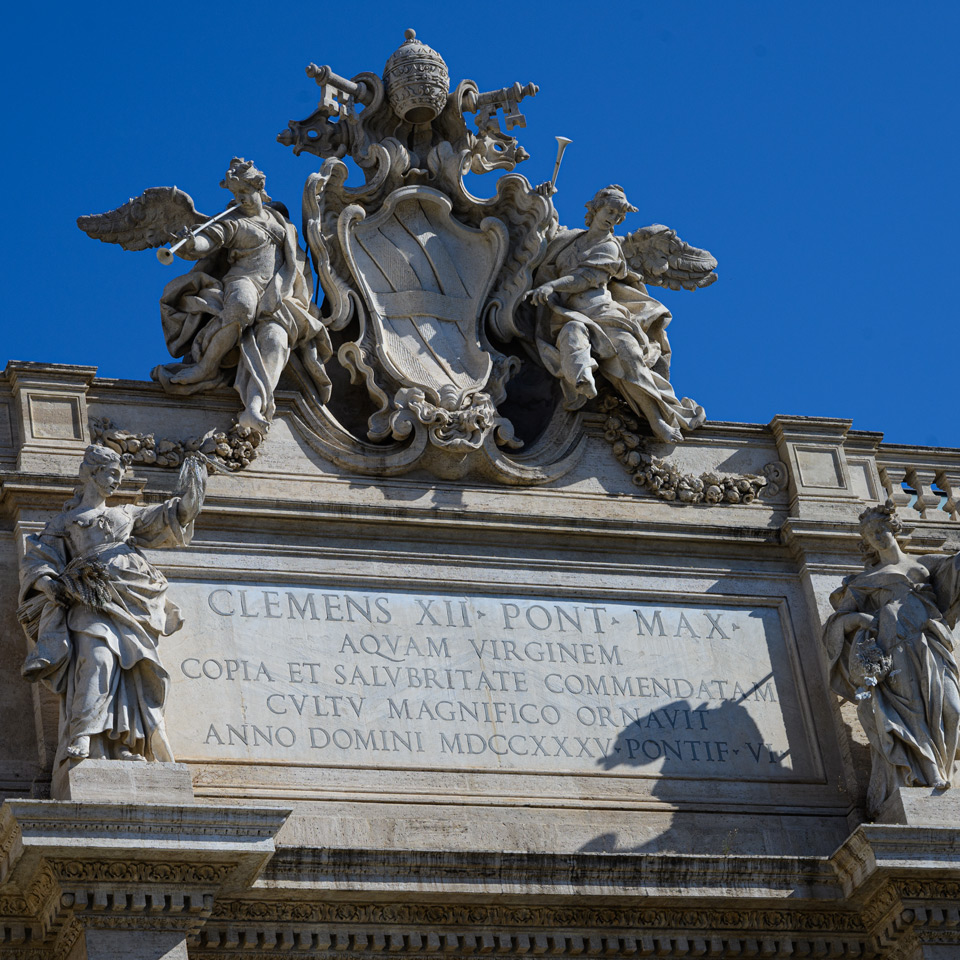
The large panel high on the Trevi Fountain reads:
CLEMENS XII PONT MAX
AQVAM VIRGINEM
COPIA ET SALVBRITATE COMMENDATAM
CVLTV MAGNIFICO ORNAVIT
ANNO DOMINI MDCCXXXV PONTIF VI
Begin with CLEMENS XII PONT MAX. Here CLEMENS XII identifies Clement XII rather than a date, and PONT MAX gives his title, Supreme Pontiff.
Now jump to the bottom line: ANNO DOMINI MDCCXXXV PONTIF VI. ANNO DOMINI introduces the calendar year, MDCCXXXV equals 1735, and the closing PONTIF VI records the sixth year of his pontificate.
The middle three lines explain the work. The object of ORNAVIT is AQVAM VIRGINEM, the Aqua Virgo aqueduct. The inscription praises its abundant, healthful water and says that Clement adorned it with a grand architectural setting.
The photograph adds a visual signature. Above the text, the striped shield of Clement’s Corsini family is crowned by the papal tiara and crossed keys. Two winged figures of Fame blow trumpets on either side.
Other inscriptions record later phases under Benedict XIV and Clement XIII; a separate text dates the completed decoration to 1762. The visible date 1735 therefore belongs to Clement XII’s phase, not to the finished fountain.
The Pantheon carries a compact inscription that uses several common abbreviations:
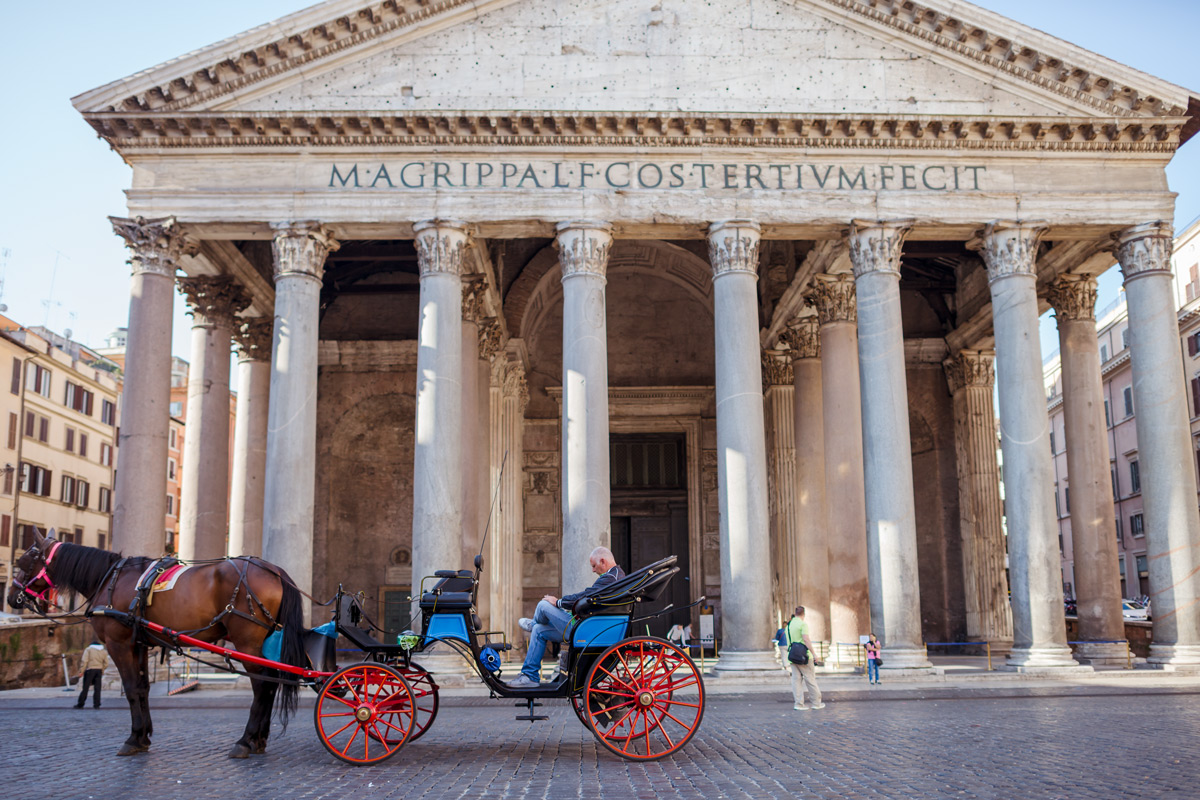
M AGRIPPA L F COS TERTIVM FECIT
There is no calendar year written in Roman numerals here. The isolated M abbreviates Marcus, while L abbreviates Lucius; neither means 1,000 or 50 in this sentence. TERTIVM is a Latin word meaning “for the third time,” not a numeral group. Context comes before arithmetic.
Read the line in four pieces. M AGRIPPA gives the name, and L F expands to Lucii filius, “son of Lucius.” COS TERTIVM records a third consulship, while FECIT claims construction. In plain English: “Marcus Agrippa, son of Lucius, made this when consul for the third time.”
COS TERTIVM also points historians to 27 BC, the year of Agrippa’s third consulship. The building visible today belongs largely to Hadrian’s second-century reconstruction, so the retained dedication preserves Agrippa’s name without telling the complete history of the surviving rotunda and dome.
Look down as you walk through Rome: the city stamps SPQR even on metal manhole covers. The initials also appear on fountains and other municipal fixtures because they remain part of Rome’s civic emblem.
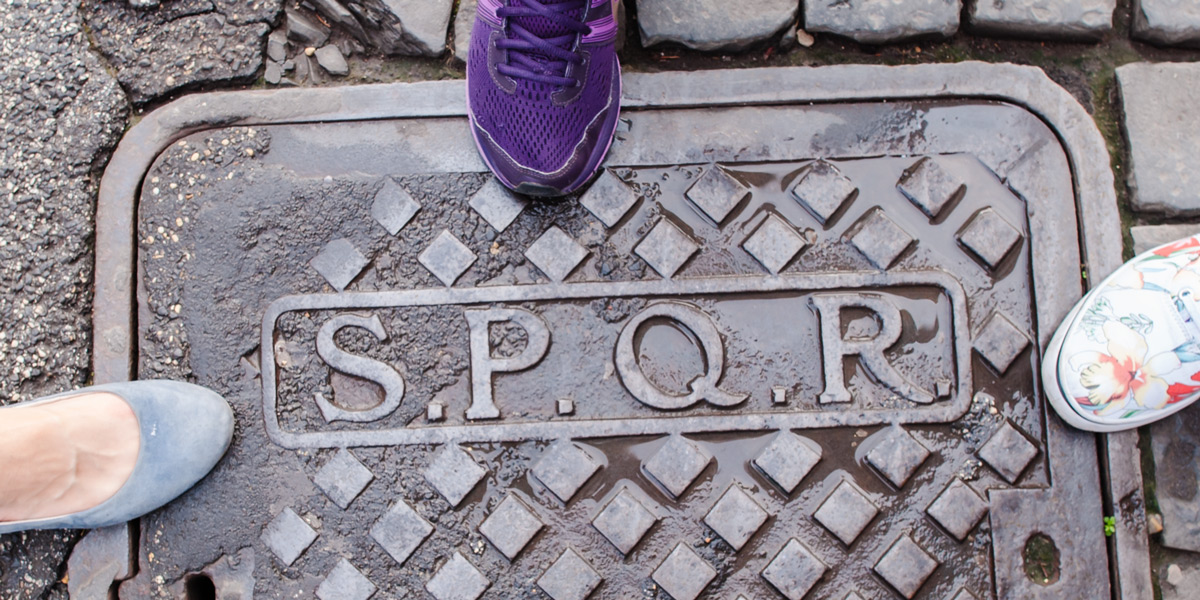
At the Roman Forum, the Temple of Saturn lets you see the phrase behind those four letters written in full:
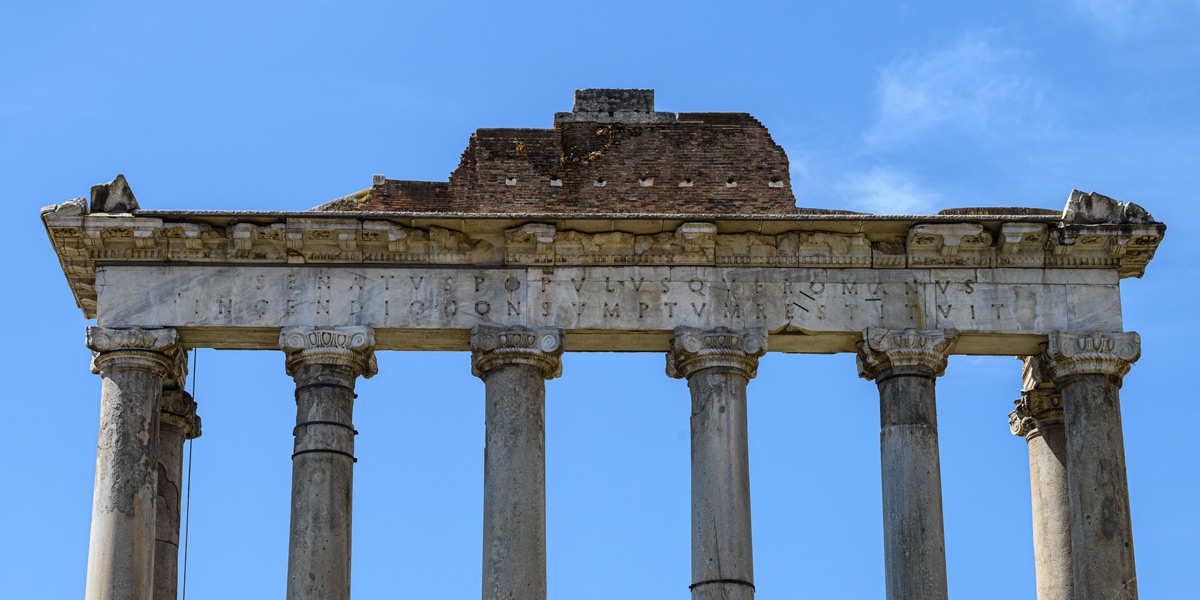
SENATVS POPVLVSQVE ROMANVS INCENDIO CONSVMPTVM RESTITVIT
The upper line in the photograph reads SENATVS POPVLVSQVE ROMANVS. Change V to U and it becomes Senatus Populusque Romanus, “The Senate and People of Rome.” Its initials form SPQR; the Q comes from -que, the ending meaning “and.”
The second line, INCENDIO CONSVMPTVM RESTITVIT, explains the action. RESTITVIT means “restored,” and the full sentence means: “The Senate and People of Rome restored what had been consumed by fire.” The surviving rebuilding is usually dated to the later fourth century AD, although the exact fire remains uncertain. The inscription itself names neither an emperor nor a year; it emphasizes the restoring authority.
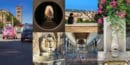
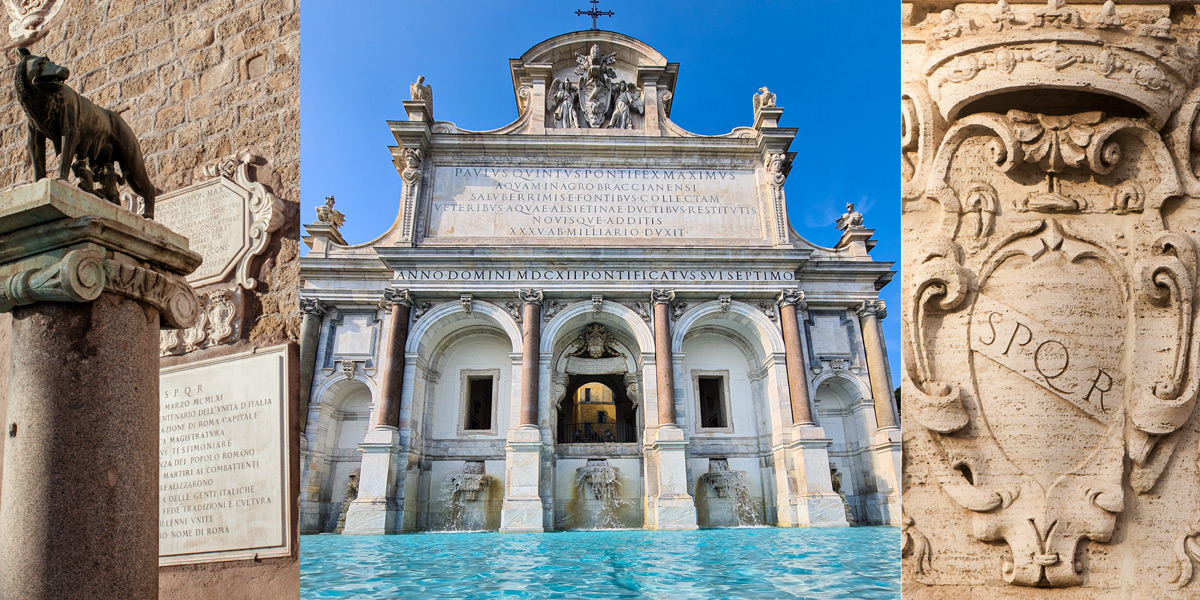
Start above the shield. A papal tiara and the crossed keys of Saint Peter identify papal authority. The emblems inside the shield identify the pope’s family but may not identify one individual by themselves. Read the collage from left to right.
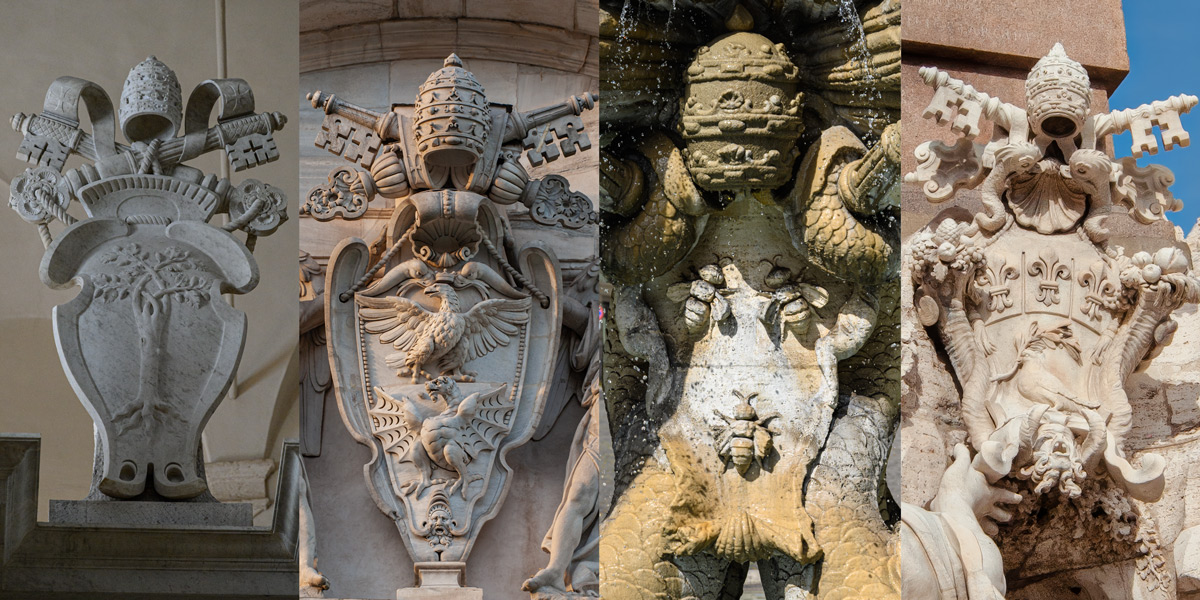
Read each coat of arms beside the inscription, then check the date and location before assigning it to one pope or building phase.
When you find a new inscription, take a straight photograph or use your phone’s zoom. Morning or late-afternoon light falling across the stone from the side often makes shallow letters easier to see than flat midday light.
Then work through the text in this order:
Do not force the entire text through an automatic translator first. Abbreviations and omitted words often produce nonsense, especially when V functions as U. Identify the fixed parts yourself, then use a reliable transcription or specialist source for the remaining grammar.
A broken letter may change a name; a numeral can mark a ruler’s sequence, and a restoration text may omit the original architect. Stop where the visible evidence stops.
At the next church, pause before walking inside. Take thirty seconds to identify one name or date before reaching for a translation.
After one successful reading, the next inscription is hard to ignore. The letters become labels left by the people who paid for the monument or later claimed it.
Rome.us © 2026. Created with love by Roman experts and guides.