

28465 views
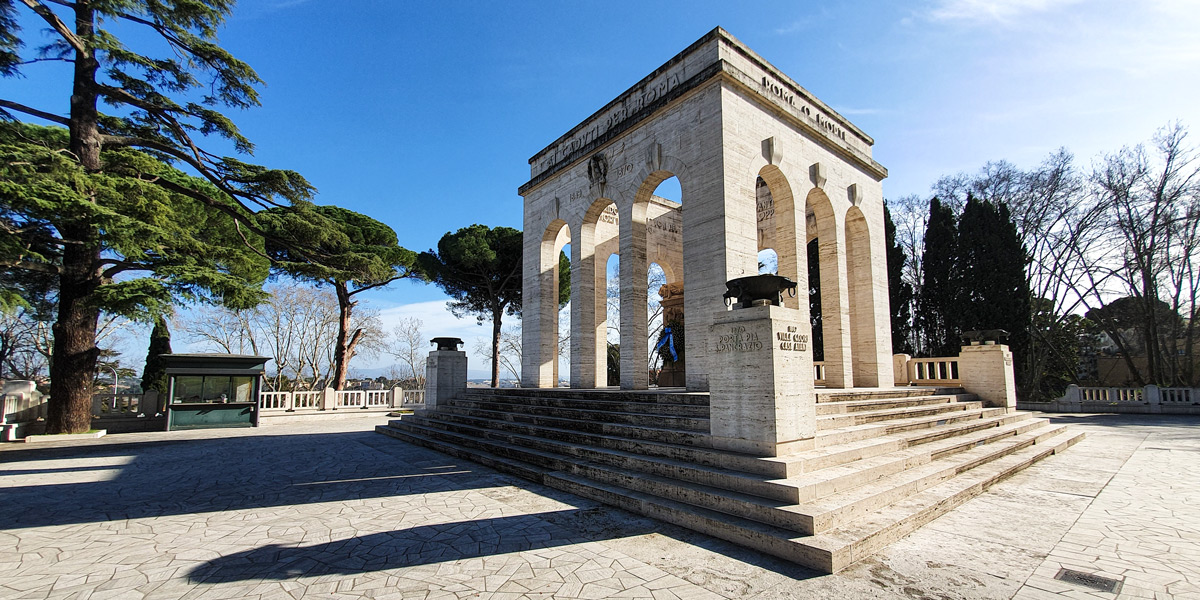
From Via Garibaldi, the white travertine arches look like the memorial. They are only its upper shell. At the rear, two stairways descend into a crypt where the remains of roughly 200 mostly unidentified fallen are kept, more than 1,600 names line the walls, and a red porphyry sarcophagus holds Goffredo Mameli — the twenty-two-year-old who wrote the words of Italy’s national anthem.
The difference between those two numbers matters. This is not a conventional cemetery with one identified body behind every name. It is an ossuary assembled from old graves and battlefields, and a collective record of the people who died in successive struggles for Rome between 1849 and 1870.
Despite its English name, the Garibaldi Ossuary Mausoleum does not contain Giuseppe Garibaldi. He is buried at his home on the island of Caprera. Garibaldino refers instead to Garibaldi’s followers and the broader cause associated with them.
The distinction changes how you read the Janiculum. The equestrian monument at Piazzale Garibaldi celebrates the commander above the city; the ossuary turns from the famous leader to the people who fought and died. Some defended the short-lived Roman Republic. Others fell in later attempts to end papal rule and make Rome the capital of a united Italy.
The location is not symbolic guesswork. This part of the hill, known as Colle del Pino, formed part of the final defensive ground of the Roman Republic in 1849.
Rome was not yet the capital of Italy in 1849. A republic had been proclaimed on February 9 after Pope Pius IX fled the city, and French forces arrived to restore papal government. Garibaldi repelled their first attack on April 30, but the decisive offensive began on June 3. Fighting continued around Porta San Pancrazio, Villa Corsini, Villa Spada, and the western edge of the Janiculum until the republic finally fell in early July.
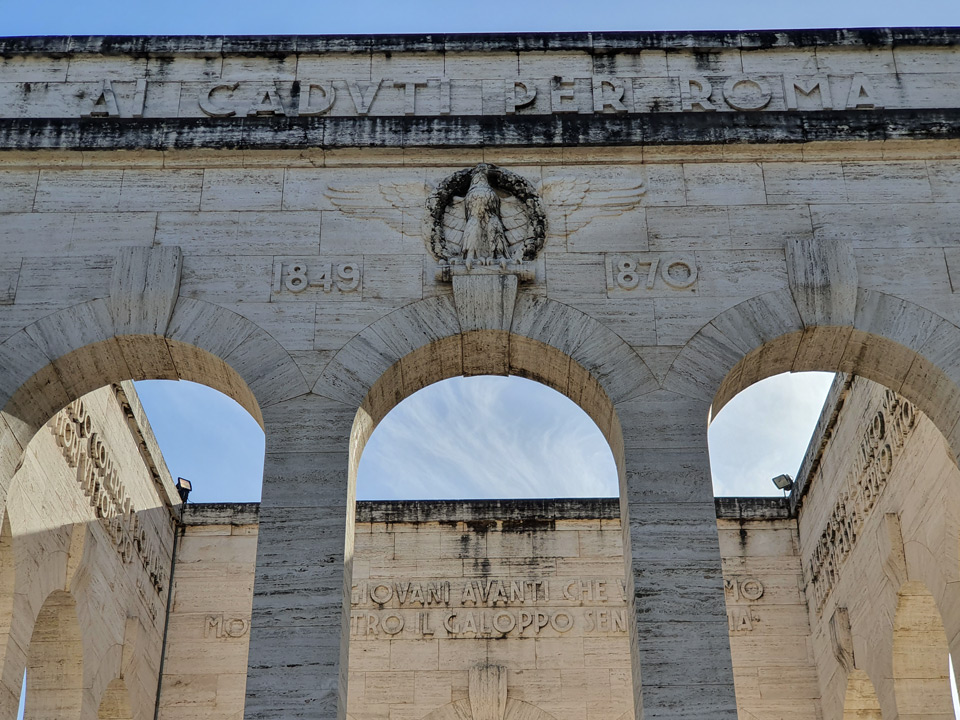
The dates on the mausoleum extend beyond that siege because this is a memorial to several campaigns, not one war. Its four corner pedestals name the battles of 1849, then Aspromonte in 1862; Monterotondo, Mentana, Villa Glori, and Casa Ajani in 1867; and finally Porta Pia and San Pancrazio in 1870. Read together, the stones turn twenty-one years of failed expeditions, insurrection, and eventual victory into a compact timeline.
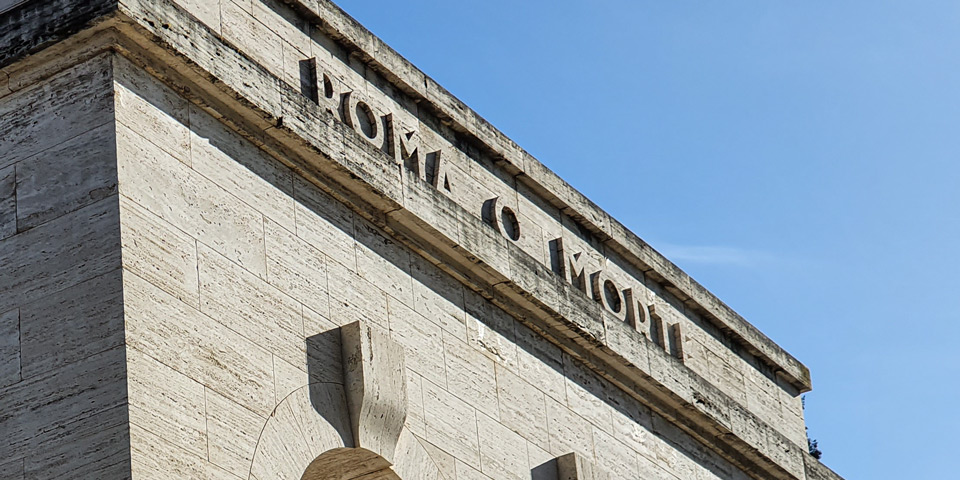
The inscription Roma o Morte — “Rome or Death” — belongs especially to the 1862 campaign. Garibaldi rallied volunteers under that cry and marched toward Rome, only to be stopped and wounded at Aspromonte by the army of the newly formed Kingdom of Italy. Five years later, French and papal troops defeated another Garibaldian attempt at Mentana. Rome was incorporated into Italy only in 1870, after Italian troops breached the wall at Porta Pia.
The effort to gather the dead began soon after the capture of Rome. In 1878–1879, Garibaldi and his son Menotti helped promote a law recognizing the Janiculum as the place where the remains of those killed in the struggles for the city should be collected.
Finding them required detective work. Some had been buried at Campo Verano; others still lay near the Aurelian Walls where they had fallen. Further searches recovered remains from Villa Borghese, La Giustiniana, and vineyards between San Pancrazio and Porta Maggiore. The first burials in the Janiculum ossuary took place in 1879, with more remains transferred in 1884.
That early burial ground was far simpler than the structure visible today and was neglected for years. The current mausoleum belongs to a later political moment.
During the 1930s, Ezio Garibaldi — Giuseppe’s grandson and president of the veterans’ association Società dei Reduci Patrie Battaglie — revived the plan for a permanent monument. The government accepted the proposal and paid for the work. Architect Giovanni Jacobucci designed the complex, which was built over two years and inaugurated on November 3, 1941, under Mussolini’s regime.
The opening ceremony centered on Mameli. His coffin, wrapped in the Italian tricolor, was carried through Rome in a deliberately long procession before reaching the hill where he had been mortally wounded ninety-two years earlier.
Jacobucci gave the memorial the severe language of an imagined ancient Rome: a square travertine portico with three round arches on each side, raised above a broad staircase. At its center stands an altar cut from a single block of red granite from Baveno. The Capitoline she-wolf, an imperial eagle, shields, Roman swords, and legionary standards cover the stone. Four bronze braziers decorated with wolf heads stand at the corners and are still lit during official commemorations.
The architecture is not neutral. It places the democratic experiment of 1849 and the volunteer tradition of the Risorgimento inside the monumental, imperial vocabulary favored by the Fascist state. That tension is part of the building’s history, not a detail to smooth away.
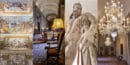
Behind the portico, a double staircase descends to a heavy bronze door. The space below is far richer than the pale exterior suggests. Gold mosaic covers the low vault; colored marbles line the floor and walls; and a large circular pillar at the center is decorated with palms and glowing alabaster crosses.
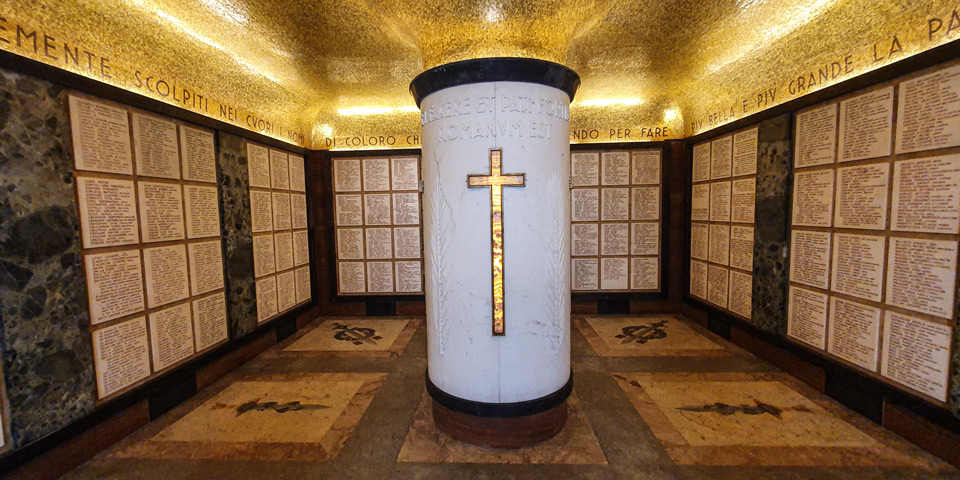
Thirty-six masonry niches are closed by panels recording more than 1,600 names. The physical remains represent only about 200 people and are mostly unidentified. The wall is therefore a roll of remembrance rather than a map showing exactly who lies behind each slab.
Among those commemorated are Luciano Manara, Enrico Dandolo, Andrea Aguyar, Colomba Antonietti, Giuditta Tavani Arquati, and Ciceruacchio and his sons.
Their stories are very different: soldiers and civilians, men and women, people killed in battle and others executed after capture. The ossuary binds them together through a shared political cause rather than a single manner or moment of death.
One burial is deliberately set apart. A polished red porphyry sarcophagus holds Goffredo Mameli, the Genoese poet who wrote Il Canto degli Italiani, better known by its opening words, Fratelli d’Italia. Mameli wrote the lyrics; Michele Novaro composed the music.
Mameli came to Rome as a committed republican and served as Garibaldi’s aide-de-camp. During the fighting at Villa Corsini on June 3, 1849, he was shot in the left leg, probably by friendly fire. Infection followed. An amputation could not save him, and he died on July 6, three days after French troops entered Rome.
His remains had their own long journey: first the Church of the Stimmate, then Campo Verano in 1872, and finally the Janiculum in 1941. The man whose words became the national anthem now lies within sight of the ground where the political republic he defended was defeated.
Inside, the historical names are fixed in stone and organized by the state. A visitor book offers a quieter second record: signatures, hometowns, brief messages, and the occasional repetition of Roma o Morte in ballpoint pen.
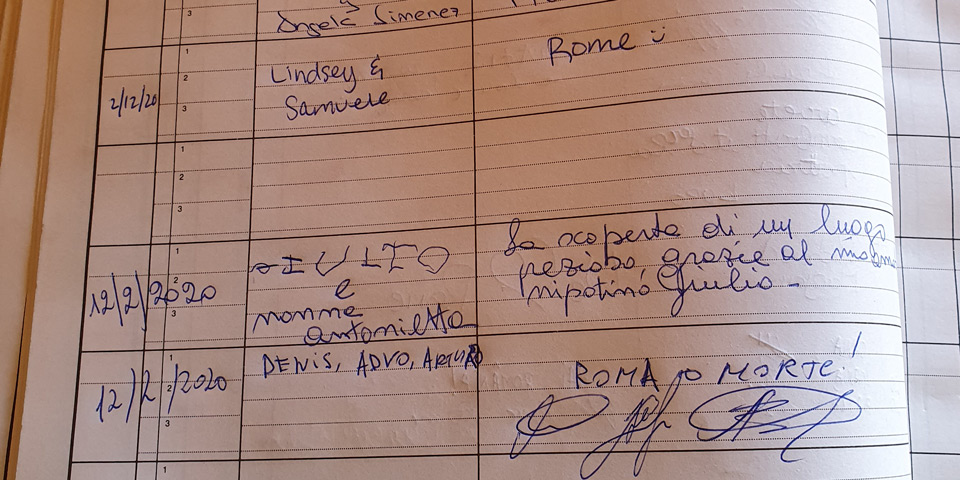
That final page brings the scale of the place back down. Above ground are arches, eagles, slogans, and the dates of battles. Below are fragments of human remains and hundreds of names. At the end, visitors add their own names simply to record that they came, read, and remembered.
Rome.us © 2026. Created with love by Roman experts and guides.