

25069 views
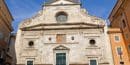
San Carlo alle Quattro Fontane, also known as San Carlino, is a Baroque landmark tucked into one of Rome’s busiest crossroads. Designed by the renowned architect Francesco Borromini, this small yet intensely inventive church is famous for its undulating façade and its oval-based interior. Built between 1638 and 1646, it shows how Borromini could turn a tight, irregular site into an elegant architectural statement that still feels modern centuries later.
Read also about Borromini’s masterpieces in Rome.
San Carlo alle Quattro Fontane grew out of the spiritual and urban energy of early-17th-century Rome. The Discalced Trinitarian Order commissioned the complex to support worship and charitable work, and the site’s tight corner location shaped everything that followed. When Francesco Borromini took over the project, he treated the awkward plot as an advantage.
Rather than hiding the constraints, he turned them into architecture—precision geometry, disciplined curves, and light used as a building material.
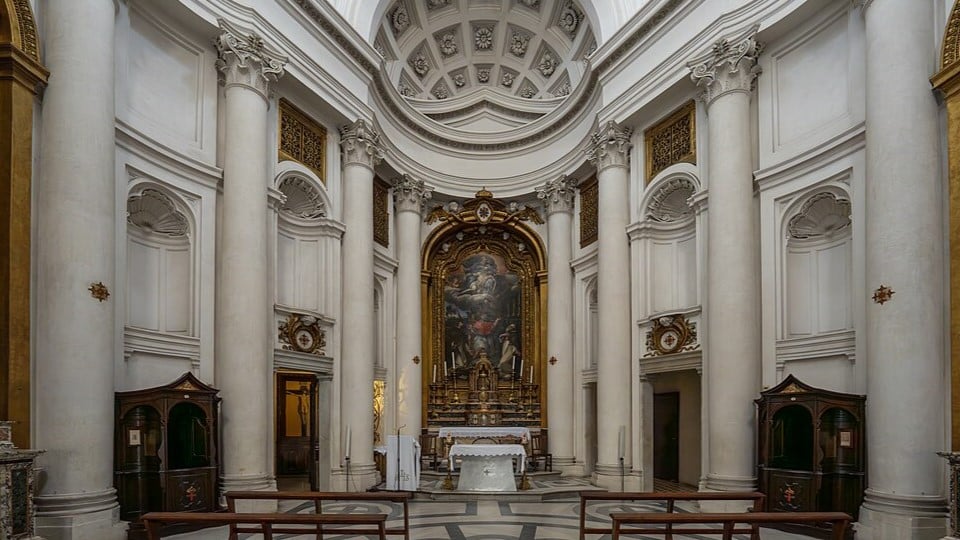
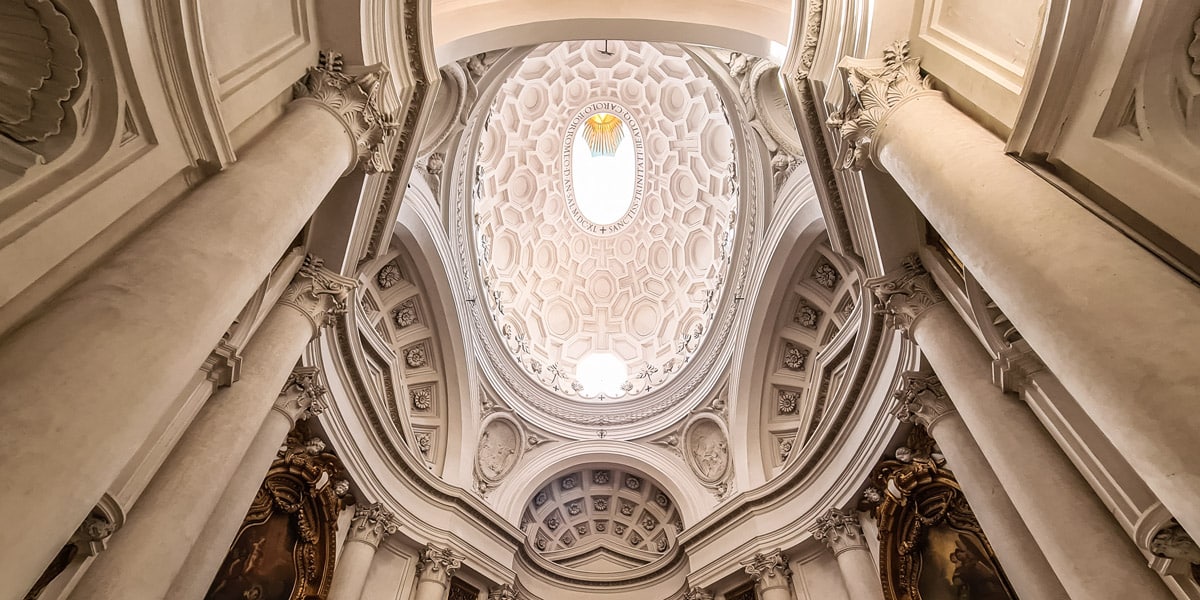
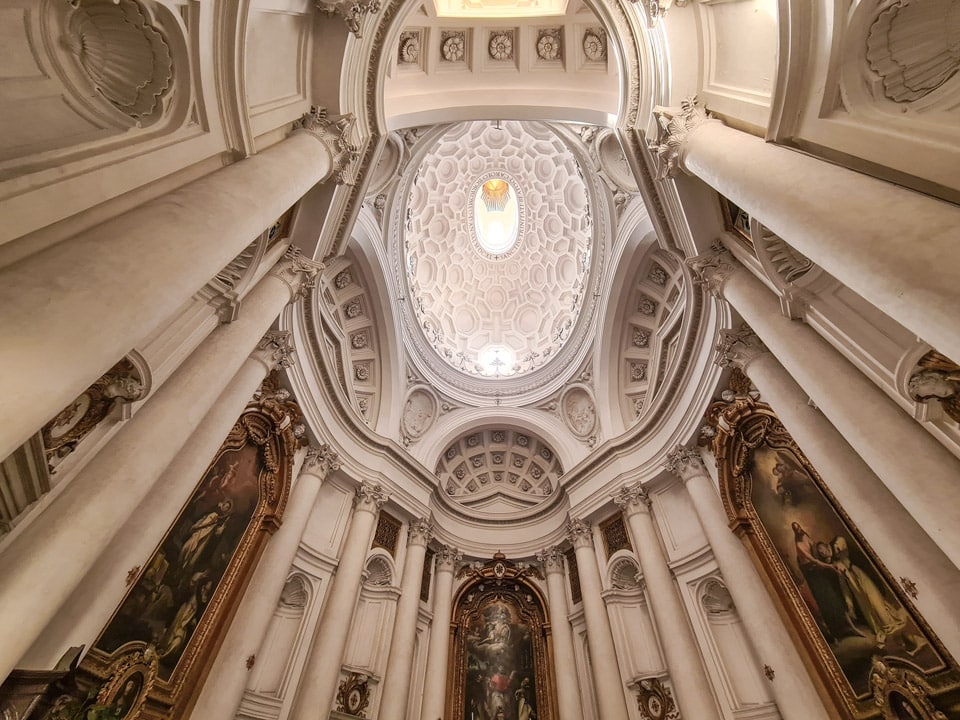
Construction began in 1638 and the church was consecrated in 1646. Borromini replaced a predictable nave with an oval-based interior that changes as you move. The walls swell and tighten, chapels open like carved pockets in the perimeter, and transitions between surfaces feel sculpted rather than assembled. Above, the dome’s patterned coffers tighten as they rise, pulling the eye upward and making the church feel taller and brighter than its modest footprint suggests.
The exterior story continued later. Borromini began the façade in the 1660s but died in 1667. The upper level and final sculptural elements were completed afterward, maintaining his distinctive vocabulary of concave and convex rhythms. Over the centuries, restoration campaigns have helped preserve the church’s crisp surfaces and the subtle lighting effects that define its interior character.
The façade reads like architecture in motion.
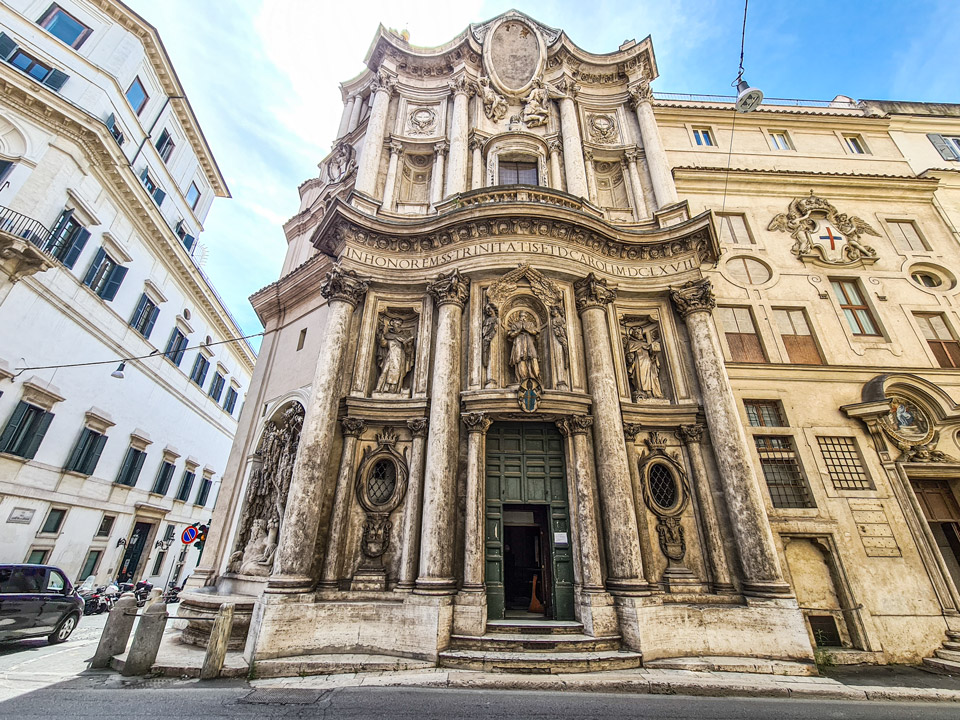
It is organized in two levels with a continuous, wave-like entablature that never sits still. Borromini builds tension through opposites: the side bays pull inward (concave), while the center pushes outward (convex). Columns with composite capitals frame the composition and sharpen the sense of push and pull, while niches and windows repeat the same curving logic at a smaller scale.
At the center, above the main entrance, a prominent niche presents the church’s devotional focus.
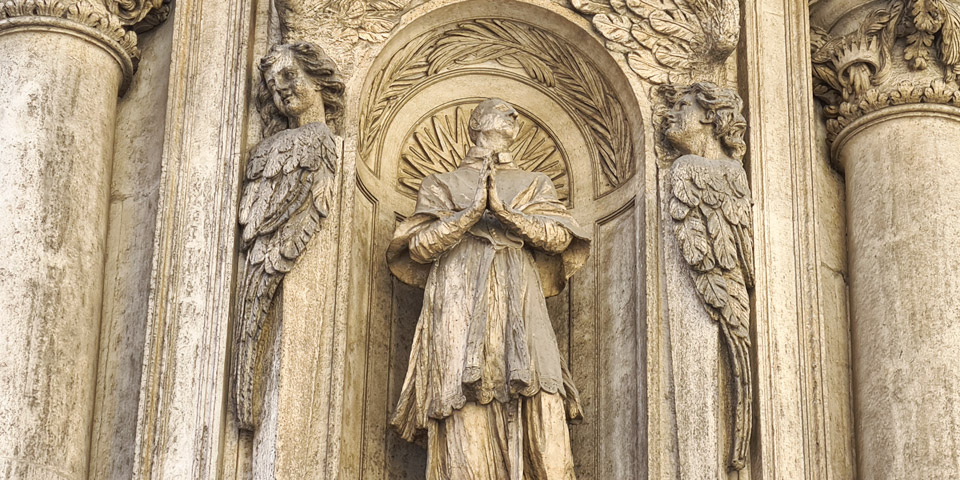
Saint Charles Borromeo stands in prayer, framed by sculptural angels that heighten the sense of a sacred vision. On either side, two full-length statues represent Saint John of Matha and Saint Felix of Valois, the founders of the Trinitarian Order.
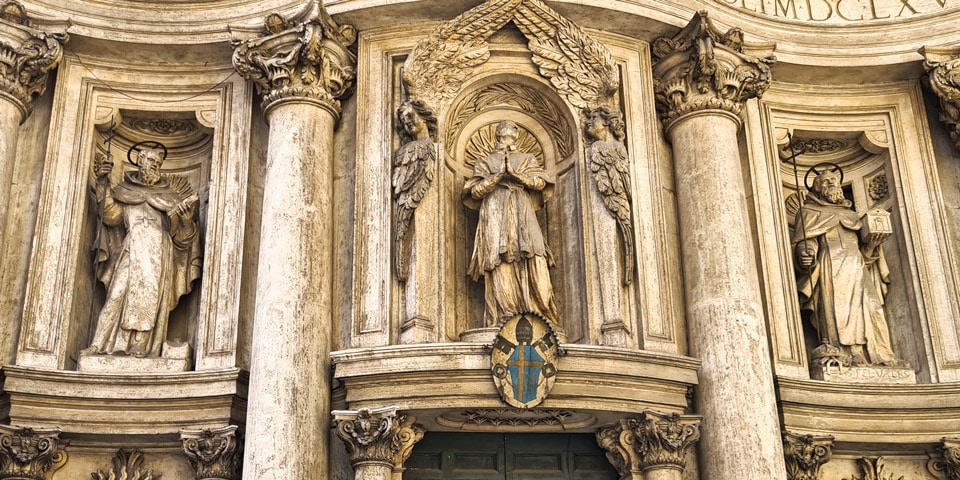
Together, the program ties the church’s dedication (Saint Charles) to the religious community that built and still inhabits the complex (the Trinitarians).
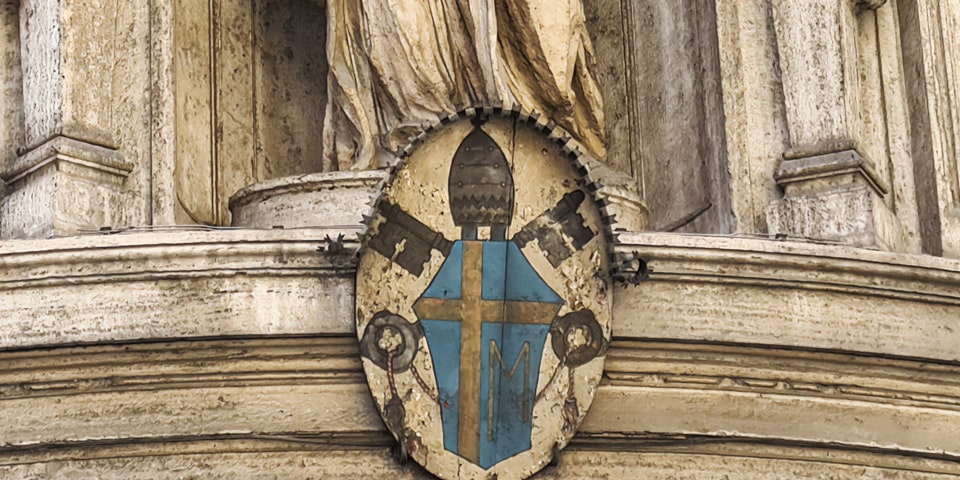
Beneath the central niche sits the coat of arms of the Trinitarian Order, a shield bearing the order’s distinctive cross. On the façade it functions like a public signature, announcing the institution behind the building in a compact heraldic emblem.
Running across the façade is the Latin dedicatory inscription: IN HONOREM SS. TRINITATIS ET D. CAROLI MDCLXVII.
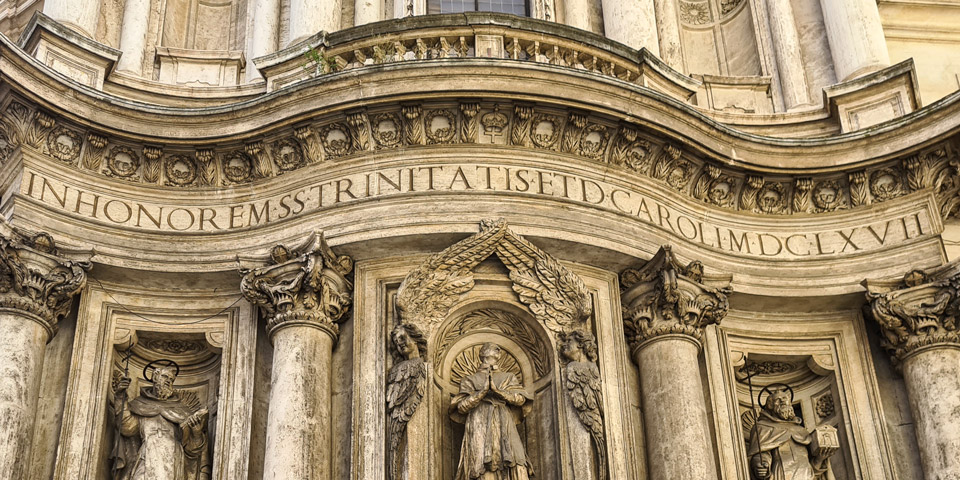
It translates as: “In honor of the Most Holy Trinity and Saint Charles, 1667.” The text states the church’s dual dedication and anchors the façade’s historical moment to the period when Borromini’s exterior concept was being realized.
Saint Charles Borromeo (1538–1584) was a cardinal and Archbishop of Milan and a leading figure of Catholic reform. He is remembered for implementing the reforms of the Council of Trent, strengthening clerical training through seminaries, and organizing aid during the Milan plague of 1576–1577. His reputation for discipline, pastoral care, and public service made him a powerful patron for a reform-minded religious order in 17th-century Rome.
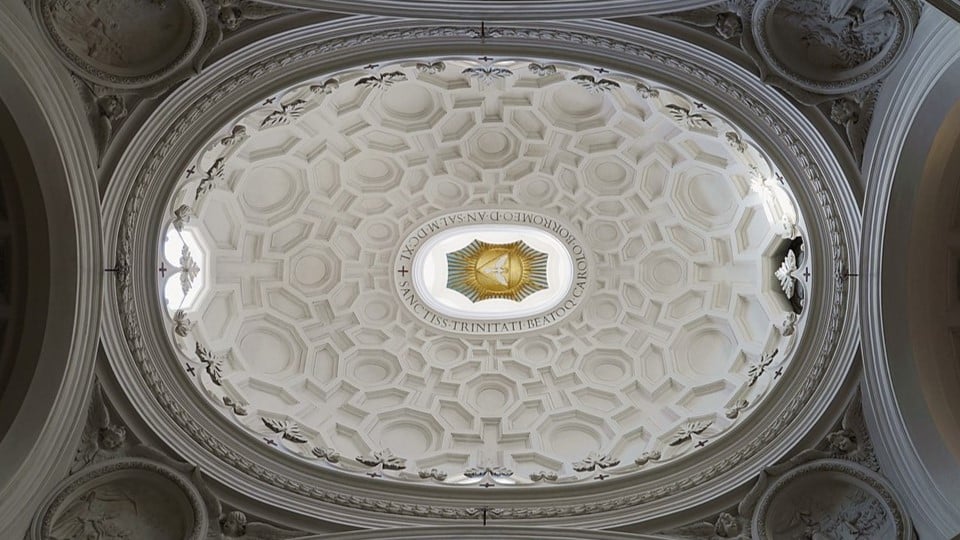
Today, San Carlo alle Quattro Fontane remains a living church and a significant stop for architecture lovers. It hosts religious services while welcoming visitors who come to study its daring curves, the disciplined geometry behind them, and the way light seems to “float” across the dome. Because the building is compact, it rewards slow looking. A slight shift in your position can completely change what you see.
The phrase “alle Quattro Fontane” means “at the Four Fountains.”
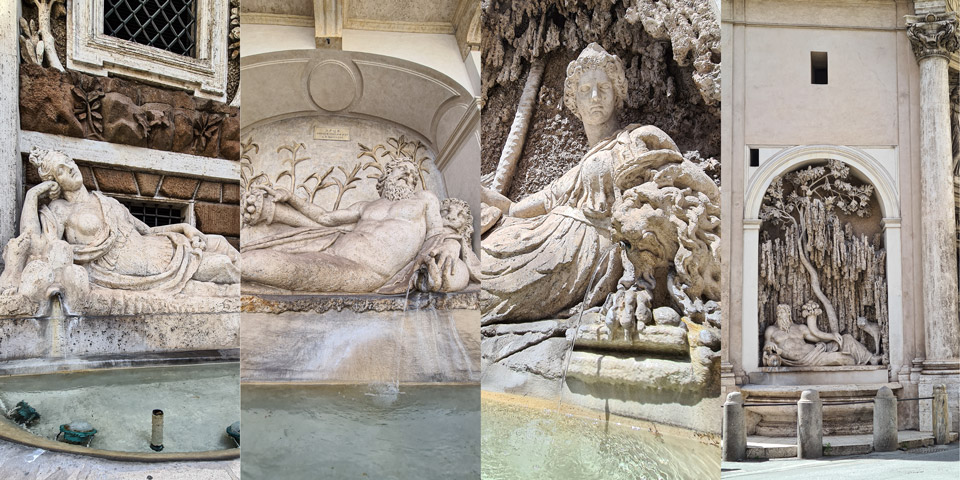
The name comes from the crossroads outside the church, where four corner fountains mark the intersection and frame the approach. The fountains predate Borromini’s church and were installed during late-16th-century urban improvements in Rome. Together, they turned this junction into a recognizable landmark—so recognizable that the church adopted the location as part of its identity.
Each fountain sits in a corner niche and features a figure associated with a river or a classical deity. Seen as a set, they blend civic symbolism (the rivers) with mythological imagery (the goddesses). That mix is part of Rome’s visual language, where everyday streets often carry layers of meaning.
This corner fountain is usually identified as the River Tiber personified: a powerful, bearded river god reclines in a niche shaped like a rocky grotto, his torso angled toward the street as if he has just surfaced from the riverbank.
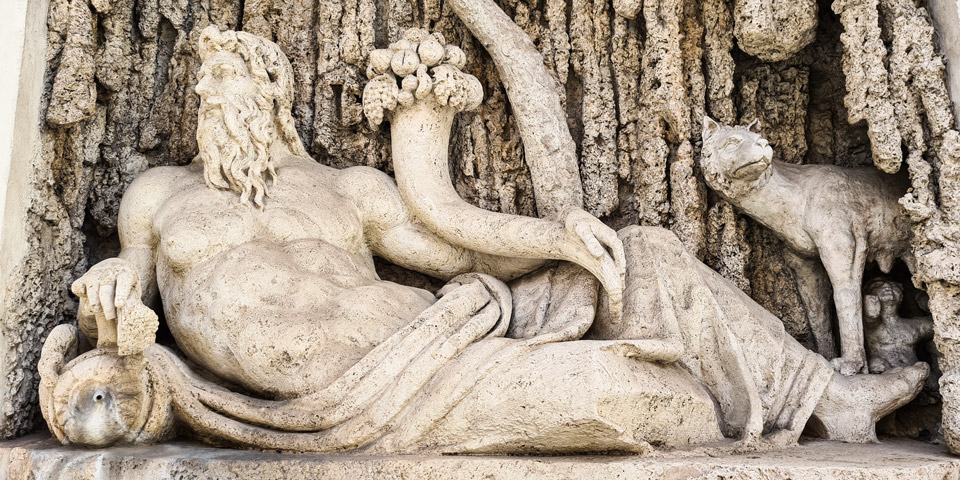
He holds a cornucopia brimming with fruit, a classic emblem of abundance and fertility that suits the Tiber’s role as Rome’s sustaining waterway. Beside him appears the Capitoline she-wolf with Romulus and Remus, a compact but unmistakable reference to the city’s foundation myth. The figure rests above a semicircular travertine basin, while the rugged “stone” backdrop and vegetal relief behind him reinforce the illusion of a natural riverside setting rather than a flat architectural wall.
Tradition identifies this corner relief as the River Arno, and the sculptor makes the reference feel distinctly Tuscan.
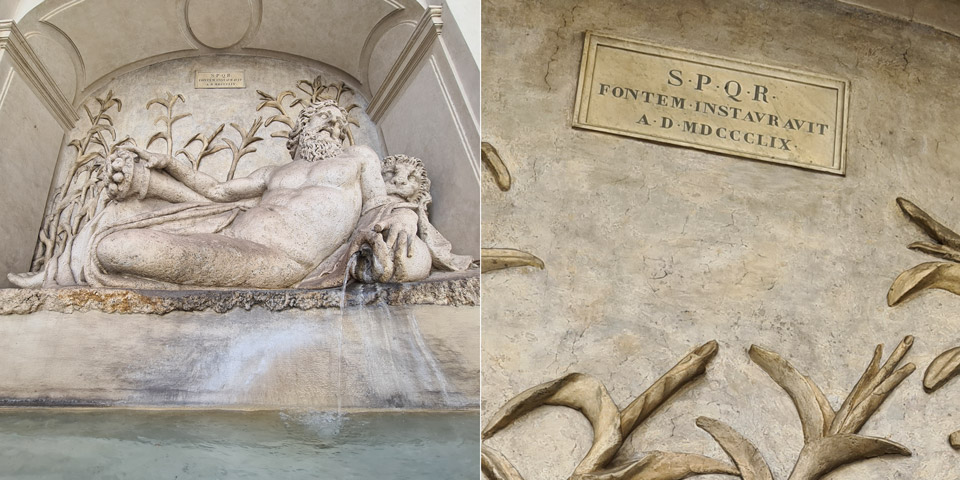
The river god reclines in a shallow niche and holds a cornucopia—a standard classical attribute for rivers, signaling fertility and plenty along the riverbanks. What sets this one apart is the lion’s head tucked beside him. Because the Arno is closely tied to Florence, the lion is often read as an intentional allusion to Florentine civic imagery (the city’s emblematic lion), while also reinforcing the idea of strength and guardianship.
At the lower edge, water spills from a tilted vessel at the figure’s hand, a practical detail that doubles as iconography: the river’s “source” becomes visible. Behind the figure, the backdrop is carved with tall, stylized riverbank plants—reeds and long-stemmed foliage—so the niche reads like a vegetal riverside setting rather than a flat wall.
Above the relief, the stone plaque adds a later chapter to the fountain’s story. It reads “S.P.Q.R. FONTEM INSTAVRAVIT A.D. MDCCCLIX”, which translates to “The Senate and People of Rome restored the fountain in the year 1859.” In other words, what you see today is not only a late-Renaissance street monument, but also a piece that Rome’s civic authorities deliberately repaired and preserved in the 19th century.
This fountain is often identified as Diana (though some descriptions also read the figure as an allegory of Fidelity), and the carved details support both interpretations.
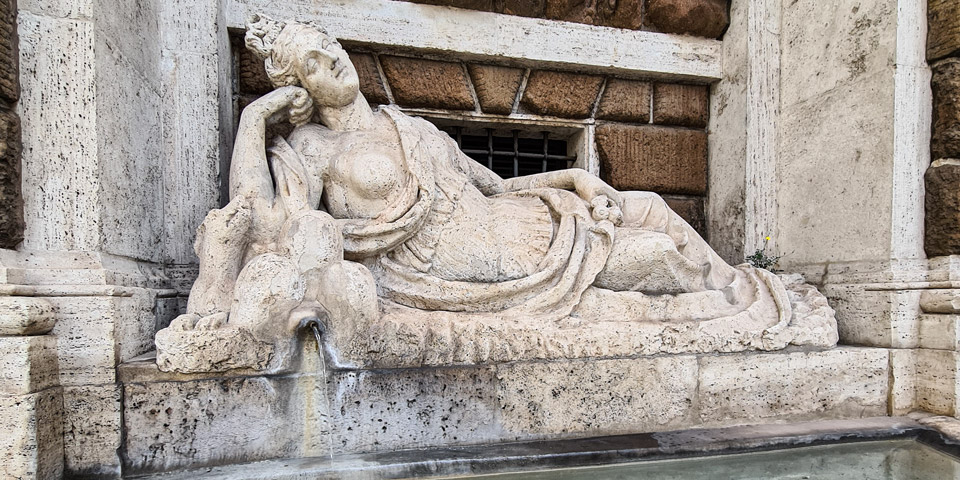
The goddess reclines in a calm, classical pose, her head resting on her hand as if in quiet vigilance. Tucked beneath her bent arm, a small dog peeks out—an unmistakable attribute of Diana as huntress, and at the same time a traditional emblem of loyalty, which is why “Fidelity” sometimes enters the conversation.
The three large “stones” beside her are not random rockwork.
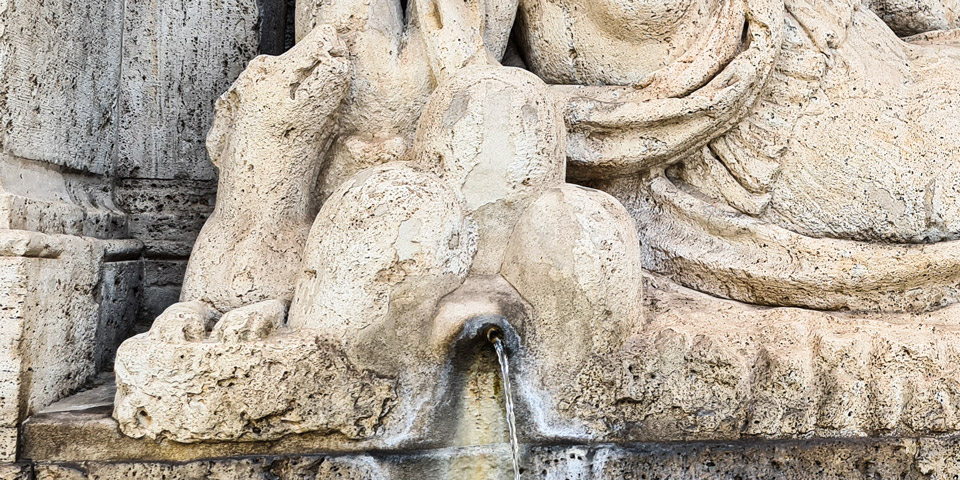
They form a stylized triple mount (three rounded hills), a heraldic reference to Pope Sixtus V Peretti, under whose pontificate the Quattro Fontane were installed. In other words, the sculpture blends mythological identity with a clear civic signature: Diana (or Fidelity) leans against the pope’s emblem, visually linking the fountain to the urban renewal campaign that created this crossroads.
Water emerges at the base from the carved rock mass near her resting side, turning the sculpture into a functional springhead. The restrained setting—more architectural than grotto-like—keeps the mood measured and “civil,” matching the figure’s composed expression and the fountain’s role as street ornament designed for daily life.
This corner fountain is commonly identified as Juno because it leans into the goddess’s civic role as a guardian of Rome.
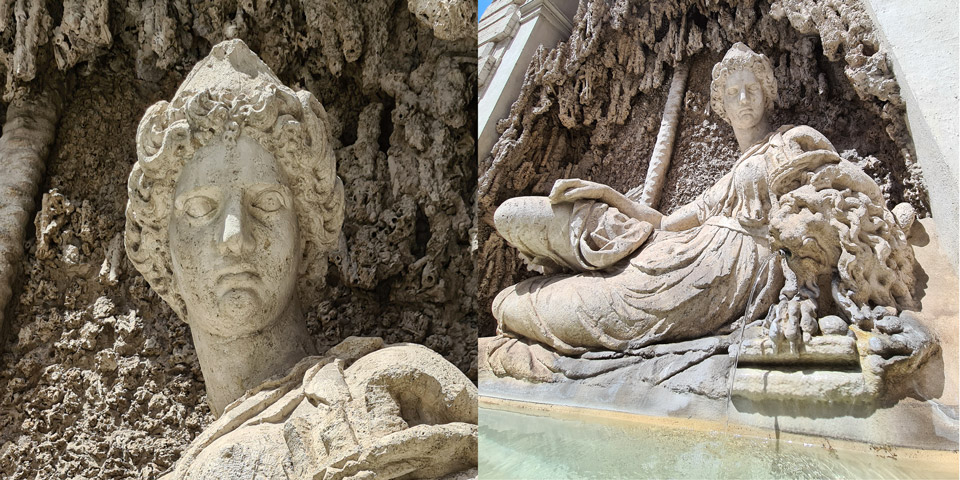
The figure reclines in a deep niche modeled as a rough grotto, with heavy, stalactite-like “stone” formations hanging above her. That rugged setting makes the smooth, idealized body and carefully carved drapery stand out even more. In her left hand she holds a long scepter, a straightforward emblem of sovereignty and protection. At her right, water pours from a lion’s head spout, a classical symbol of strength that turns the fountain’s plumbing into part of the iconography.
On the left, you can also see a large waterfowl (often read as a goose).
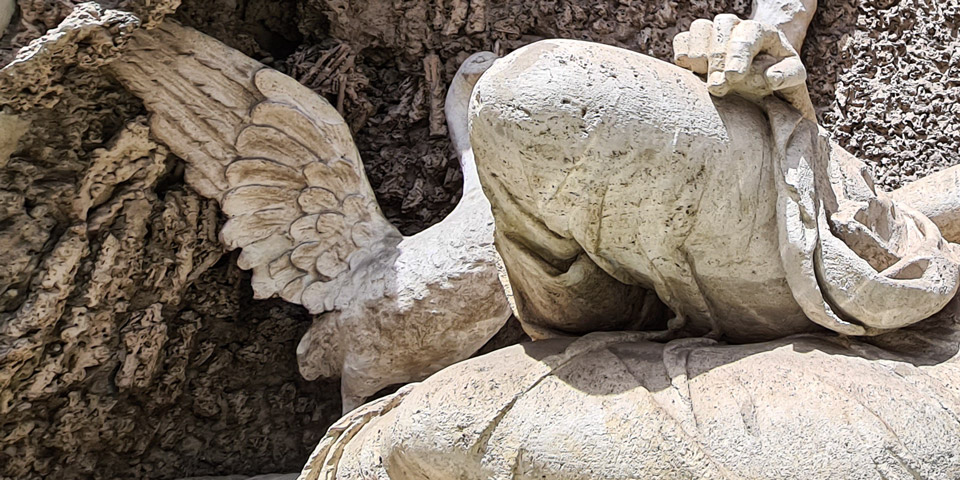
That detail connects to one of Rome’s best-known legends: the sacred geese of Juno on the Capitoline supposedly raised the alarm during a nighttime Gallic attack, traditionally dated to 390 BC, waking the defenders in time to save the city. In that story, Juno becomes a “watchful” protector—sometimes associated with the epithet Juno Moneta (“the Warner”). Read together, the scepter, the lion spout, and the goose make a coherent statement: this is not just a decorative goddess, but a figure of vigilance and civic defense.
Rome.us © 2026. Created with love by Roman experts and guides.