

29160 views
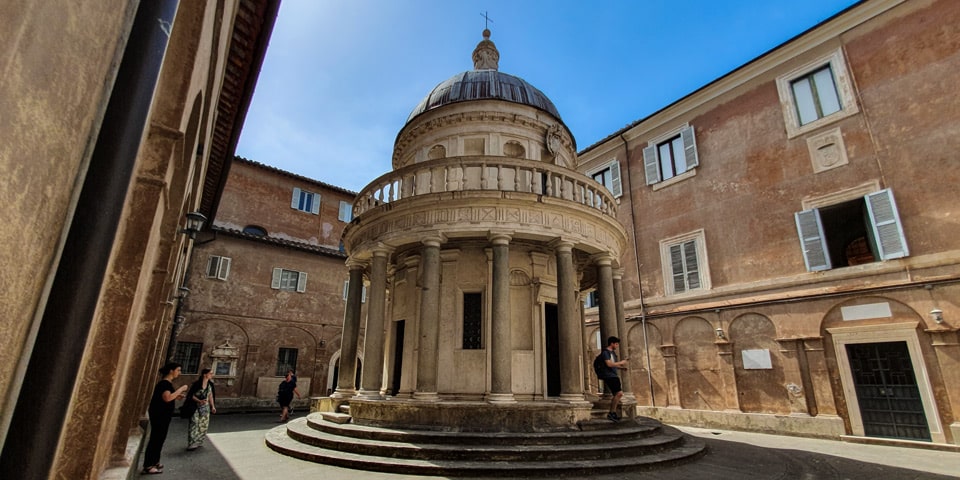
The Tempietto stands in a convent courtyard barely wide enough to give it breathing room. Walk once around the sixteen columns and the building already feels complete. Every step, opening, pilaster, and curve returns the eye to the same center.
Donato Bramante built this small commemorative chapel in the early sixteenth century at the place then identified with the crucifixion of Saint Peter. Its interior is only about four meters across. Its architectural reach is far greater. Generations of architects studied the Tempietto as a model of the High Renaissance search for order, proportion, and a convincing revival of ancient Rome.
The name simply means “little temple.” It belongs to the complex of San Pietro in Montorio on the Janiculum Hill, now occupied in part by the Royal Academy of Spain. The setting explains why a masterpiece familiar from architecture books can still feel surprisingly private when you see it in Rome.
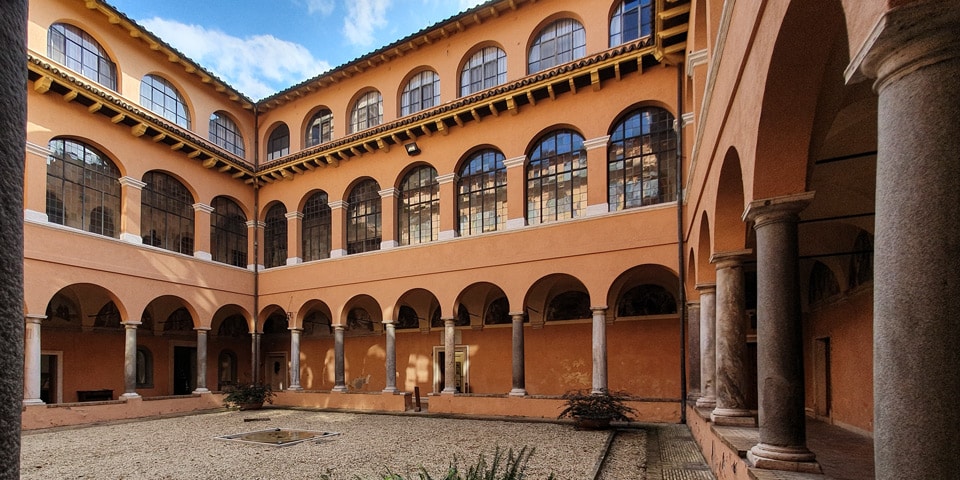
You reach the Tempietto through the complex of San Pietro in Montorio and the Real Academia de España en Roma. The academy’s arcaded courtyard is part of the approach. Temporary exhibitions by resident artists sometimes appear in these spaces, although they are not a permanent part of the visit.
The Catholic Monarchs of Spain, Ferdinand of Aragon and Isabella of Castile, financed the Tempietto. Rome’s official tourism authority dates its construction cautiously from about 1502 to 1509. The commission formed part of the Spanish royal patronage of San Pietro in Montorio and was traditionally connected with a vow made for the birth of the couple’s son John, who died in 1497.
Bramante had recently arrived in Rome after a long career in northern Italy. Here he encountered ancient buildings at first hand. The Tempietto shows how quickly he learned from them without copying any single monument. Its circular form recalls Roman round temples and funerary memorials. Its purpose is Christian: it is a martyrium, a building that marks and honors a place associated with martyrdom.
The project also carried political weight. A Spanish royal foundation stood over a site connected with the first pope, in Rome, at the moment when Ferdinand and Isabella were presenting their monarchy as a defender of Catholic Christendom. Architecture, devotion, and royal identity meet in the same tiny building.
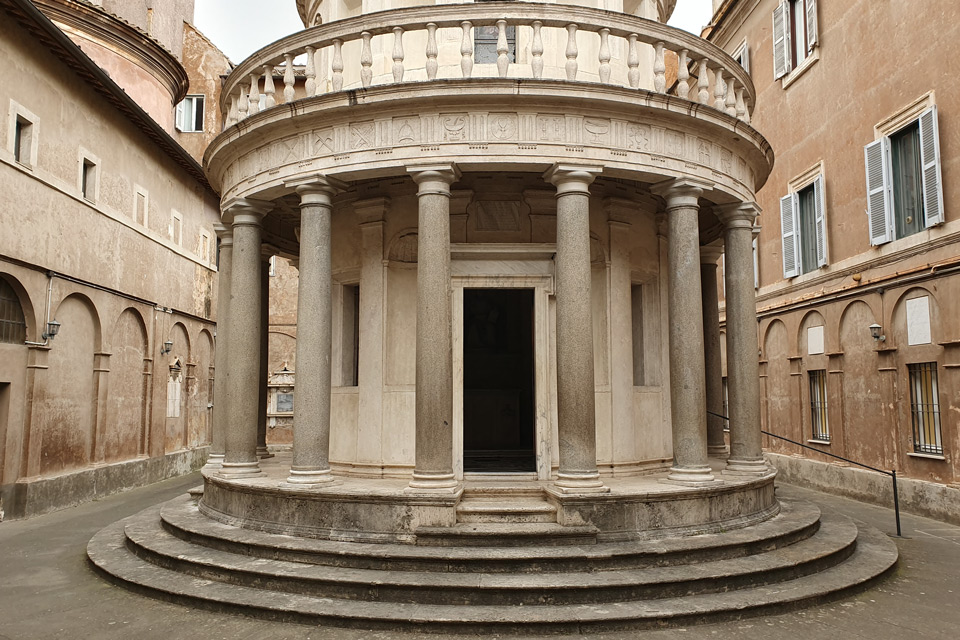
Three circular steps lift the chapel above the courtyard. Sixteen gray granite columns surround the cylindrical chamber, or cella, while the doorway remains clearly visible through the colonnade. This frontal view makes Bramante’s concentric plan easier to read than the wider courtyard perspective.
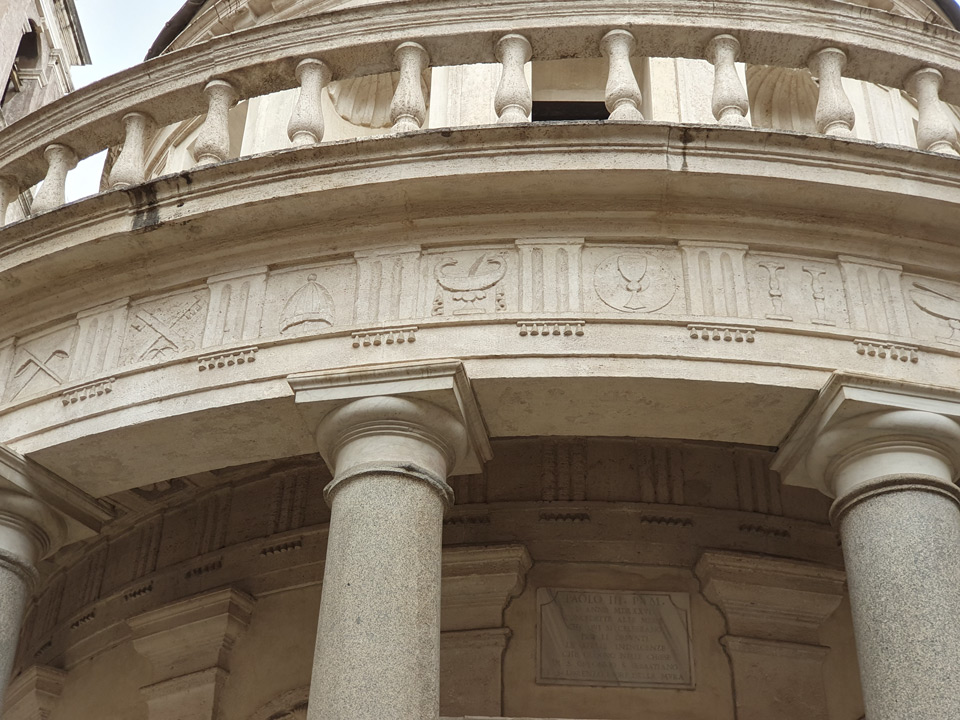
Above the columns runs a Doric entablature with alternating triglyphs and 48 carved metopes. Thirteen motifs recur around the frieze in an irregular sequence. Among them are Saint Peter’s keys, the papal tiara, chalices, patens, censers, and other objects associated with papal liturgy. Bramante kept the visual grammar of an ancient Doric temple and gave its small relief panels a Christian program.
The number sixteen was considered perfect in the architectural tradition inherited from Vitruvius. More important on site is the repeated geometry. Steps, colonnade, inner wall, balustrade, drum, and dome form concentric layers. You understand the plan simply by walking around it.
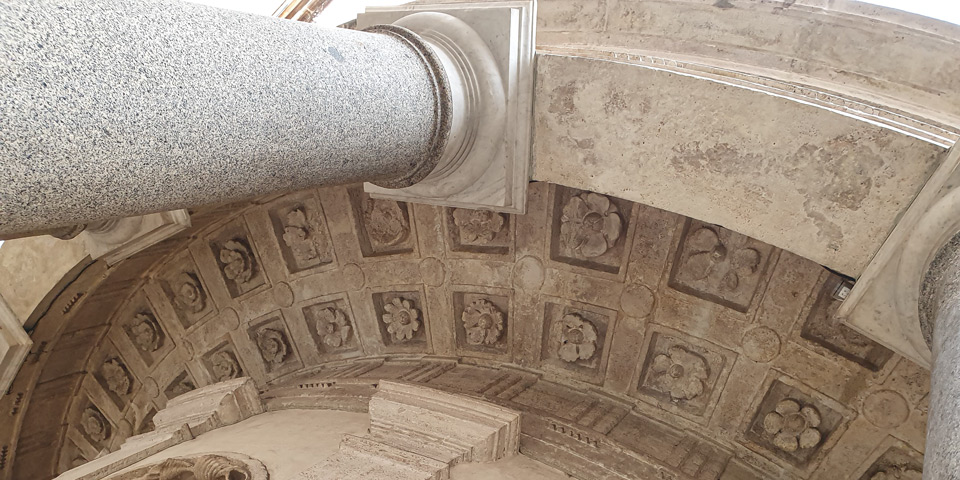
Step beneath the colonnade and look up. The ring-shaped passage has a coffered ceiling filled with carved floral rosettes. These flowers are conventional architectural ornaments rather than identifiable botanical species. Their repetition continues the measured rhythm established by the columns and metopes.
Bramante probably intended the circle to continue beyond the chapel. Sebastiano Serlio later published a plan showing the Tempietto inside a circular colonnaded courtyard. That surrounding architecture was never built. The round chapel consequently stands inside the rectangular court seen today. The cramped setting is historically misleading, although it creates one of Rome’s most memorable architectural surprises.
The columns and the wall behind them create a steady alternation of light and shadow. The upper level then changes scale. Narrow pilasters on the drum echo the columns below, while the dome draws the separate horizontal rings into one silhouette. This sequence became highly influential in later Renaissance and Baroque architecture.
The Tempietto was designed around a precise religious claim. The center of the chapel marked the spot where Saint Peter was believed to have been crucified. Catholic tradition also holds that the apostle was crucified upside down because he considered himself unworthy to die in the same manner as Christ.
The location requires careful wording. Ancient testimony connects Peter’s martyrdom and burial with the Vatican area, where St Peter’s Basilica now stands. Identification of a site on the Janiculum became influential much later. The Tempietto records the tradition accepted by its patrons in Renaissance Rome; it does not provide archaeological proof of the execution site.
That distinction does not weaken the building’s meaning. Bramante organized every level around the alleged point of martyrdom. The plan turns a remembered event into geometry.
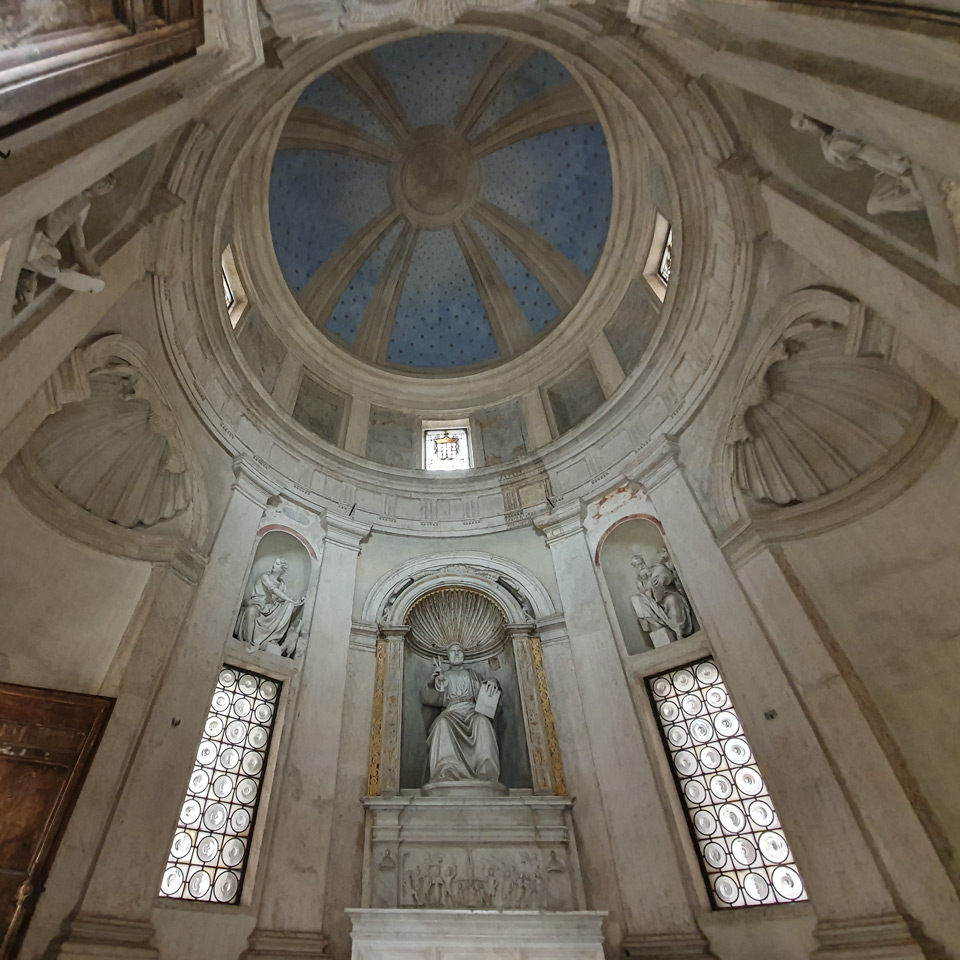
The chamber is small enough to take in from the doorway. Deep niches make it appear larger than its four-meter diameter. At the center of the altar wall sits Saint Peter, holding a book and the keys that identify his authority in Catholic iconography. Rome’s official description attributes the statue to an unidentified Lombard artist of the sixteenth century.
The relief below the apostle shows his martyrdom. Peter appears within the altar itself, while the supposed physical site of that martyrdom lies on the building’s vertical axis beneath the floor. Image, altar, and place are meant to be read together.
Four other niches contain the Evangelists. Their accompanying creatures identify them even when a visitor does not recognize their faces.
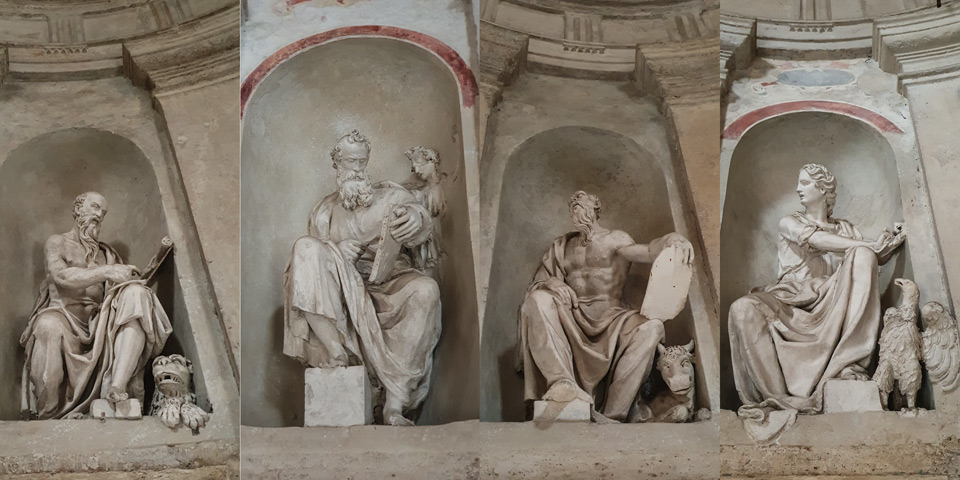
From left to right in the photograph, they are Matthew with a winged human figure, Mark with the lion, Luke with the ox, and John with the eagle. The four symbols come from the living creatures described in Ezekiel and the Book of Revelation. Christian tradition later assigned one to each Gospel writer.
Matthew’s human or angelic figure refers to the Gospel’s opening genealogy and Christ’s human birth. Mark’s lion recalls the voice crying in the wilderness at the beginning of his account. Luke’s ox is a sacrificial animal, suited to a Gospel that opens in the Temple and repeatedly addresses sacrifice and priesthood. John’s eagle represents the theological height of a Gospel that begins with the eternal Word rather than an earthly genealogy or childhood narrative.
Together, the four figures place Peter within the written witness of the Gospels. Their symbols also provide a compact visual code. Once learned here, the same angel, lion, ox, and eagle become recognizable on church façades, pulpits, mosaics, and manuscripts across Rome and the rest of Christian Europe.
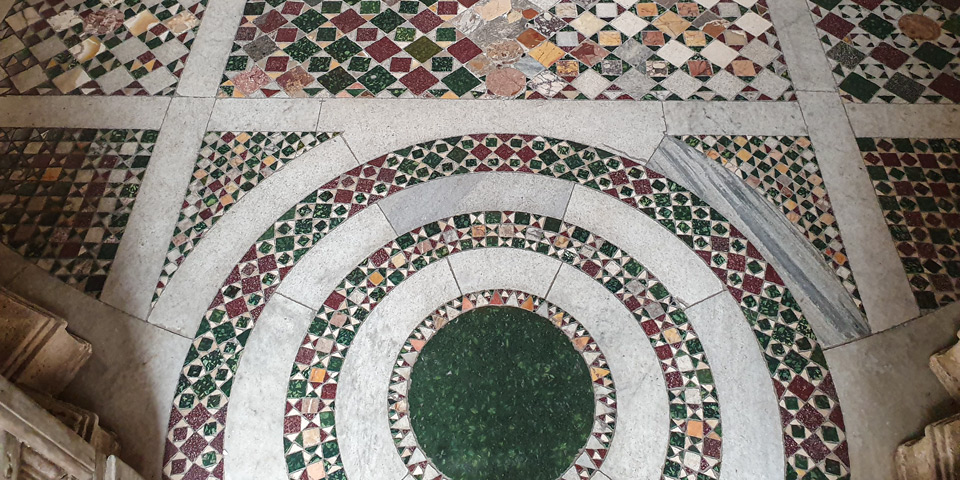
The floor uses small pieces of green, red, yellow, black, and white stone to construct circles, stars, diamonds, and interlocking bands. This is the Cosmatesque style, named after the Roman marble-working families who developed its best-known medieval examples during the twelfth and thirteenth centuries.
The Tempietto floor is a Renaissance work in that older Roman visual language. Its disciplined circles suit Bramante’s centralized plan, while the fragments of colored stone bring the scale down from architecture to something almost jewel-like.
Rome preserves broader and older Cosmatesque pavements in churches such as the Basilica of Santa Maria in Trastevere. Another useful comparison is the Bufalini Chapel inside Santa Maria in Ara Coeli. Here, however, the pattern is compressed into a room only a few paces wide. The floor reinforces the center before the visitor even notices the crypt below it.
Two curving stairways descend from the courtyard to the circular crypt. Its present marble, stucco, and altar arrangement largely belongs to a 1628 refurbishment. At the center, a floor slab protects the opening traditionally identified as the hole made for Peter’s cross. The claim is devotional rather than archaeological, but its location is essential to Bramante’s design.
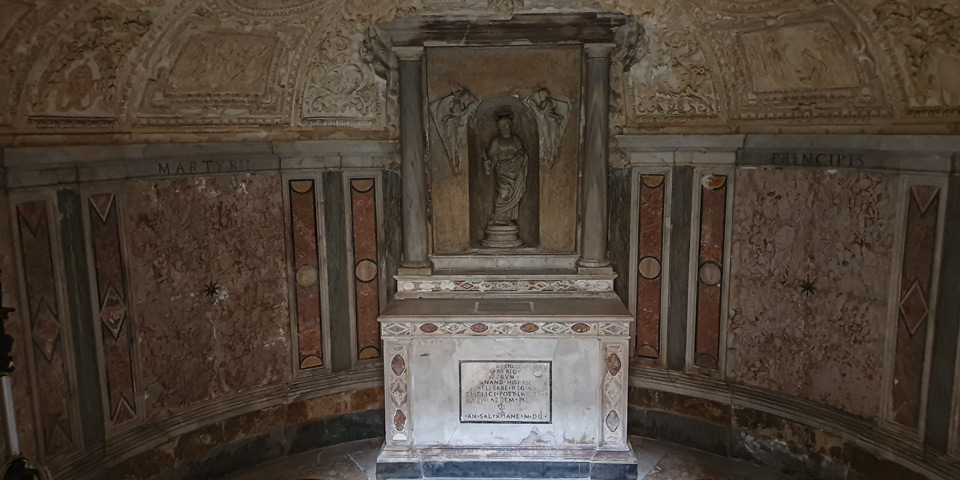
The altar carries the Tempietto’s foundation inscription. Its abbreviated Latin dedicates the chapel to the martyrdom of the Prince of the Apostles, names Ferdinand of Aragon and Isabella of Castile as its patrons, and ends with the date 1502. The words MARTYRII PRINCIPIS, visible across the wall behind it, continue the same idea: this is a memorial to the martyrdom of Saint Peter, regarded by Catholics as the chief of the Apostles.
A different plaque near the crypt entrance begins Anno salutis Christianae MD, “In the year of Christian salvation 1500.” In normalized Latin, its principal text reads:
ANNO SALVTIS CHRISTIANAE MD
SVB IVBILEO ET PONTIFICATV ALEXANDRI VI
DIE IX IVNII, FERIA TERTIA POST PENTECOSTES
SIT NOTVM OMNIBVS ET SINGVLIS PRAESENTIBVS INSPECTVRIS
QVOD CONSECRATA EST PRAESENS ECCLESIA ET ALTARE HOC
IN HONOREM BEATI PETRI APOSTOLI
IN HOC LOCO CRVCIFIXI
ET RELIQVIAE INFRASCRIPTAE IN EO RECLVSAE SVNT
In English: “In the year of Christian salvation 1500, during the Jubilee and the pontificate of Alexander VI, on 9 June, the Tuesday after Pentecost, let it be known to all who see this that the present church and this altar were consecrated in honor of the Blessed Apostle Peter, crucified in this place, and that the relics listed below were enclosed in it.”
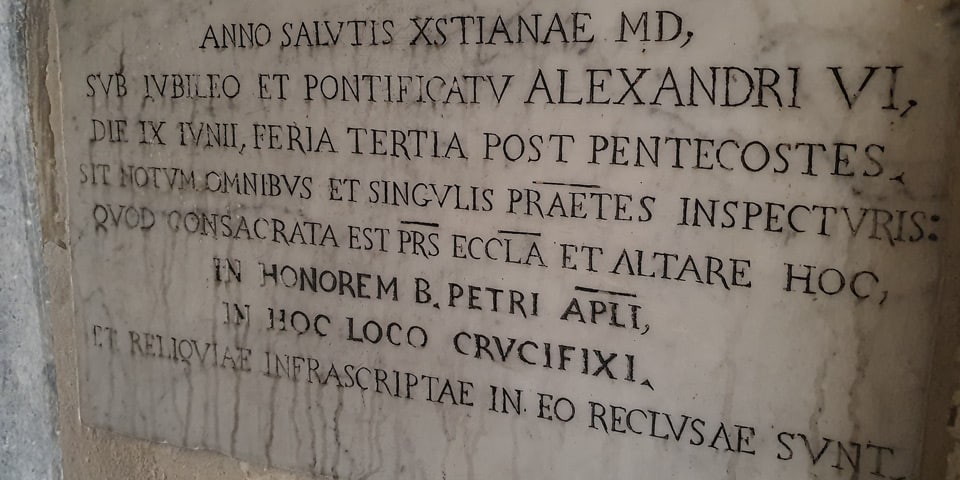
Its position can cause confusion. This is a later copy of a text concerning the consecration of San Pietro in Montorio and its high altar. It does not date the Tempietto to 1500. The foundation inscription of Bramante’s chapel gives 1502.
The opening, the center of the upper floor, the seated apostle, the drum, and the dome share one vertical line. Outside, the building develops through concentric circles. Inside, meaning develops upward from the alleged point of martyrdom. This alignment is the clearest explanation for the Tempietto’s unusually concentrated effect.
The crypt also changes the apparent proportions of the building. From the courtyard the chapel looks like a compact two-level monument raised on steps. Once the lower chamber becomes visible, the structure reads as a marker extending both above and below ground.
A short Italian plaque above the entrance summarizes a privilege granted by Pope Paul III in 1536. The fuller Latin text survives in the light shaft between the upper chapel and the crypt stairs.
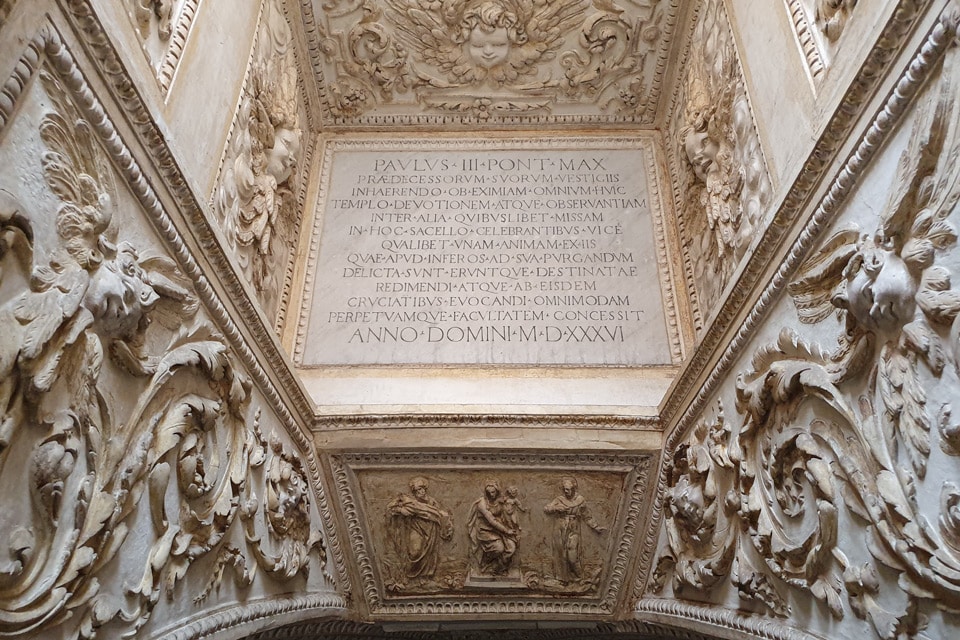
PAVLVS III PONT MAX
PRAEDECESSORVM SVORVM VESTIGIIS
INHAERENDO OB EXIMIAM OMNIVM HVIC
TEMPLO DEVOTIONEM ATQVE OBSERVANTIAM
INTER ALIA QVIBVS LIBET MISSAM
IN HOC SACELLO CELEBRANTIBVS VICE
QVALIBET VNAM ANIMAM EX IIS
QVAE APVD INFEROS AD SVA PVRGANDVM
DELICTA SVNT ERVNT QVE DESTINATAE
REDIMENDI ATQVE AB EISDEM
CRVCIATIBVS EVOCANDI OMNIMODAM
PERPETVAMQVE FACVLTATEM CONCESSIT
ANNO DOMINI M D XXXVI
In plain English, the inscription says that Pope Paul III, following the example of his predecessors and recognizing the devotion shown toward the chapel, granted a perpetual privilege to those celebrating Mass here. On each occasion, the celebrant could obtain the release of one soul undergoing purification for its sins. The text ends with the year 1536.
The phrase apud inferos can sound like a reference to hell when read in isolation. The following words, ad sua purgandum delicta, specify souls undergoing purification for their sins, so the intended Catholic context is purgatory. The inscription documents the Tempietto’s active devotional use within decades of its construction.
The Tempietto entered the architectural canon quickly. Serlio included its plan, elevation, section, and proposed courtyard in his sixteenth-century treatise alongside the monuments of ancient Rome. That publication allowed architects who had never visited the Janiculum to study Bramante’s proportions.
Its relationship with St Peter’s Basilica is often simplified. Bramante did not produce a larger copy of the Tempietto for the Vatican. The two projects share a more fundamental ambition: a centralized sacred building whose mass can be understood from every side, ordered by classical columns and crowned by a dome. Bramante began the new basilica in 1506, and later architects radically altered his design. The compact experiment on the Janiculum still helps visitors understand the architectural ideas behind that much larger project.
The Tempietto also demonstrates that monumentality does not depend on size. Its chamber could fit inside many Roman chapels. The controlled sequence of base, columns, entablature, balustrade, drum, and dome gives each part a clear job. Nothing requires distance to make sense.
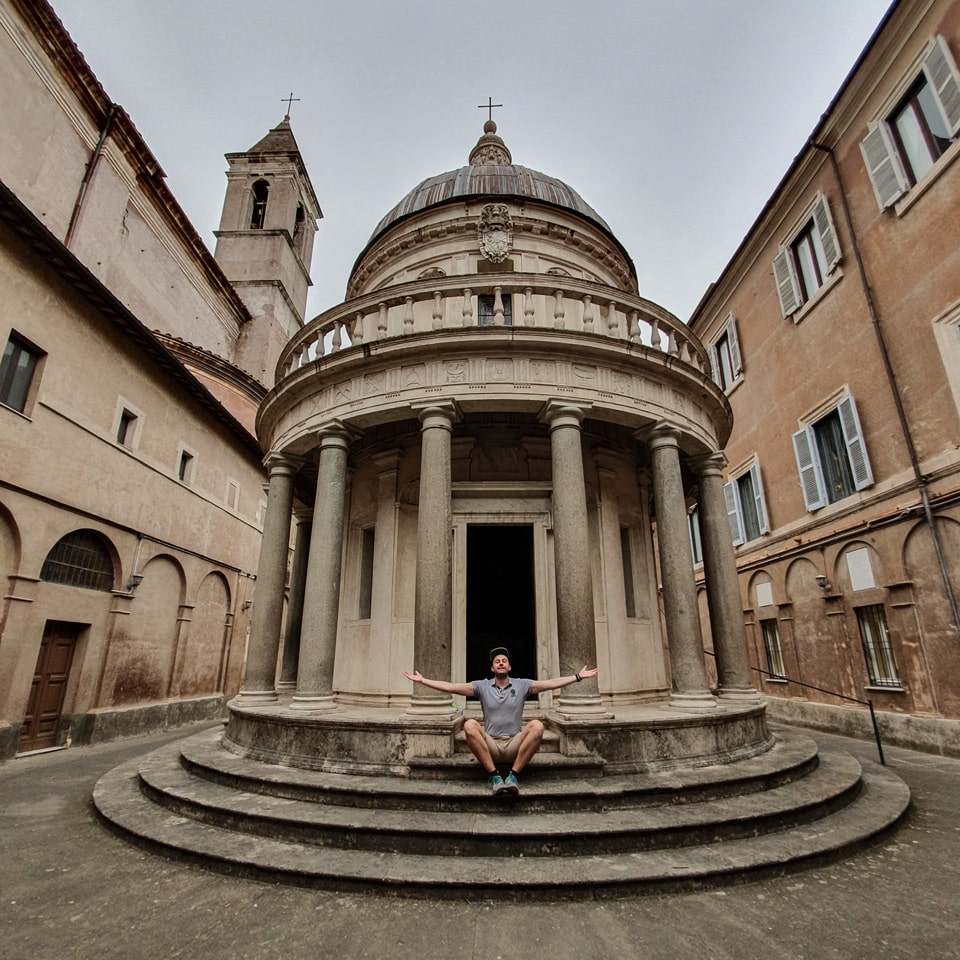
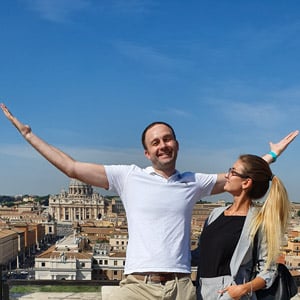
That is me, Artur Jakucewicz, sitting on the steps. On this visit I had the courtyard to myself, even though the building has occupied a central place in histories of Renaissance architecture for centuries. The photograph also captures the building’s central idea. Bramante created a Catholic martyrium through a circular colonnade and carefully measured proportions borrowed from ancient Roman temples. Its scale is intimate, but its conception is monumental.
For a reader interested in Renaissance architecture, the visit is unusually efficient. In a few minutes you can examine Bramante’s classical design and see how it serves the cult of Saint Peter. The small courtyard often gives you more room to look carefully than many famous Roman churches.
The Tempietto works well as the first major stop on a walk up from Trastevere. After circling the exterior, step inside, identify Peter and the Evangelists, and look down at the floor before checking whether the crypt is accessible. A ten-minute visit gives enough time to read those elements together.
Before leaving the academy, look through the windows along the accessible route. One frames the terracotta roofs of Trastevere and the historic center beyond them. The large white monument on the far right is the Altar of the Fatherland, also known as the Vittoriano. The academy does not operate this window as an observation terrace, and access depends on which parts of the building are open. If you encounter it, stop for a moment before leaving.
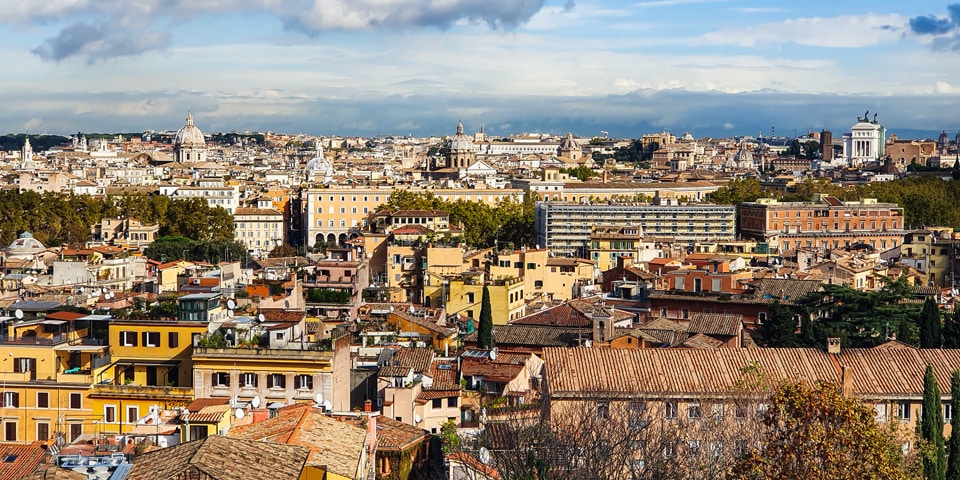
From San Pietro in Montorio, the Fontana dell’Acqua Paola is close by. Continue uphill for the monuments and skyline view at Piazzale Garibaldi. Seen in that sequence, Bramante’s chapel belongs to the wider history of the Janiculum. Its Spanish royal patronage and Roman devotional purpose come together in one of the clearest surviving statements of Renaissance design.
Rome.us © 2026. Created with love by Roman experts and guides.