

Rome.us
  • TAXI FARES CALCULATOR
  • BOOK PRIVATE TOUR
  • ABOUT US
  • HOW TO GET
    • Fiumicino Airport
    • Ciampino Airport
    • Termini Railway Station
    • Public Transport
    • To Venice
    • To Florence
    • To Ostia Antica
    • To Naples
    • To Milan
    • To Pisa
    • To Siena
  • TIPS
    • TOP Attractions
    • Tickets to Vatican museums
    • Rome Three Day Itinerary
    • Rainy Days in Rome
    • Buying a Sim Card in Italy
    • Renting a Car in Rome
    • Apps for Tourists
    • Free Things to Do
    • Unusual Things to do
    • ASK US
    • Instagram
    • Pinterest
  • ANCIENT SITES
    • Castel Sant’Angelo
    • Colosseum
    • Pantheon
    • Roman Forum
  • WHERE TO STAY
    • How to Choose a Hotel in Rome
    • Hotels with Best Views
    • Hotels near Termini
    • Hotels near the Colloseum
    • Best Hostels
    • Hotels near Navona Square
    • 3 Star Hotels
    • 4 Star Hotels
    • 5 Star Hotels
    • Apartments For Rent
  • VATICAN CITY
    • St Peter’s Basilica
    • Sistine Chapel
    • Vatican Museums
    • Raphael’s Rooms
    • Michelangelo’s Pieta
    • St Peters Dome
    • St Peter’s Square
    • Vatican Military
    • Swiss Guard
    • Pilgrims of Hope Jubilee
  • MUSEUMS
    • Ara Pacis Augustae
    • Borghese Gallery
    • Capitoline Museums
    • Caravaggio’s Paintings
    • Great Synagogue
    • Palazzo Farnese
    • Spada Gallery
  • PARKS
    • Appian Way
    • Orange Garden
    • Park of the Aqueducts
    • Pincio Terrace
    • Villa Ada
    • Vatican Gardens
    • Villa Borghese
    • Villa Celimontana
    • Villa Torlonia
    • Zoo
  • CHURCHES
    • Capuchin Crypt
    • Holy Stairs
    • Sant’Agnese in Agone
    • San Giovanni in Laterano
    • Santa Maria Maggiore
    • Saint Paul Outside the Walls
    • St Peter in Chains
    • St. Ignatius of Loyola
  • FOUNTAINS & SQUARES
    • Navona Square
    • Spanish Steps
    • Trevi Fountain
    • Altar of The Fatherland
    • Fontana della Barcaccia
    • Fountain of the 4 Rivers
    • Fountain of the Pantheon
    • Piazza del Popolo
    • Piazza Venezia
    • Turtle Fountain
    • Triton Fountain
  • HILLS
    • Aventine
    • Capitoline
    • Janiculum
    • Palatine
    • Pincian
  • DAY TRIPS
    • To Tivoli
    • To Ostia Antica
    • Beaches near Rome
    • To Alberobello
  • WEATHER
    • January
    • February
    • March
    • April
    • May
    • June
    • July
    • August
    • September
    • October
    • November
    • December
  • WHERE TO EAT
    • Famous Roman Dishes
    • Best Pizza Places
    • Best Pasta Places
    • Local Italian Food
    • Best Gelato Places
    • Best Rooftop Bars
  • NEIGHBORHOODS
    • Campo Marzio
    • Jewish Ghetto Quarters
    • Quartiere Coppedè
    • Monti
    • Sant’Eustachio
    • Trastevere
    • Trevi
  • Shopping
    • Castel Romano Outlet
    • Farmers Markets
    • Souvenirs from Rome
  • EMPERORS
    • Good Emperors
    • Marcus Aurelius
    • Gaius Julius Caesar
    • Nero
    • Octavian Augustus
    • Caligula
    • Hadrian
    • Vespasian
    • Commodus
    • Trajan
Home / Famous Catholic Churches in Rome /

San Carlo alle Quattro Fontane

Written by: Artur Jakucewicz

San Carlo alle Quattro Fontane Rome Francesco Borromini
Opening Hours
Sunday: 10:00 AM - 1:00 PM, 3:00 PM - 5:00 PM
Monday: 10:00 AM - 1:00 PM, 3:00 PM - 5:00 PM
Tuesday: 10:00 AM - 1:00 PM, 3:00 PM - 5:00 PM
Wednesday: 10:00 AM - 1:00 PM, 3:00 PM - 5:00 PM
Thursday: 10:00 AM - 1:00 PM, 3:00 PM - 5:00 PM
Friday: 10:00 AM - 1:00 PM, 3:00 PM - 5:00 PM
Saturday: 10:00 AM - 1:00 PM, 3:00 PM - 5:00 PM
Address Via del Quirinal, 23 , Rome
Website sancarlino.org

San Carlo alle Quattro Fontane, also known as San Carlino, is a Baroque landmark tucked into one of Rome’s busiest crossroads. Designed by the renowned architect Francesco Borromini, this small yet intensely inventive church is famous for its undulating façade and its oval-based interior. Built between 1638 and 1646, it shows how Borromini could turn a tight, irregular site into an elegant architectural statement that still feels modern centuries later.

Read also about Borromini’s masterpieces in Rome.

Contents

Toggle
  • Things to Know Before Visit
    • Who was the architect of San Carlo alle Quattro Fontane?
    • What is the significance of the elliptical interior of the church San Carlo alle Quattro Fontane?
    • What inspired the architectural design of San Carlo alle Quattro Fontane?
    • What are some notable features of the church’s facade?
  • History of San Carlo alle Quattro Fontane
    • Façade Details
    • The Church Nowadays
  • The Four Fountains Nearby and Why the Church Has This Name
    • The Tiber Fountain
    • The Arno Fountain
    • The Diana Fountain
    • The Juno Fountain
  • What to See Inside San Carlo alle Quattro Fontane
  • Interesting Facts
  • Best Value Hotels Near San Carlo alle Quattro Fontane
  • Nearby Attractions

Things to Know Before Visit

Who was the architect of San Carlo alle Quattro Fontane?

The celebrated Baroque architect Francesco Borromini designed the church and is renowned for his innovative approach to architecture and design.

What is the significance of the elliptical interior of the church San Carlo alle Quattro Fontane?

The elliptical shape of the interior of San Carlo alle Quattro Fontane creates a sense of intimacy and unity among worshippers while allowing for a unique play of light that enhances the spiritual atmosphere.

What inspired the architectural design of San Carlo alle Quattro Fontane?

Borromini's design of San Carlo alle Quattro Fontane was influenced by his fascination with geometry and mathematics, resulting in a harmonious fusion of form and function characteristic of Baroque architecture.

What are some notable features of the church’s facade?

The facade of San Carlo alle Quattro Fontane is adorned with intricate details, including angelic figures representing the cardinal virtues and bees symbolizing the patronage of the Barberini family, offering a rich tapestry of symbolism and allegory.

History of San Carlo alle Quattro Fontane

San Carlo alle Quattro Fontane grew out of the spiritual and urban energy of early-17th-century Rome. The Discalced Trinitarian Order commissioned the complex to support worship and charitable work, and the site’s tight corner location shaped everything that followed. When Francesco Borromini took over the project, he treated the awkward plot as an advantage.

Rather than hiding the constraints, he turned them into architecture—precision geometry, disciplined curves, and light used as a building material.
San Carlo alle Quattro Fontane inside

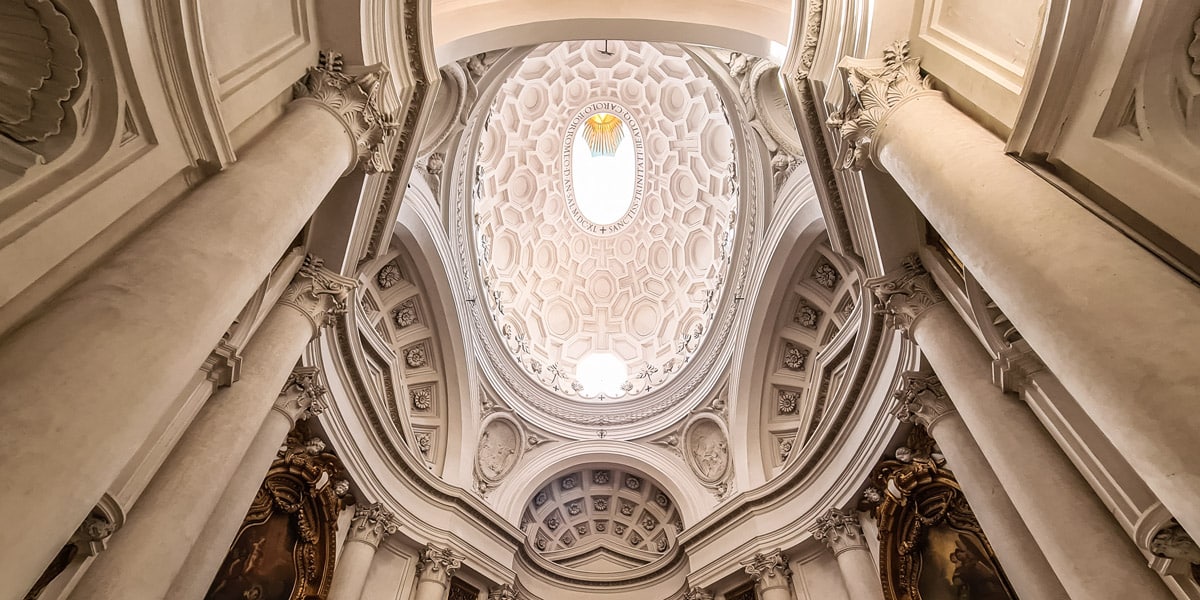
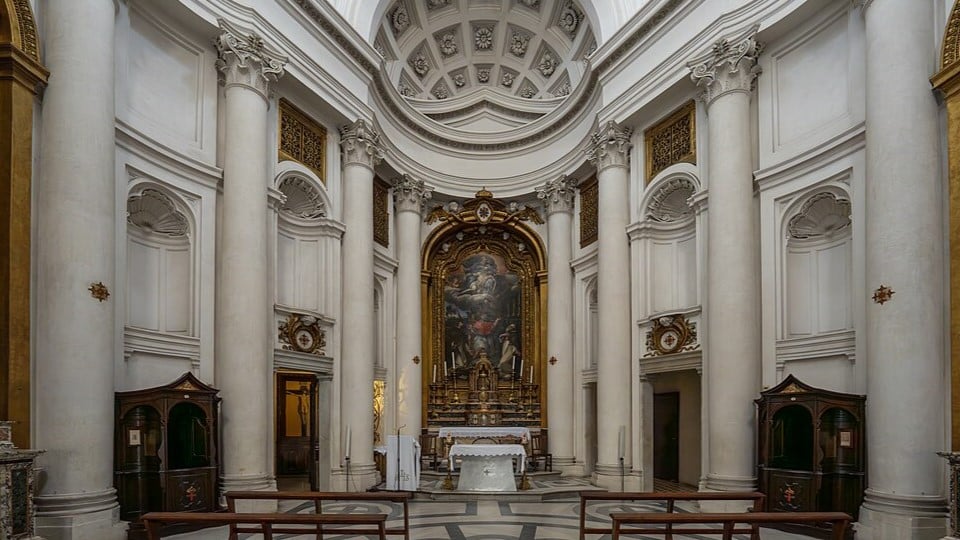
Construction began in 1638 and the church was consecrated in 1646. Borromini replaced a predictable nave with an oval-based interior that changes as you move. The walls swell and tighten, chapels open like carved pockets in the perimeter, and transitions between surfaces feel sculpted rather than assembled. Above, the dome’s patterned coffers tighten as they rise, pulling the eye upward and making the church feel taller and brighter than its modest footprint suggests.

The exterior story continued later. Borromini began the façade in the 1660s but died in 1667. The upper level and final sculptural elements were completed afterward, maintaining his distinctive vocabulary of concave and convex rhythms. Over the centuries, restoration campaigns have helped preserve the church’s crisp surfaces and the subtle lighting effects that define its interior character.

Façade Details

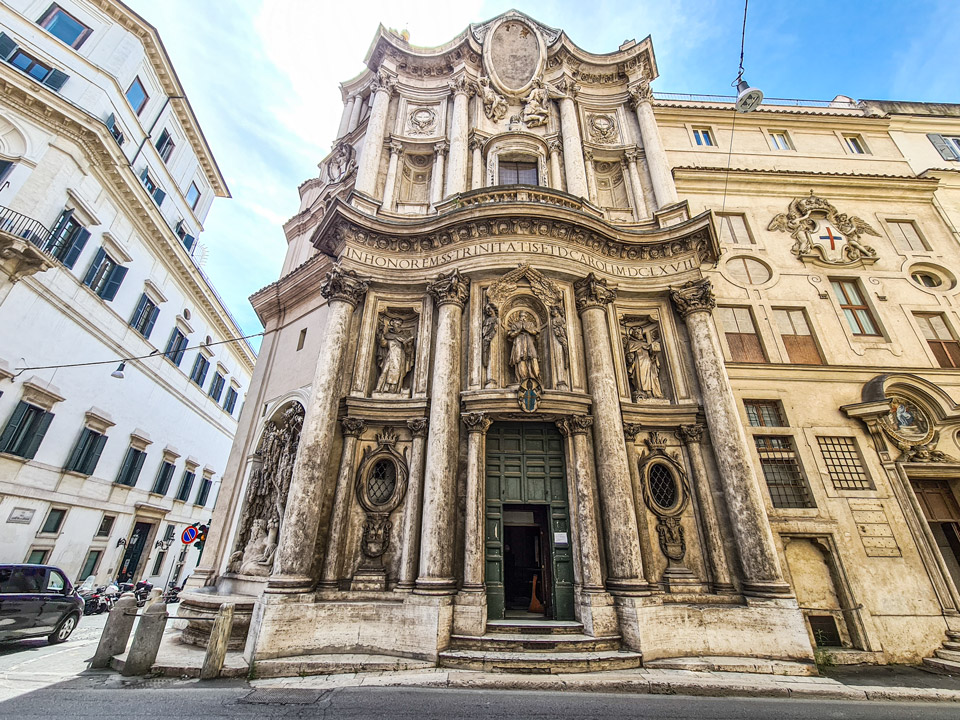
The façade reads like architecture in motion.
Facade Details San Carlo alle Quattro Fontane Rome Francesco Borromini

It is organized in two levels with a continuous, wave-like entablature that never sits still. Borromini builds tension through opposites: the side bays pull inward (concave), while the center pushes outward (convex). Columns with composite capitals frame the composition and sharpen the sense of push and pull, while niches and windows repeat the same curving logic at a smaller scale.

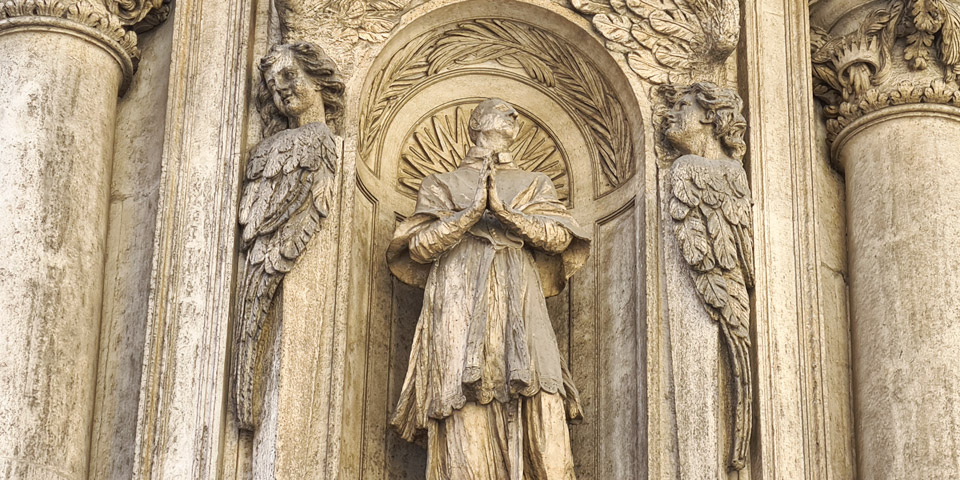
At the center, above the main entrance, a prominent niche presents the church’s devotional focus.
Saint Charles Borromeo stands in prayer framed by sculptural angels

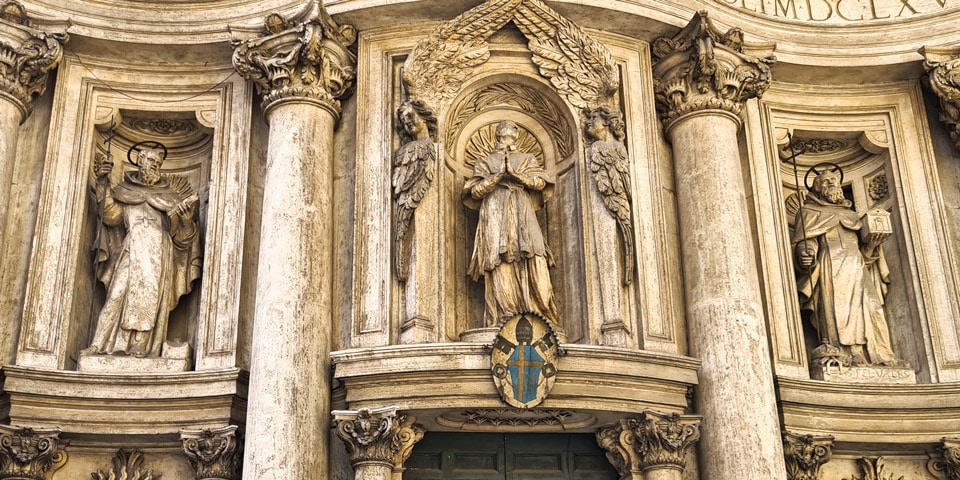
Saint Charles Borromeo stands in prayer, framed by sculptural angels that heighten the sense of a sacred vision. On either side, two full-length statues represent Saint John of Matha and Saint Felix of Valois, the founders of the Trinitarian Order.
On either side Saint John of Matha and Saint Felix of Valois the founders of the Trinitarian Order

Together, the program ties the church’s dedication (Saint Charles) to the religious community that built and still inhabits the complex (the Trinitarians).
coat of arms of the Trinitarian Order

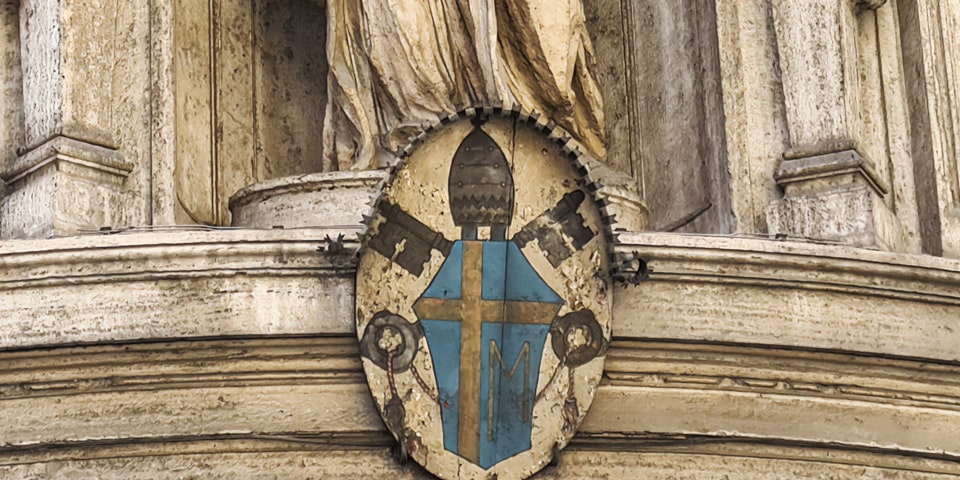
Beneath the central niche sits the coat of arms of the Trinitarian Order, a shield bearing the order’s distinctive cross. On the façade it functions like a public signature, announcing the institution behind the building in a compact heraldic emblem.

Running across the façade is the Latin dedicatory inscription: IN HONOREM SS. TRINITATIS ET D. CAROLI MDCLXVII.
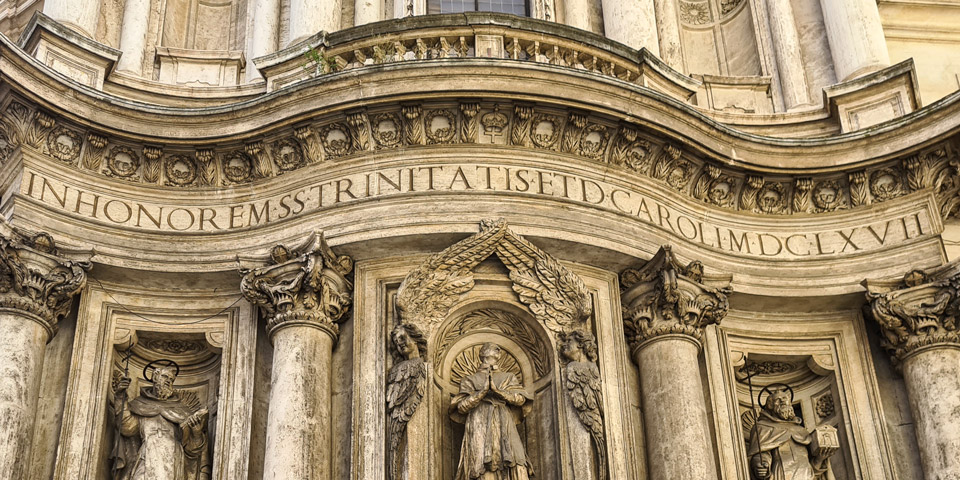
Latin inscription IN HONOREM SS TRINITATIS ET D. CAROLI MDCLXVII

It translates as: “In honor of the Most Holy Trinity and Saint Charles, 1667.” The text states the church’s dual dedication and anchors the façade’s historical moment to the period when Borromini’s exterior concept was being realized.

Saint Charles Borromeo (1538–1584) was a cardinal and Archbishop of Milan and a leading figure of Catholic reform. He is remembered for implementing the reforms of the Council of Trent, strengthening clerical training through seminaries, and organizing aid during the Milan plague of 1576–1577. His reputation for discipline, pastoral care, and public service made him a powerful patron for a reform-minded religious order in 17th-century Rome.
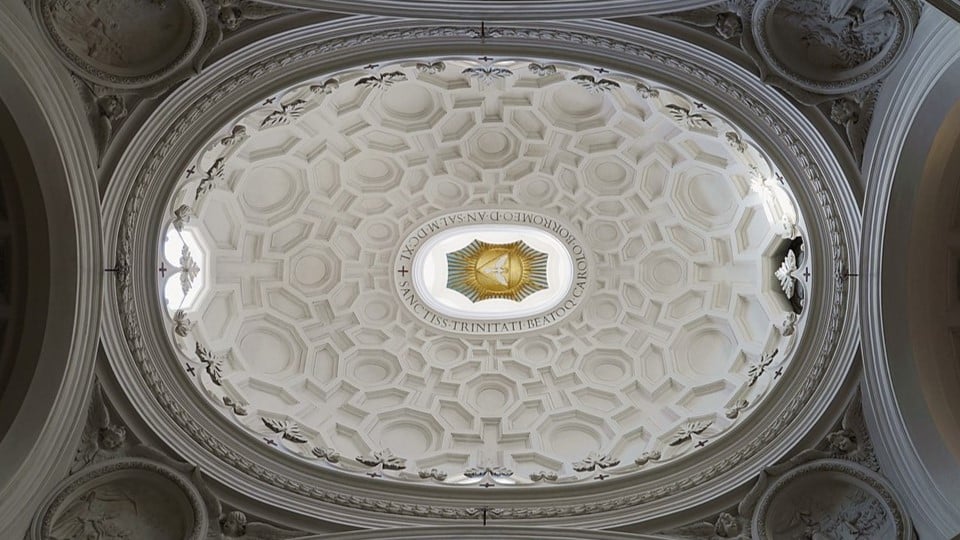
The Church Nowadays

San Carlo alle Quattro Fontane

Today, San Carlo alle Quattro Fontane remains a living church and a significant stop for architecture lovers. It hosts religious services while welcoming visitors who come to study its daring curves, the disciplined geometry behind them, and the way light seems to “float” across the dome. Because the building is compact, it rewards slow looking. A slight shift in your position can completely change what you see.

The Four Fountains Nearby and Why the Church Has This Name

The phrase “alle Quattro Fontane” means “at the Four Fountains.”
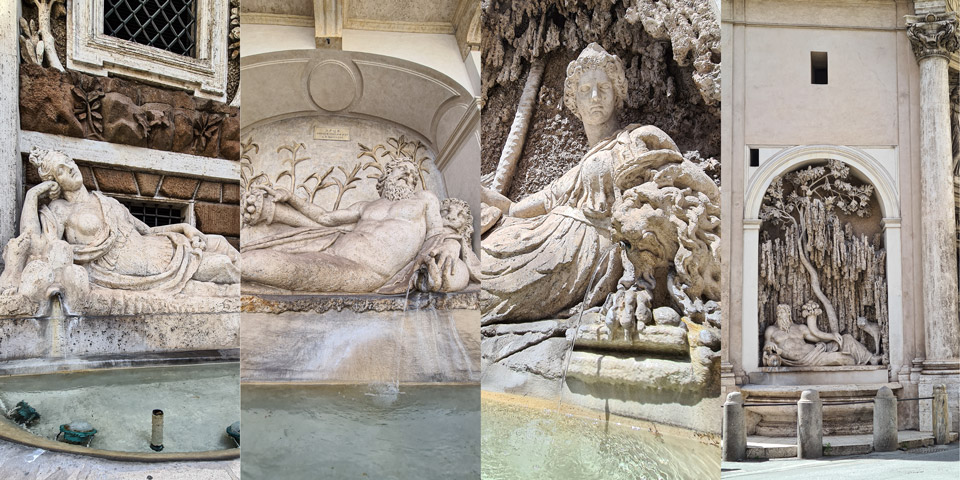
Four Fountains Nearby San Carlo at the Four Fountains Church Rome

The name comes from the crossroads outside the church, where four corner fountains mark the intersection and frame the approach. The fountains predate Borromini’s church and were installed during late-16th-century urban improvements in Rome. Together, they turned this junction into a recognizable landmark—so recognizable that the church adopted the location as part of its identity.

Each fountain sits in a corner niche and features a figure associated with a river or a classical deity. Seen as a set, they blend civic symbolism (the rivers) with mythological imagery (the goddesses). That mix is part of Rome’s visual language, where everyday streets often carry layers of meaning.

The Tiber Fountain

This corner fountain is usually identified as the River Tiber personified: a powerful, bearded river god reclines in a niche shaped like a rocky grotto, his torso angled toward the street as if he has just surfaced from the riverbank.
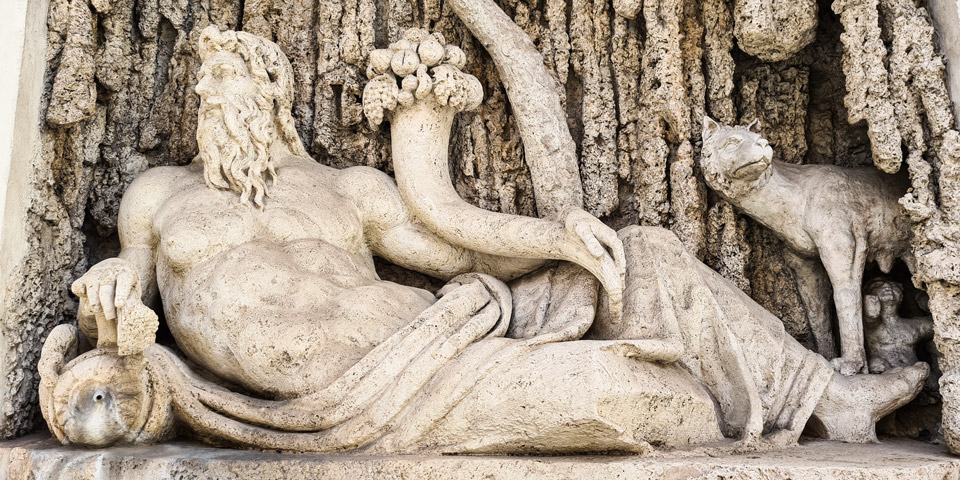
Tiber Fountain Rome San Carlo alle Quattro Fontane

He holds a cornucopia brimming with fruit, a classic emblem of abundance and fertility that suits the Tiber’s role as Rome’s sustaining waterway. Beside him appears the Capitoline she-wolf with Romulus and Remus, a compact but unmistakable reference to the city’s foundation myth. The figure rests above a semicircular travertine basin, while the rugged “stone” backdrop and vegetal relief behind him reinforce the illusion of a natural riverside setting rather than a flat architectural wall.

The Arno Fountain

Tradition identifies this corner relief as the River Arno, and the sculptor makes the reference feel distinctly Tuscan.
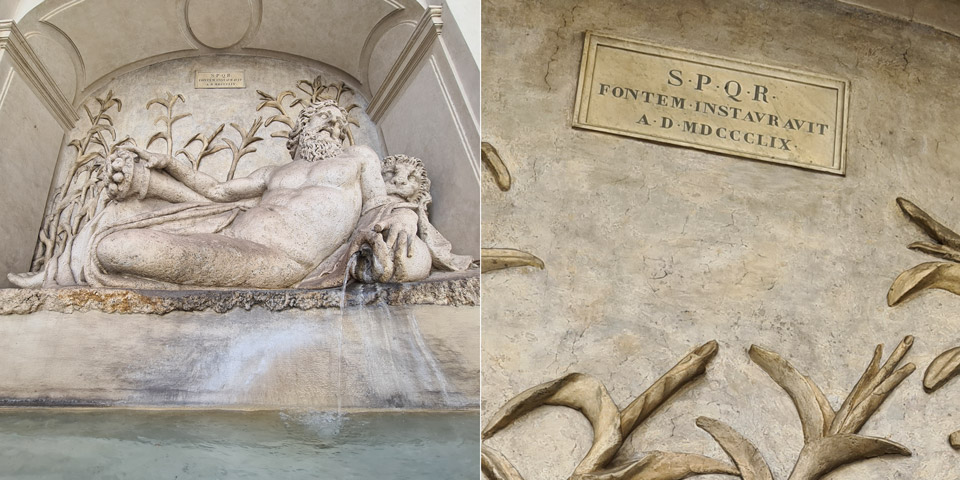
Arno Fountain Rome San Carlo alle Quattro Fontane

The river god reclines in a shallow niche and holds a cornucopia—a standard classical attribute for rivers, signaling fertility and plenty along the riverbanks. What sets this one apart is the lion’s head tucked beside him. Because the Arno is closely tied to Florence, the lion is often read as an intentional allusion to Florentine civic imagery (the city’s emblematic lion), while also reinforcing the idea of strength and guardianship.

At the lower edge, water spills from a tilted vessel at the figure’s hand, a practical detail that doubles as iconography: the river’s “source” becomes visible. Behind the figure, the backdrop is carved with tall, stylized riverbank plants—reeds and long-stemmed foliage—so the niche reads like a vegetal riverside setting rather than a flat wall.

Above the relief, the stone plaque adds a later chapter to the fountain’s story. It reads “S.P.Q.R. FONTEM INSTAVRAVIT A.D. MDCCCLIX”, which translates to “The Senate and People of Rome restored the fountain in the year 1859.” In other words, what you see today is not only a late-Renaissance street monument, but also a piece that Rome’s civic authorities deliberately repaired and preserved in the 19th century.

The Diana Fountain

This fountain is often identified as Diana (though some descriptions also read the figure as an allegory of Fidelity), and the carved details support both interpretations.
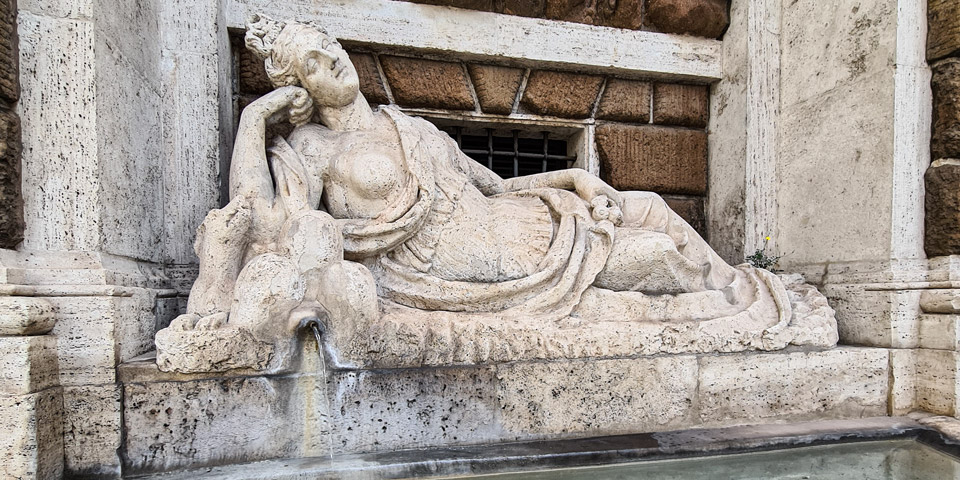
Diana Fountain Rome San Carlo alle Quattro Fontane

The goddess reclines in a calm, classical pose, her head resting on her hand as if in quiet vigilance. Tucked beneath her bent arm, a small dog peeks out—an unmistakable attribute of Diana as huntress, and at the same time a traditional emblem of loyalty, which is why “Fidelity” sometimes enters the conversation.

The three large “stones” beside her are not random rockwork.
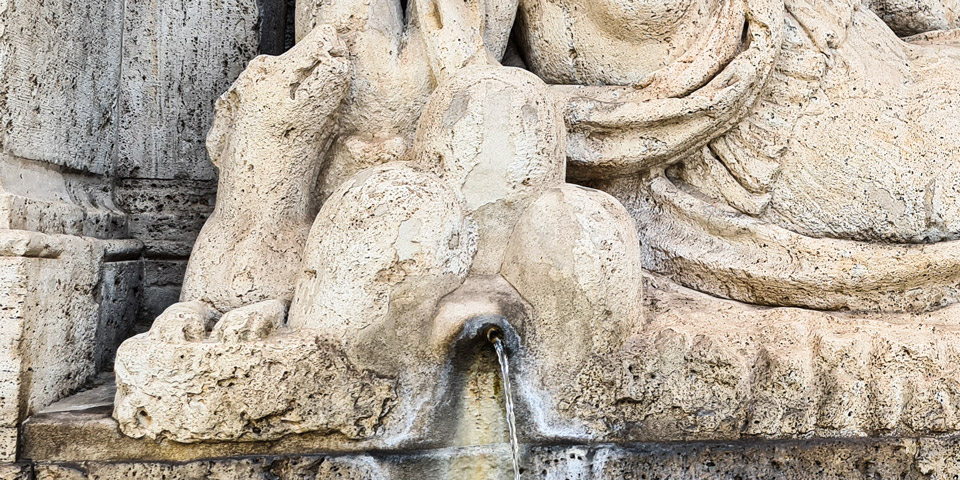
triple mount heraldic reference to Pope Sixtus V Peretti Diana Fountain Rome

They form a stylized triple mount (three rounded hills), a heraldic reference to Pope Sixtus V Peretti, under whose pontificate the Quattro Fontane were installed. In other words, the sculpture blends mythological identity with a clear civic signature: Diana (or Fidelity) leans against the pope’s emblem, visually linking the fountain to the urban renewal campaign that created this crossroads.

Water emerges at the base from the carved rock mass near her resting side, turning the sculpture into a functional springhead. The restrained setting—more architectural than grotto-like—keeps the mood measured and “civil,” matching the figure’s composed expression and the fountain’s role as street ornament designed for daily life.

The Juno Fountain

This corner fountain is commonly identified as Juno because it leans into the goddess’s civic role as a guardian of Rome.
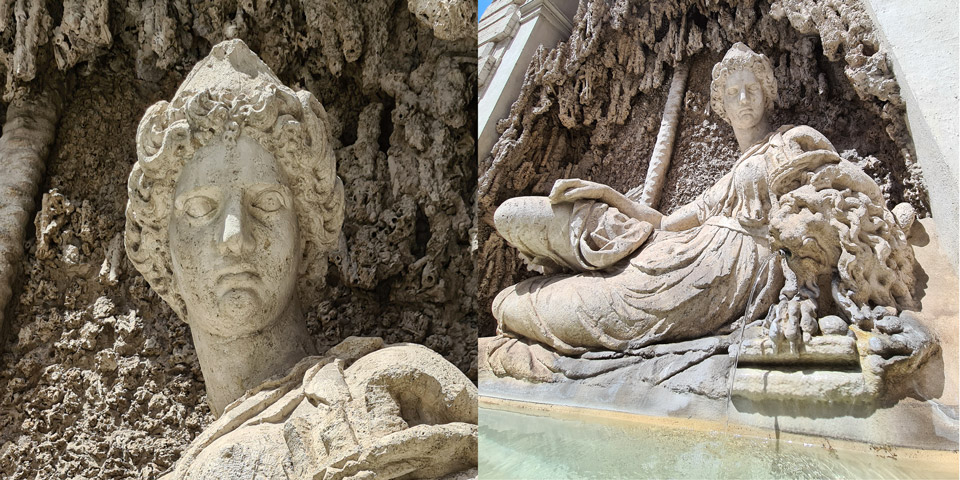
The Juno Fountain Rome San Carlo alle Quattro Fontane

The figure reclines in a deep niche modeled as a rough grotto, with heavy, stalactite-like “stone” formations hanging above her. That rugged setting makes the smooth, idealized body and carefully carved drapery stand out even more. In her left hand she holds a long scepter, a straightforward emblem of sovereignty and protection. At her right, water pours from a lion’s head spout, a classical symbol of strength that turns the fountain’s plumbing into part of the iconography.

On the left, you can also see a large waterfowl (often read as a goose).
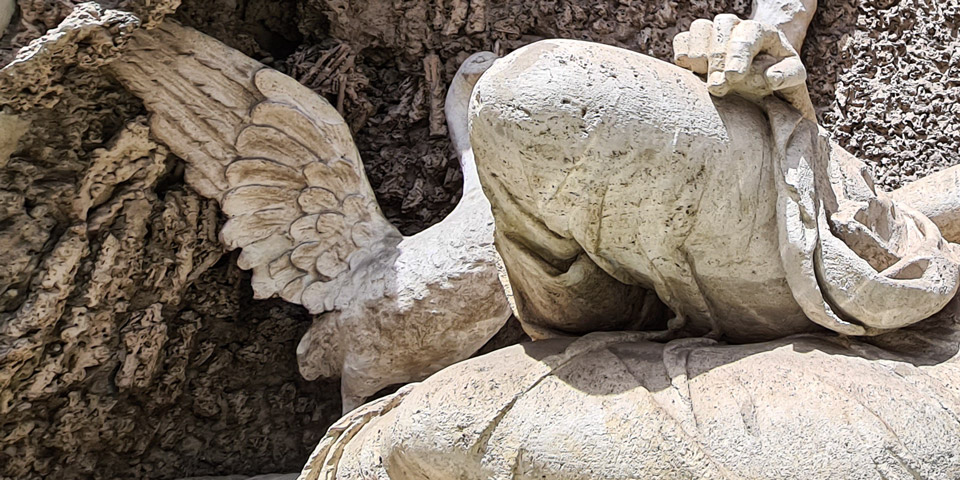
sacred geese of Juno Rome

That detail connects to one of Rome’s best-known legends: the sacred geese of Juno on the Capitoline supposedly raised the alarm during a nighttime Gallic attack, traditionally dated to 390 BC, waking the defenders in time to save the city. In that story, Juno becomes a “watchful” protector—sometimes associated with the epithet Juno Moneta (“the Warner”). Read together, the scepter, the lion spout, and the goose make a coherent statement: this is not just a decorative goddess, but a figure of vigilance and civic defense.
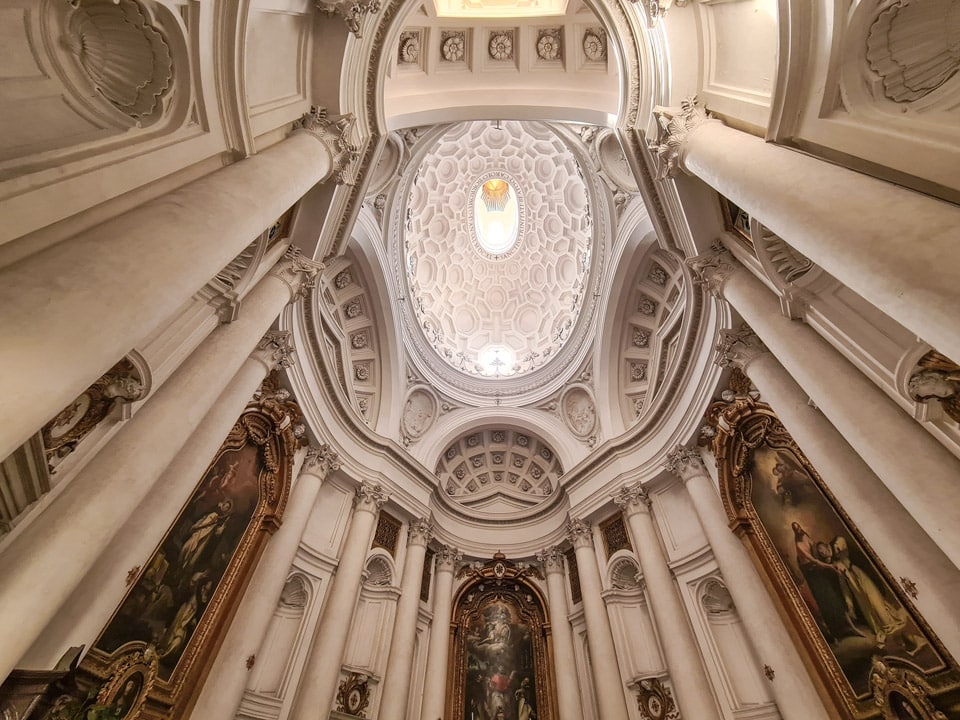
What to See Inside San Carlo alle Quattro Fontane

Interior Details Inside San Carlo alle Quattro Fontane

  • The first thing you notice is the oval-based plan. As you walk, the walls seem to flex—expanding in one direction, tightening in another.
  • Then look up. The coffered dome uses a shrinking pattern that pulls your eye higher, so the space feels taller and brighter than its size suggests.
  • Watch how the light behaves. Instead of harsh beams, illumination spreads softly across curves and edges, as if the architecture is glowing from within.
  • The side chapels and altars are worth a slow pass. They anchor the interior, yet they also repeat the church’s rhythm of concave and convex forms.
  • Because the palette is mostly white, detail appears through shadow and relief. Give your eyes a moment and you’ll start to see moldings, transitions, and fine carving emerge.
  • Try viewing the nave from several angles. The geometry changes with your position, which is exactly what Borromini intended.
  • Even on a busy day, the church invites a pause. A short moment of stillness helps you feel how the space was designed to steady attention, not just impress.
  • If you take photos, mix perspectives. Wide shots capture the overall motion of the interior, while close-ups reveal the precision of the coffers, edges, and junctions.

Interesting Facts

  1. San Carlo alle Quattro Fontane is famous for making a compact space feel monumental. Borromini used proportion, curvature, and patterned coffers to heighten the dome’s apparent scale.
  2. The façade reads like a moving surface. Its concave and convex sections catch daylight at different times of day, so the church seems to change as you walk past it.
  3. The church’s name is geographical as much as devotional. “At the Four Fountains” refers to the crossroads outside, where the four corner fountains became a defining marker of the neighborhood.
  4. San Carlino is often cited as a turning point in Baroque architecture because it treats geometry as a living system—curves generate space, and space directs emotion.
  5. The dedication honors Saint Charles Borromeo, a major figure of Catholic reform remembered for discipline, pastoral care, and charitable priorities—values that resonated strongly with the Trinitarian community on this site.

Best Value Hotels Near San Carlo alle Quattro Fontane

Suite Artis Barberini
7 min
1083 ft
330 m
Croce Di Malta
17 min
2854 ft
870 m
Colosseo Relais
18 min
3018 ft
920 m
Hotel Romano
20 min
3248 ft
990 m
LHG Comfy Rooms
24 min
4003 ft
1.2 km
Relais Villa Borghese
25 min
4167 ft
1.3 km
History Suite
28 min
4626 ft
1.4 km

Nearby Attractions

Palazzo Barberini
4 min 590 ft 180 m
St. Paul's Within the Walls
6 min 920 ft 280 m
Piazza Barberini
6 min 1020 ft 310 m
Triton Fountain
6 min 1020 ft 310 m
Quirinal Hill
6 min 1050 ft 320 m
Piazza della Repubblica
8 min 1280 ft 390 m
Fountain of the Naiads
8 min 1380 ft 420 m
Capuchin Crypt
9 min 1410 ft 430 m
St. Mary of the Angels
10 min 1670 ft 510 m
Viminal Hill
11 min 1840 ft 560 m

Author: Artur Jakucewicz

Artur Jakucewicz

I have lived in Rome for over 10 years and am glad to share my experience and knowledge. I love ancient history and architecture — author of travel guides in Italy for independent travelers.

Dive Deeper into Rome's Stories

Fiumicino Airport Terminal 3

25069 views

How to Get from Fiumicino Airport to Rome City Center

Visiting Sistine Chapel

935965 views

Sistine Chapel

The Borghese Gallery and Museum The Ultimate Guide for Visitors

16013 views

The Borghese Gallery and Museum

Vatican Museums Guide

991470 views

The Vatican Museums

The Colosseum

135741 views

Colosseum

Visiting Pantheon in Rome

34710 views

Pantheon

Roman Forum in Rome Italy

42224 views

Roman Forum – Ultimate Guide for Antic History Lovers

What to See in Rome

35537 views

What to See in Rome – TOP 30 Tourist Attractions & Places

Hotels with best views in Rome

15465 views

Hotels with Best Views in Rome

Show more

About us

About us ROME.US Authors Kate Zusmann and Artur Jakucewicz
We're Kate and Artur, a duo bound by our shared fascination with the Eternal City – Rome. Our paths, driven by a mutual passion for its timeless stories and architectural marvels, converged in a way we had never imagined.

Explore Rome

  • Capitoline Museums in Rome

    Capitoline Museums

  • The Colosseum

    Why the Colosseum is Important?

  • tram in Rome

    Trams in Rome

  • Eternal City Rome

    Eternal City – Why Rome is Named So?

  • St Paul's Within the Walls Rome

    St. Paul’s Within the Walls

Rome.us
  • social logo
  • social logo
  • social logo
  • social logo

This website uses cookies. For more info read the cookies policy

Rome.us © 2026. Created with love by Roman experts and guides.