

Rome.us
  • TAXI FARES CALCULATOR
  • BOOK PRIVATE TOUR
  • ABOUT US
  • HOW TO GET
    • Fiumicino Airport
    • Ciampino Airport
    • Termini Railway Station
    • Public Transport
    • To Venice
    • To Florence
    • To Ostia Antica
    • To Naples
    • To Milan
    • To Pisa
    • To Siena
  • TIPS
    • TOP Attractions
    • Tickets to Vatican museums
    • Rome Three Day Itinerary
    • Rainy Days in Rome
    • Buying a Sim Card in Italy
    • Renting a Car in Rome
    • Apps for Tourists
    • Free Things to Do
    • Unusual Things to do
    • ASK US
    • Instagram
    • Pinterest
  • ANCIENT SITES
    • Castel Sant’Angelo
    • Colosseum
    • Pantheon
    • Roman Forum
  • WHERE TO STAY
    • How to Choose a Hotel in Rome
    • Hotels with Best Views
    • Hotels near Termini
    • Hotels near the Colloseum
    • Best Hostels
    • Hotels near Navona Square
    • 3 Star Hotels
    • 4 Star Hotels
    • 5 Star Hotels
    • Apartments For Rent
  • VATICAN CITY
    • St Peter’s Basilica
    • Sistine Chapel
    • Vatican Museums
    • Raphael’s Rooms
    • Michelangelo’s Pieta
    • St Peters Dome
    • St Peter’s Square
    • Vatican Military
    • Swiss Guard
    • Pilgrims of Hope Jubilee
  • MUSEUMS
    • Ara Pacis Augustae
    • Borghese Gallery
    • Capitoline Museums
    • Caravaggio’s Paintings
    • Great Synagogue
    • Palazzo Farnese
    • Spada Gallery
  • PARKS
    • Appian Way
    • Orange Garden
    • Park of the Aqueducts
    • Pincio Terrace
    • Villa Ada
    • Vatican Gardens
    • Villa Borghese
    • Villa Celimontana
    • Villa Torlonia
    • Zoo
  • CHURCHES
    • Capuchin Crypt
    • Holy Stairs
    • Sant’Agnese in Agone
    • San Giovanni in Laterano
    • Santa Maria Maggiore
    • Saint Paul Outside the Walls
    • St Peter in Chains
    • St. Ignatius of Loyola
  • FOUNTAINS & SQUARES
    • Navona Square
    • Spanish Steps
    • Trevi Fountain
    • Altar of The Fatherland
    • Fontana della Barcaccia
    • Fountain of the 4 Rivers
    • Fountain of the Pantheon
    • Piazza del Popolo
    • Piazza Venezia
    • Turtle Fountain
    • Triton Fountain
  • HILLS
    • Aventine
    • Capitoline
    • Janiculum
    • Palatine
    • Pincian
  • DAY TRIPS
    • To Tivoli
    • To Ostia Antica
    • Beaches near Rome
    • To Alberobello
  • WEATHER
    • January
    • February
    • March
    • April
    • May
    • June
    • July
    • August
    • September
    • October
    • November
    • December
  • WHERE TO EAT
    • Famous Roman Dishes
    • Best Pizza Places
    • Best Pasta Places
    • Local Italian Food
    • Best Gelato Places
    • Best Rooftop Bars
  • NEIGHBORHOODS
    • Campo Marzio
    • Jewish Ghetto Quarters
    • Quartiere Coppedè
    • Monti
    • Sant’Eustachio
    • Trastevere
    • Trevi
  • Shopping
    • Castel Romano Outlet
    • Farmers Markets
    • Souvenirs from Rome
  • EMPERORS
    • Good Emperors
    • Marcus Aurelius
    • Gaius Julius Caesar
    • Nero
    • Octavian Augustus
    • Caligula
    • Hadrian
    • Vespasian
    • Commodus
    • Trajan
Home / Famous Catholic Churches in Rome /

Sant’Andrea al Quirinale

Written by: Artur Jakucewicz

The Church of Saint Andrew on the Quirinal
Opening Hours
Sunday: 9:00 AM - 12:00 PM, 3:00 PM - 6:00 PM
Monday: 9:00 AM - 12:00 PM, 3:00 PM - 6:00 PM
Tuesday: 9:00 AM - 12:00 PM, 3:00 PM - 6:00 PM
Wednesday: 9:00 AM - 12:00 PM, 3:00 PM - 6:00 PM
Thursday: 9:00 AM - 12:00 PM, 3:00 PM - 6:00 PM
Friday: 9:00 AM - 12:00 PM, 3:00 PM - 6:00 PM
Saturday: 9:00 AM - 12:00 PM, 3:00 PM - 6:00 PM
Address Via del Quirinale, 30, Rome
Website santandrea.gesuiti.it

Sant’Andrea al Quirinale (The Church of Saint Andrew on the Quirinal) is a Roman Catholic titular church in Rome. Built for the Jesuit seminary on Quirinal Hill, it stands as a hallmark of Roman Baroque design. Gian Lorenzo Bernini created the church’s overall concept and worked with Giovanni de Rossi to bring it to life.

Contents

Toggle
  • Things to Know Before to Visit Sant’Andrea al Quirinale
    • Who was the influential figure behind the commissioning of Sant’Andrea al Quirinale?
    • Which artistic elements contribute to the captivating interior of Sant’Andrea al Quirinale?
    • What role did Sant’Andrea al Quirinale play in its early years?
    • How has Sant’Andrea al Quirinale been preserved over the centuries?
  • History of Sant’Andrea al Quirinale
  • What to Look for on the Outside?
  • Inside
    • The Oval Dome
  • Summary What to See Inside Sant’Andrea al Quirinale
  • Interesting Facts
  • Best Value Hotels Near Sant'Andrea al Quirinale
  • Nearby Attractions

Things to Know Before to Visit Sant’Andrea al Quirinale

Who was the influential figure behind the commissioning of Sant’Andrea al Quirinale?

Sant'Andrea al Quirinale was commissioned by Cardinal Camillo Pamphili, the nephew of Pope Innocent X, in the mid-17th century, showcasing the Pamphili family's influence and dedication to the Jesuit order.

Which artistic elements contribute to the captivating interior of Sant’Andrea al Quirinale?

The church's interior is marked by Baroque theatricality, intricate stucco work, gilded details, and celebrated frescoes by artists like Giovanni Battista Gaulli. This interplay of light and shadow creates a visually stunning and immersive experience for visitors.

What role did Sant’Andrea al Quirinale play in its early years?

Originally constructed as a Jesuit seminary on Quirinal Hill, the church served as a spiritual and educational hub for the Jesuit community, reflecting the broader influence of the Jesuit order in Rome during the 17th century.

How has Sant’Andrea al Quirinale been preserved over the centuries?

Sant'Andrea has undergone meticulous restorations to maintain its architectural brilliance. These efforts have ensured that the church stands today as a well-preserved testament to Rome's artistic and religious heritage, attracting visitors with its historical significance and visual splendor.

History of Sant’Andrea al Quirinale

Sant’Andrea al Quirinale dates to the 17th century, when the Jesuits expanded their educational and religious presence in Rome. Cardinal Camillo Pamphili—nephew of Pope Innocent X—commissioned the church to serve the Jesuit seminary on the Quirinal. The location, set above the city’s historic center, offered both prominence and quiet separation from the surrounding streets.

Bernini, one of the defining figures of the Baroque era, shaped Sant’Andrea into a compact but dramatic sacred space. He collaborated with Giovanni de Rossi on the project. Construction began in 1658 and finished in 1670, during a period when Rome’s churches became stages for architecture, light, and devotion.
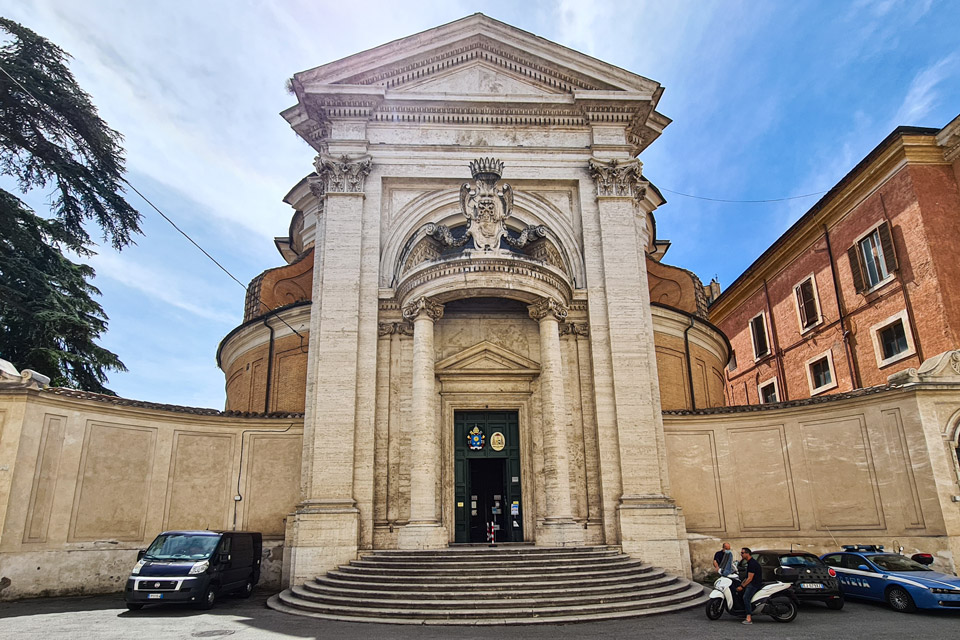
What to Look for on the Outside?

Facade Sant'Andrea al Quirinale

Sant’Andrea al Quirinale is all about controlled drama. Bernini sets the approach with a semi-circular staircase and a compact porch that feels like a proscenium: two Ionic columns support a curved canopy, while the concave side walls pull the façade inward and hint at the church’s oval plan behind it.

Look above the porch. The large stone coat of arms belongs to Cardinal Camillo Francesco Maria Pamphilj (often spelled Pamphili), the church’s main financier and a nephew of Pope Innocent X.
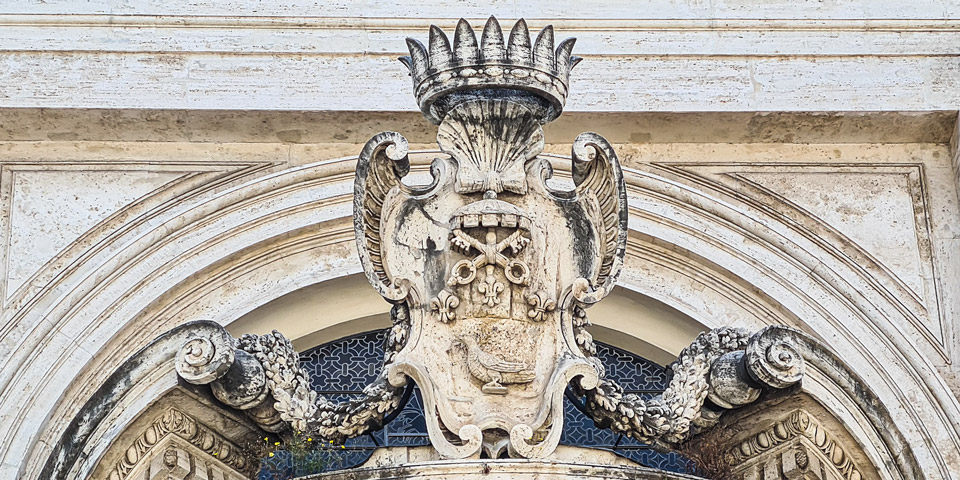
large stone coat of arms belongs to Cardinal Camillo Francesco Maria Pamphilj

Centered on the shield is the Pamphilj family emblem—a dove carrying an olive branch—paired with three fleurs-de-lis, a combination you’ll see across Rome wherever the family left its mark. Bernini frames the shield with an oversized cartouche and scrollwork, then crowns it with a princely coronet. A carved festoon of rose garlands runs alongside the heraldry, a traditional symbol of martyrdom that fits the church’s dedication to Saint Andrew.

Finally, check the two oval plaques on the doors.
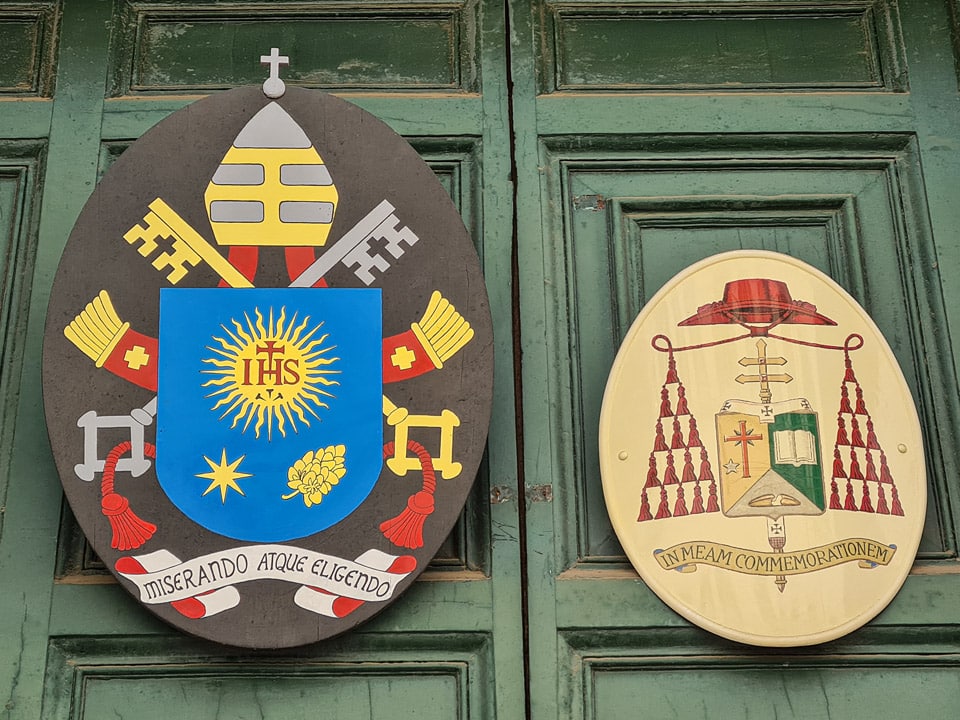
Pope Francis’ coat of arms and plaque belongs to Cardinal Odilo Pedro Scherer

The left one shows Pope Francis’ coat of arms: the Jesuit IHS blazing in a sunburst, with a star and a spikenard flower, and the motto Miserando atque eligendo. The right plaque belongs to Cardinal Odilo Pedro Scherer, the current cardinal-priest of Sant’Andrea al Quirinale. You can spot the classic markers of a cardinal’s arms: the red galero with tassels, the cross behind the shield, and the motto In meam commemorationem (“In remembrance of me”). Together, the façade and its heraldry tell you exactly who shaped this church—its patrons, its Jesuit identity, and its living place in Rome today.

Inside

Once you step inside, Bernini’s plan does the work for you. The church is built on an oval, so the space feels intimate, yet it still sweeps you forward. The side chapels sit back in shadow, while the main axis stays bright and focused on the high altar—exactly where Bernini wanted your eyes to land first.
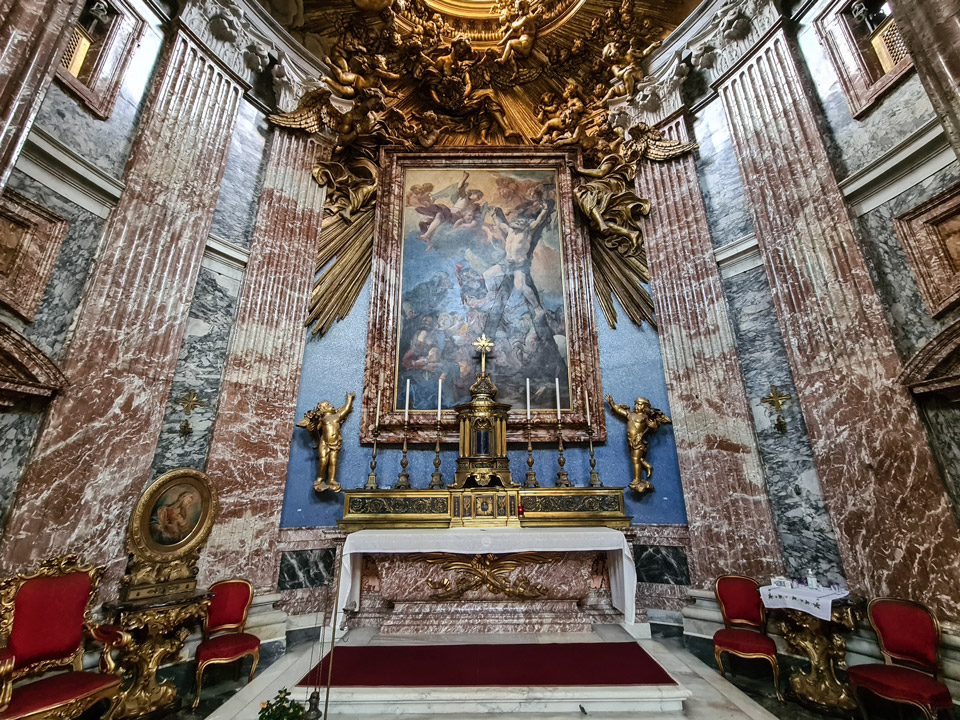
altar Sant'Andrea al Quirinale Rome

At the altar, the subject is the church’s patron saint. The large canvas shows Saint Andrew at the moment of martyrdom. Andrew was one of the Twelve Apostles and the brother of Saint Peter. Christian tradition remembers him as a missionary and preacher who died for the faith.
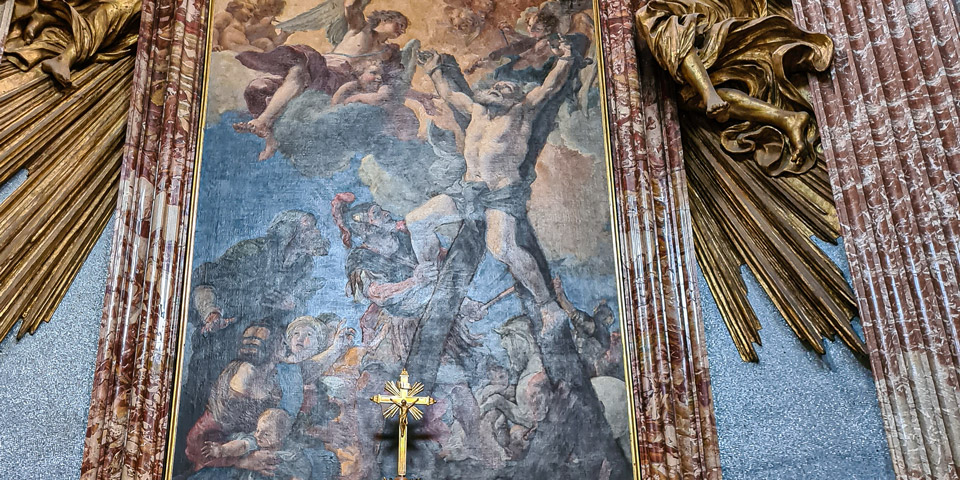
Saint Andrew’s Cross

He is closely associated with the X-shaped cross—often called Saint Andrew’s Cross—a form that sets his martyrdom apart from the familiar Latin cross of Christ.

The altarpiece is by Guillaume Courtois (known in Rome as Il Borgognone) and is typically dated to 1668. Bernini turns it into a full Baroque “stage set” by pushing the story beyond the painted surface. Look above and around the canvas: the white stucco angels and the sculpted figure of Andrew appear to burst out of the architecture, lifting the scene upward in a visual crescendo. The sculptural work is attributed to Bernini’s circle, with Antonio Raggi most often credited for the dramatic figure and angelic elements that complete the illusion of ascent.

Near the entrance, you’ll see a striking marble composition with a scrolling banner and fluttering drapery.
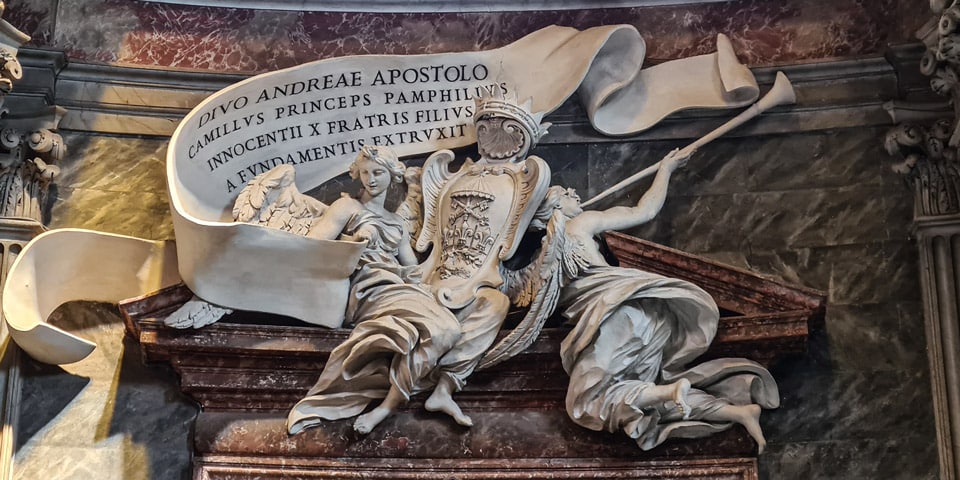
DIVO-ANDREAE-APOSTOLO-CAMILLVS-PRINCEPS-PAMPHILIVS-INNOCENTII-X-FRATRIS-FILIVS-A-FUNDAMENTIS-EXTRVXIT

The Latin inscription makes the patronage explicit. It reads, line by line:

DIVO ANDREAE APOSTOLO
CAMILLVS PRINCEPS PAMPHILIVS
INNOCENTII X FRATRIS FILIVS
A FUNDAMENTIS EXTRVXIT

In English: “To Saint Andrew the Apostle, Prince Camillo Pamphilj, son of the brother of Innocent X, built this from the foundations.” It’s a concise public signature: the dedication to Andrew, the name of the patron, and the family connection to Pope Innocent X.

Also watch your step—because the floor carries its own biography.
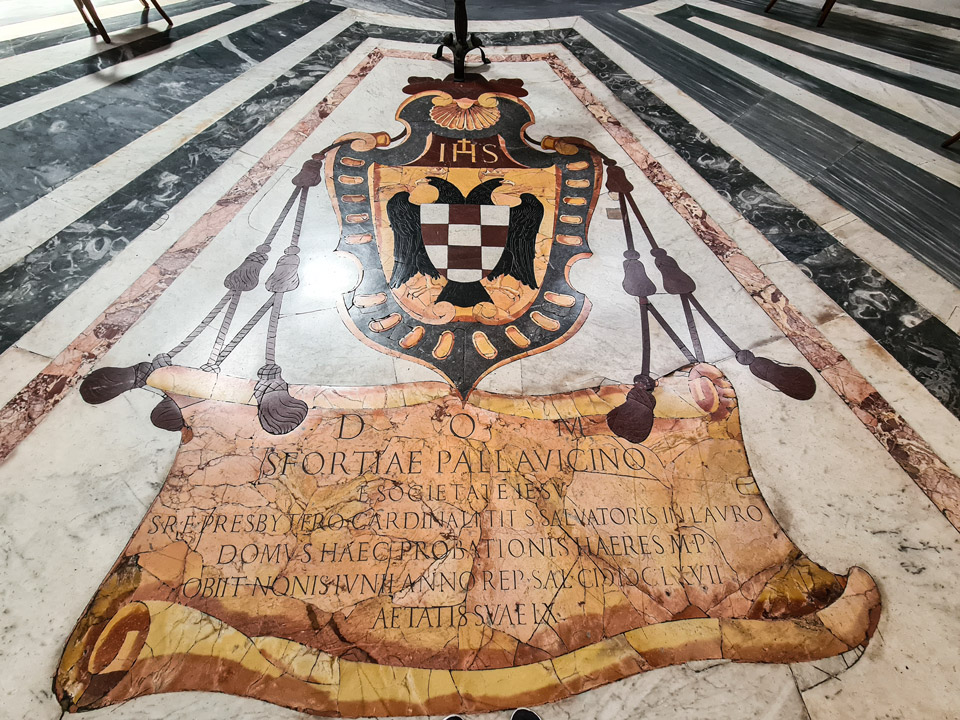
coat of arms with two eagles belongs to Cardinal Francesco Maria Sforza Pallavicino

The large inlaid coat of arms with two eagles belongs to Cardinal Francesco Maria Sforza Pallavicino, S.J., a Jesuit theologian and cardinal associated with the church and the Jesuit community here. The inscription identifies him and records his death. Parts of the text vary by spacing and wear, but the meaning is clear:

D.O.M. (“To God, the Best and Greatest”)
“To Sforza Pallavicino, of the Society of Jesus, cardinal-priest… This house of probation, his heir, placed this memorial… He died on the Nones of June (June 5) … in the 60th year of his age.”

It’s no accident that the interior feels so unified. Bernini treated the building like a single artwork—architecture, painting, sculpture, light, and text all pulling in the same direction. Bernini took special pride in Sant’Andrea and spoke of it with unusual satisfaction, as if it captured exactly what he believed a church interior should do.

The Oval Dome

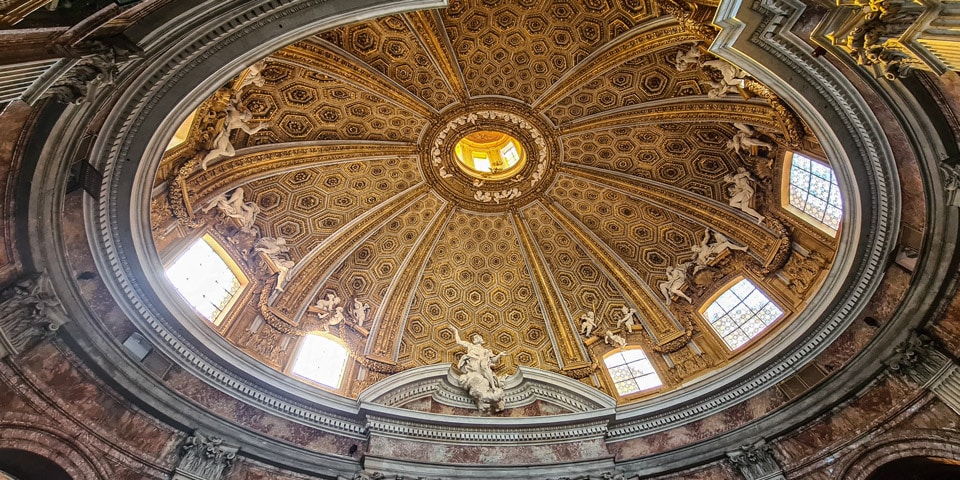
Bernini carries the oval theme into the dome, and that choice changes everything.
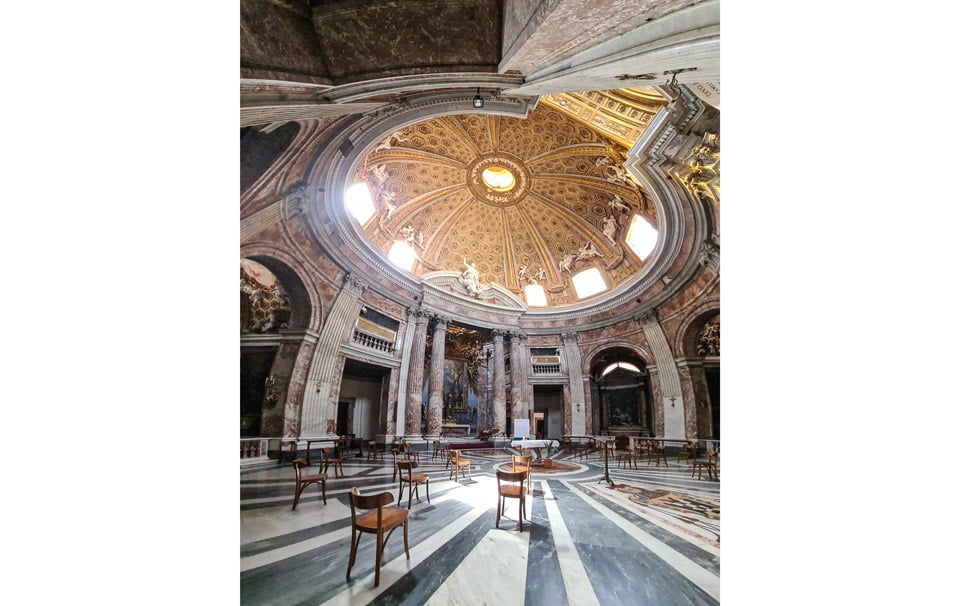
The Oval Dome by Bernini Sant'Andrea al Quirinale Rome

A circular dome can feel static. An oval dome feels as if it’s in motion, stretching the space along the altar axis and reinforcing the forward pull of the plan. The coffering tightens as it rises, and the bright opening at the top draws the eye upward, so the dome reads taller than it really is.

The comparison visitors often make is with San Carlo alle Quattro Fontane, the small masterpiece by Borromini just down the street. Bernini knew it well. If Borromini’s church is an essay in restless geometry, Sant’Andrea is a lesson in theatrical clarity: the oval isn’t a puzzle to solve—it’s a funnel of attention, guiding you from Andrew’s cross at the altar to the light above.

Summary: What to See Inside Sant’Andrea al Quirinale

  • Look first at the main altar, where Bernini’s design pulls the whole interior into focus with confident lines and fine detail.
  • Then lift your eyes to the elliptical dome, a Baroque flourish that makes the space feel taller and more expansive than you might expect.
  • As you move through the nave, notice how stucco, marble, and gilding work together to give the interior its rich, glowing finish.
  • Along the walls, paintings and frescoes add color and narrative, guiding visitors through scenes tied to Saint Andrew and the church’s wider iconography.
  • Finally, step into the side chapels, where smaller altars and devotional details create quieter moments away from the main axis of the church.

Interesting Facts

  1. Sant’Andrea al Quirinale was commissioned in the mid-17th century by Cardinal Camillo Pamphili, reflecting the Pamphili family’s influence and support for the Jesuit order.
  2. Gian Lorenzo Bernini designed the church as a concentrated showcase of Roman Baroque architecture, where proportion and spectacle work together rather than compete.
  3. The church’s elliptical dome stands out as an architectural choice that increases the sense of movement and depth, departing from the symmetry of a traditional circular dome.
  4. Baroque theatricality shapes the interior experience, with carefully managed light, shadow, and ornament guiding the eye toward the altar.
  5. The church includes frescoes by artists such as Giovanni Battista Gaulli and Giuseppe Ghezzi, depicting scenes from the life of Saint Andrew and other religious narratives.
  6. Built for the Jesuit seminary on Quirinal Hill, the church served as a spiritual and educational anchor for the community during the 1600s.
  7. Multiple restorations over the centuries have helped preserve Sant’Andrea’s architecture and decoration, keeping it among the best-maintained Baroque churches in Rome.

Read also about the artworks of Borromini in Rome.

Best Value Hotels Near Sant'Andrea al Quirinale

Suite Artis Barberini
7 min
1083 ft
330 m
Croce Di Malta
15 min
2493 ft
760 m
Colosseo Relais
15 min
2526 ft
770 m
Hotel Romano
17 min
2789 ft
850 m
History Suite
24 min
3871 ft
1.2 km
LHG Comfy Rooms
28 min
4659 ft
1.4 km
Bellezza Al Colosseo
29 min
4757 ft
1.5 km

Nearby Attractions

Quirinal Hill
3 min 430 ft 130 m
San Carlo alle Quattro Fontane
4 min 720 ft 220 m
Palazzo Barberini
5 min 850 ft 260 m
Triton Fountain
6 min 1020 ft 310 m
Piazza Barberini
7 min 1120 ft 340 m
Trevi Fountain
9 min 1440 ft 440 m
Capuchin Crypt
9 min 1510 ft 460 m
St. Paul's Within the Walls
9 min 1540 ft 470 m
Colonna Palace Gallery
10 min 1710 ft 520 m
Viminal Hill
12 min 1900 ft 580 m

Author: Artur Jakucewicz

Artur Jakucewicz

I have lived in Rome for over 10 years and am glad to share my experience and knowledge. I love ancient history and architecture — author of travel guides in Italy for independent travelers.

Dive Deeper into Rome's Stories

Fiumicino Airport Terminal 3

25118 views

How to Get from Fiumicino Airport to Rome City Center

Visiting Sistine Chapel

936059 views

Sistine Chapel

The Borghese Gallery and Museum The Ultimate Guide for Visitors

16076 views

The Borghese Gallery and Museum

Vatican Museums Guide

991622 views

The Vatican Museums

The Colosseum

137729 views

Colosseum

Visiting Pantheon in Rome

34753 views

Pantheon

Roman Forum in Rome Italy

43600 views

Roman Forum – Ultimate Guide for Antic History Lovers

What to See in Rome

35629 views

What to See in Rome – TOP 30 Tourist Attractions & Places

Hotels with best views in Rome

15702 views

Hotels with Best Views in Rome

Show more

About us

About us ROME.US Authors Kate Zusmann and Artur Jakucewicz
We're Kate and Artur, a duo bound by our shared fascination with the Eternal City – Rome. Our paths, driven by a mutual passion for its timeless stories and architectural marvels, converged in a way we had never imagined.

Explore Rome

  • cost of living in rome

    Cost of Living in Rome

  • The Basilica of St. Stephen in the Round

    The Basilica of St. Stephen in the Round on the Caelian Hill

  • santa maria sopra minerva

    Santa Maria sopra Minerva

  • location of colosseum

    Where is the Colosseum Located in Rome?

  • Ponte district in Rome

    Ponte District – one of the most luxurious Roman neighbourhoods

Rome.us
  • social logo
  • social logo
  • social logo
  • social logo

This website uses cookies. For more info read the cookies policy

Rome.us © 2026. Created with love by Roman experts and guides.