

25117 views
Sant’Andrea al Quirinale (The Church of Saint Andrew on the Quirinal) is a Roman Catholic titular church in Rome. Built for the Jesuit seminary on Quirinal Hill, it stands as a hallmark of Roman Baroque design. Gian Lorenzo Bernini created the church’s overall concept and worked with Giovanni de Rossi to bring it to life.
Sant’Andrea al Quirinale dates to the 17th century, when the Jesuits expanded their educational and religious presence in Rome. Cardinal Camillo Pamphili—nephew of Pope Innocent X—commissioned the church to serve the Jesuit seminary on the Quirinal. The location, set above the city’s historic center, offered both prominence and quiet separation from the surrounding streets.
Bernini, one of the defining figures of the Baroque era, shaped Sant’Andrea into a compact but dramatic sacred space. He collaborated with Giovanni de Rossi on the project. Construction began in 1658 and finished in 1670, during a period when Rome’s churches became stages for architecture, light, and devotion.
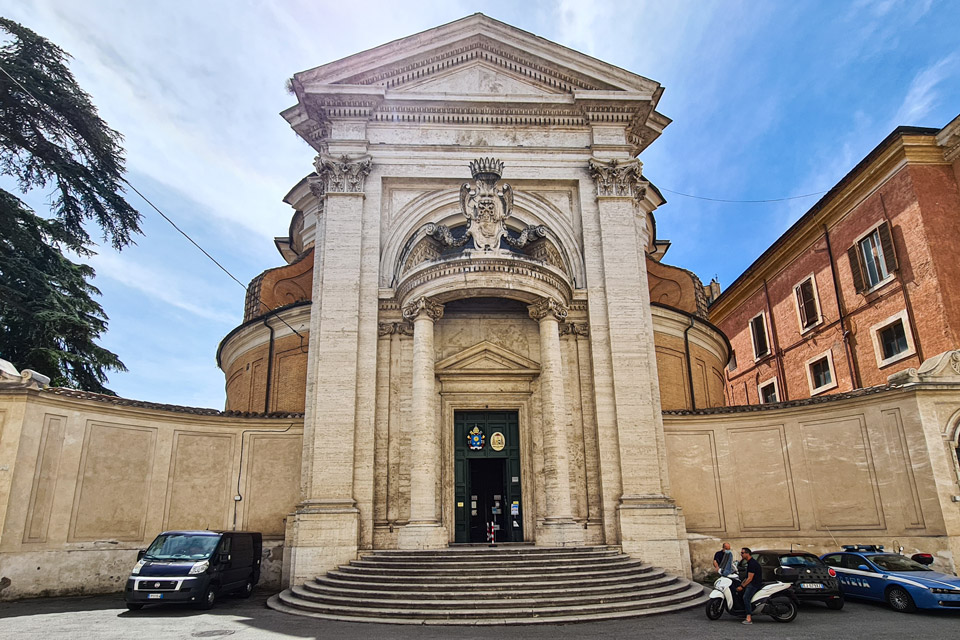
Sant’Andrea al Quirinale is all about controlled drama. Bernini sets the approach with a semi-circular staircase and a compact porch that feels like a proscenium: two Ionic columns support a curved canopy, while the concave side walls pull the façade inward and hint at the church’s oval plan behind it.
Look above the porch. The large stone coat of arms belongs to Cardinal Camillo Francesco Maria Pamphilj (often spelled Pamphili), the church’s main financier and a nephew of Pope Innocent X.
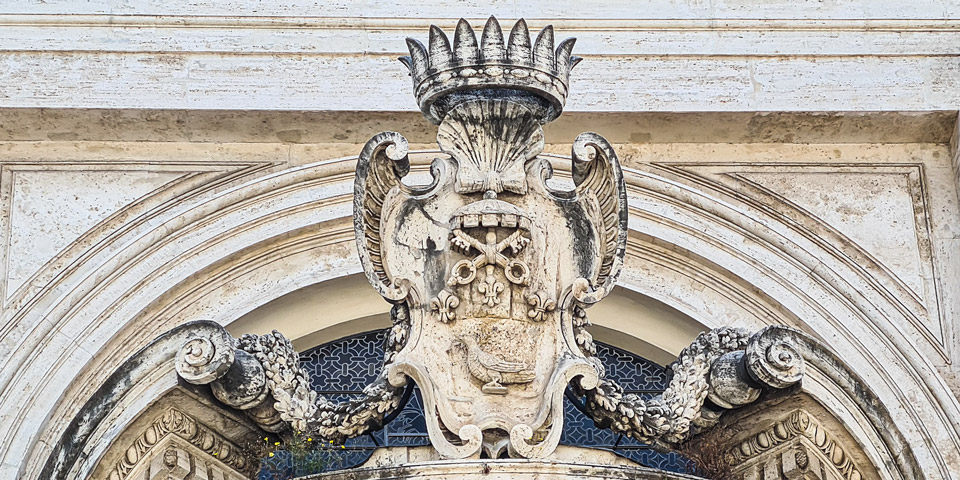
Centered on the shield is the Pamphilj family emblem—a dove carrying an olive branch—paired with three fleurs-de-lis, a combination you’ll see across Rome wherever the family left its mark. Bernini frames the shield with an oversized cartouche and scrollwork, then crowns it with a princely coronet. A carved festoon of rose garlands runs alongside the heraldry, a traditional symbol of martyrdom that fits the church’s dedication to Saint Andrew.
Finally, check the two oval plaques on the doors.
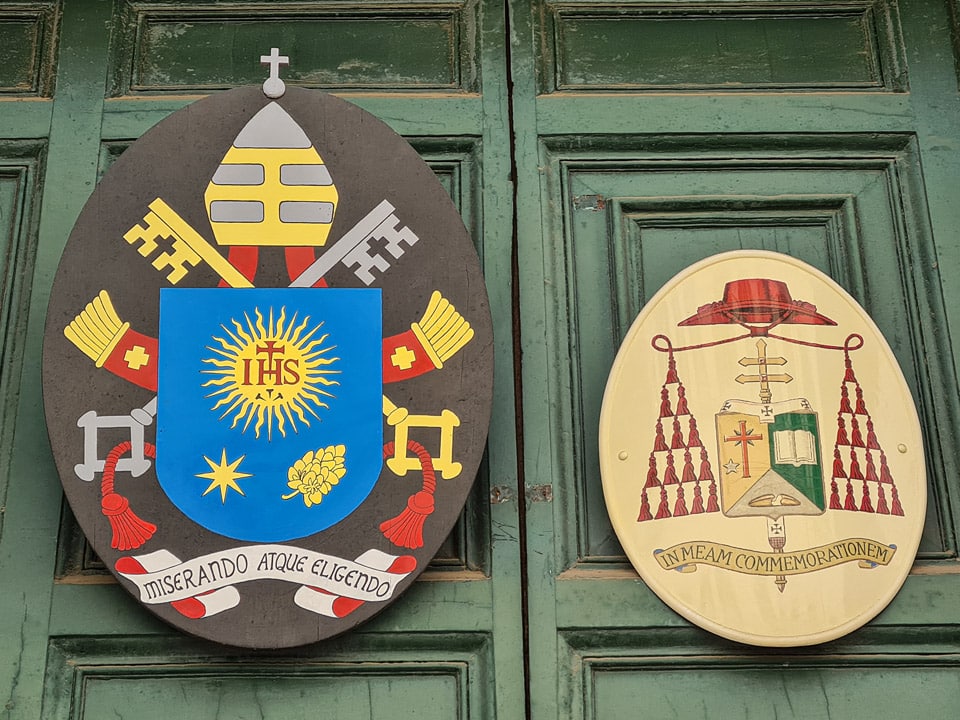
The left one shows Pope Francis’ coat of arms: the Jesuit IHS blazing in a sunburst, with a star and a spikenard flower, and the motto Miserando atque eligendo. The right plaque belongs to Cardinal Odilo Pedro Scherer, the current cardinal-priest of Sant’Andrea al Quirinale. You can spot the classic markers of a cardinal’s arms: the red galero with tassels, the cross behind the shield, and the motto In meam commemorationem (“In remembrance of me”). Together, the façade and its heraldry tell you exactly who shaped this church—its patrons, its Jesuit identity, and its living place in Rome today.
Once you step inside, Bernini’s plan does the work for you. The church is built on an oval, so the space feels intimate, yet it still sweeps you forward. The side chapels sit back in shadow, while the main axis stays bright and focused on the high altar—exactly where Bernini wanted your eyes to land first.
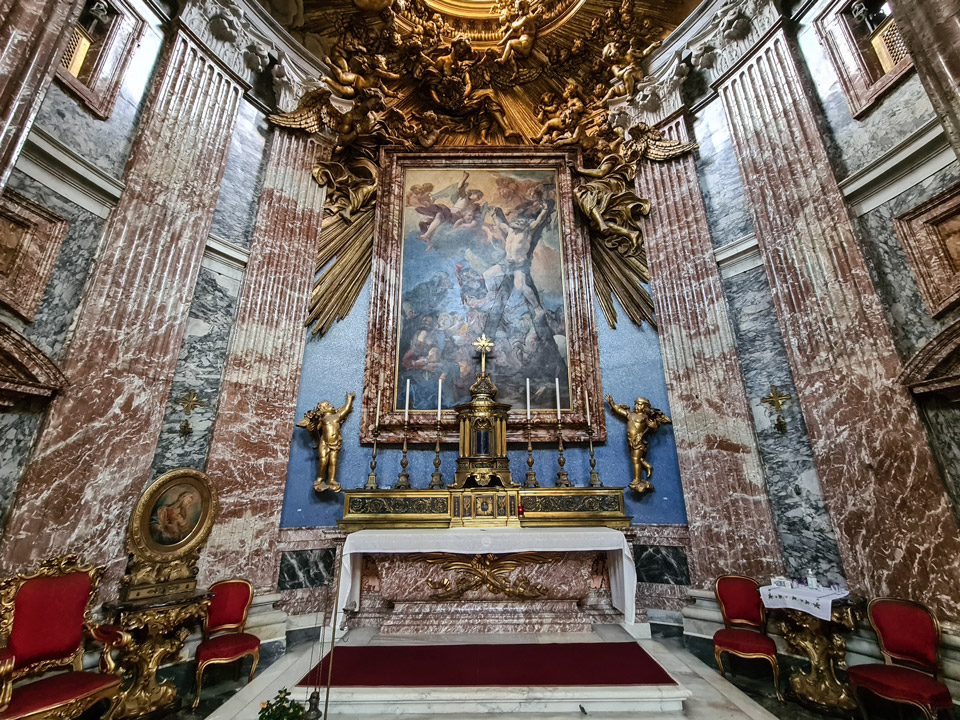
At the altar, the subject is the church’s patron saint. The large canvas shows Saint Andrew at the moment of martyrdom. Andrew was one of the Twelve Apostles and the brother of Saint Peter. Christian tradition remembers him as a missionary and preacher who died for the faith.
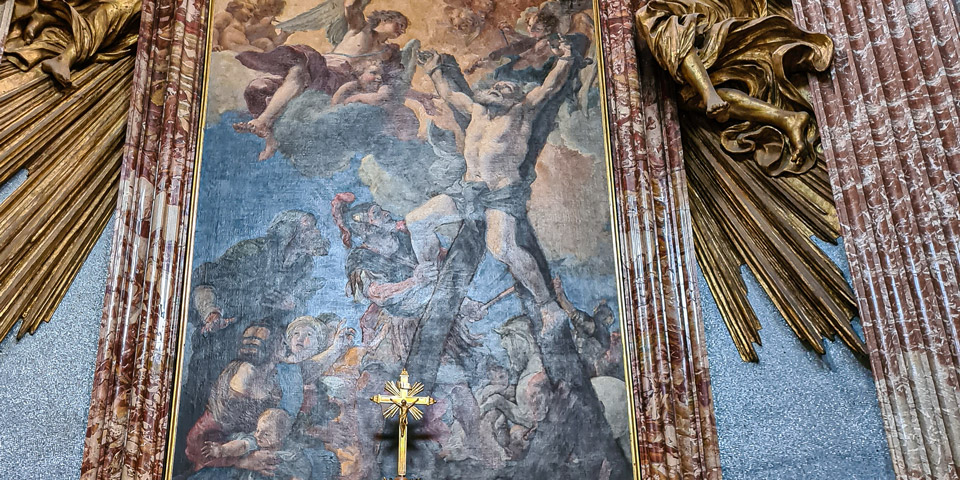
He is closely associated with the X-shaped cross—often called Saint Andrew’s Cross—a form that sets his martyrdom apart from the familiar Latin cross of Christ.
The altarpiece is by Guillaume Courtois (known in Rome as Il Borgognone) and is typically dated to 1668. Bernini turns it into a full Baroque “stage set” by pushing the story beyond the painted surface. Look above and around the canvas: the white stucco angels and the sculpted figure of Andrew appear to burst out of the architecture, lifting the scene upward in a visual crescendo. The sculptural work is attributed to Bernini’s circle, with Antonio Raggi most often credited for the dramatic figure and angelic elements that complete the illusion of ascent.
Near the entrance, you’ll see a striking marble composition with a scrolling banner and fluttering drapery.
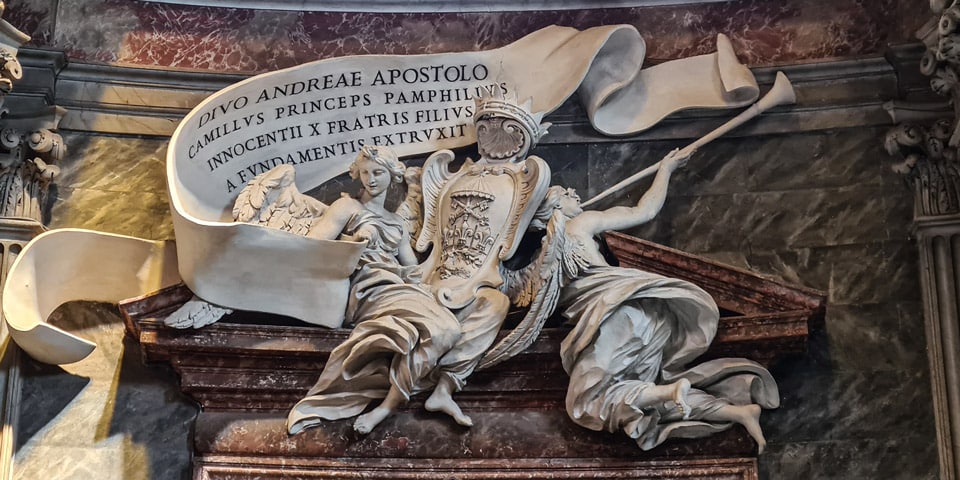
The Latin inscription makes the patronage explicit. It reads, line by line:
DIVO ANDREAE APOSTOLO
CAMILLVS PRINCEPS PAMPHILIVS
INNOCENTII X FRATRIS FILIVS
A FUNDAMENTIS EXTRVXIT
In English: “To Saint Andrew the Apostle, Prince Camillo Pamphilj, son of the brother of Innocent X, built this from the foundations.” It’s a concise public signature: the dedication to Andrew, the name of the patron, and the family connection to Pope Innocent X.
Also watch your step—because the floor carries its own biography.
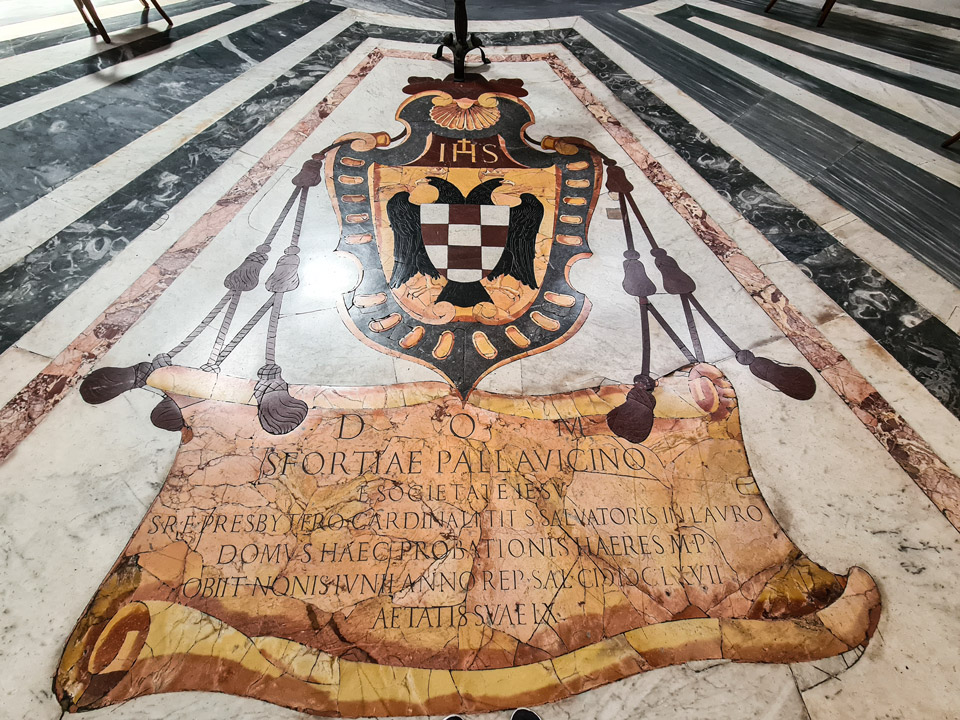
The large inlaid coat of arms with two eagles belongs to Cardinal Francesco Maria Sforza Pallavicino, S.J., a Jesuit theologian and cardinal associated with the church and the Jesuit community here. The inscription identifies him and records his death. Parts of the text vary by spacing and wear, but the meaning is clear:
D.O.M. (“To God, the Best and Greatest”)
“To Sforza Pallavicino, of the Society of Jesus, cardinal-priest… This house of probation, his heir, placed this memorial… He died on the Nones of June (June 5) … in the 60th year of his age.”
It’s no accident that the interior feels so unified. Bernini treated the building like a single artwork—architecture, painting, sculpture, light, and text all pulling in the same direction. Bernini took special pride in Sant’Andrea and spoke of it with unusual satisfaction, as if it captured exactly what he believed a church interior should do.
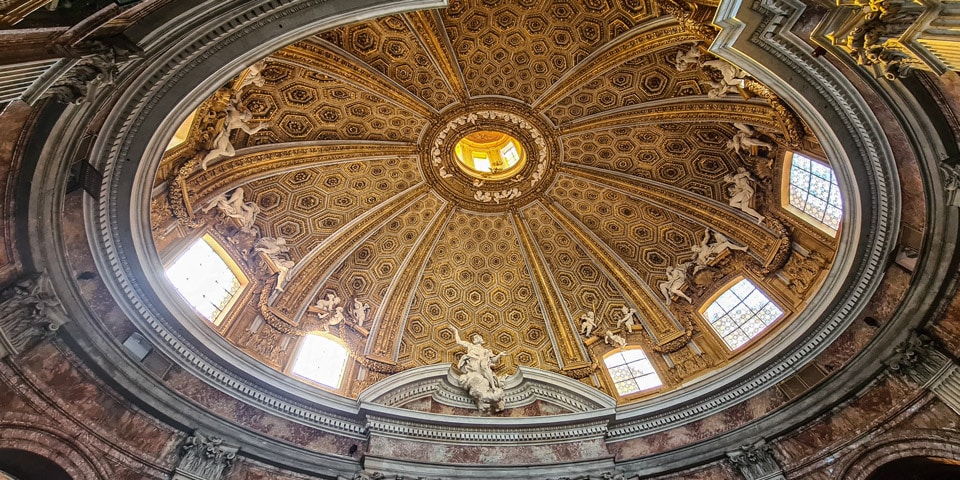
Bernini carries the oval theme into the dome, and that choice changes everything.
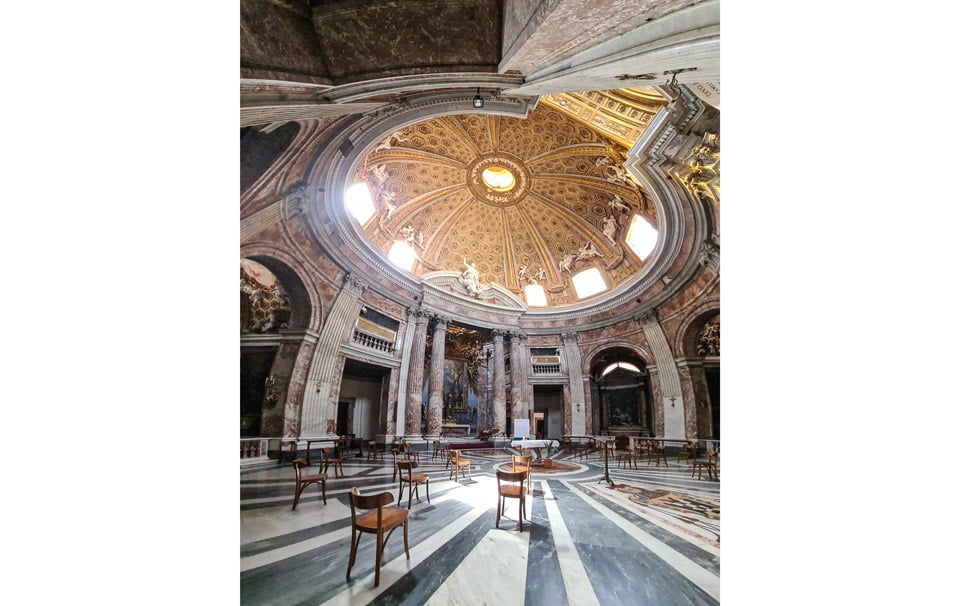
A circular dome can feel static. An oval dome feels as if it’s in motion, stretching the space along the altar axis and reinforcing the forward pull of the plan. The coffering tightens as it rises, and the bright opening at the top draws the eye upward, so the dome reads taller than it really is.
The comparison visitors often make is with San Carlo alle Quattro Fontane, the small masterpiece by Borromini just down the street. Bernini knew it well. If Borromini’s church is an essay in restless geometry, Sant’Andrea is a lesson in theatrical clarity: the oval isn’t a puzzle to solve—it’s a funnel of attention, guiding you from Andrew’s cross at the altar to the light above.
Read also about the artworks of Borromini in Rome.
Rome.us © 2026. Created with love by Roman experts and guides.